Prologue
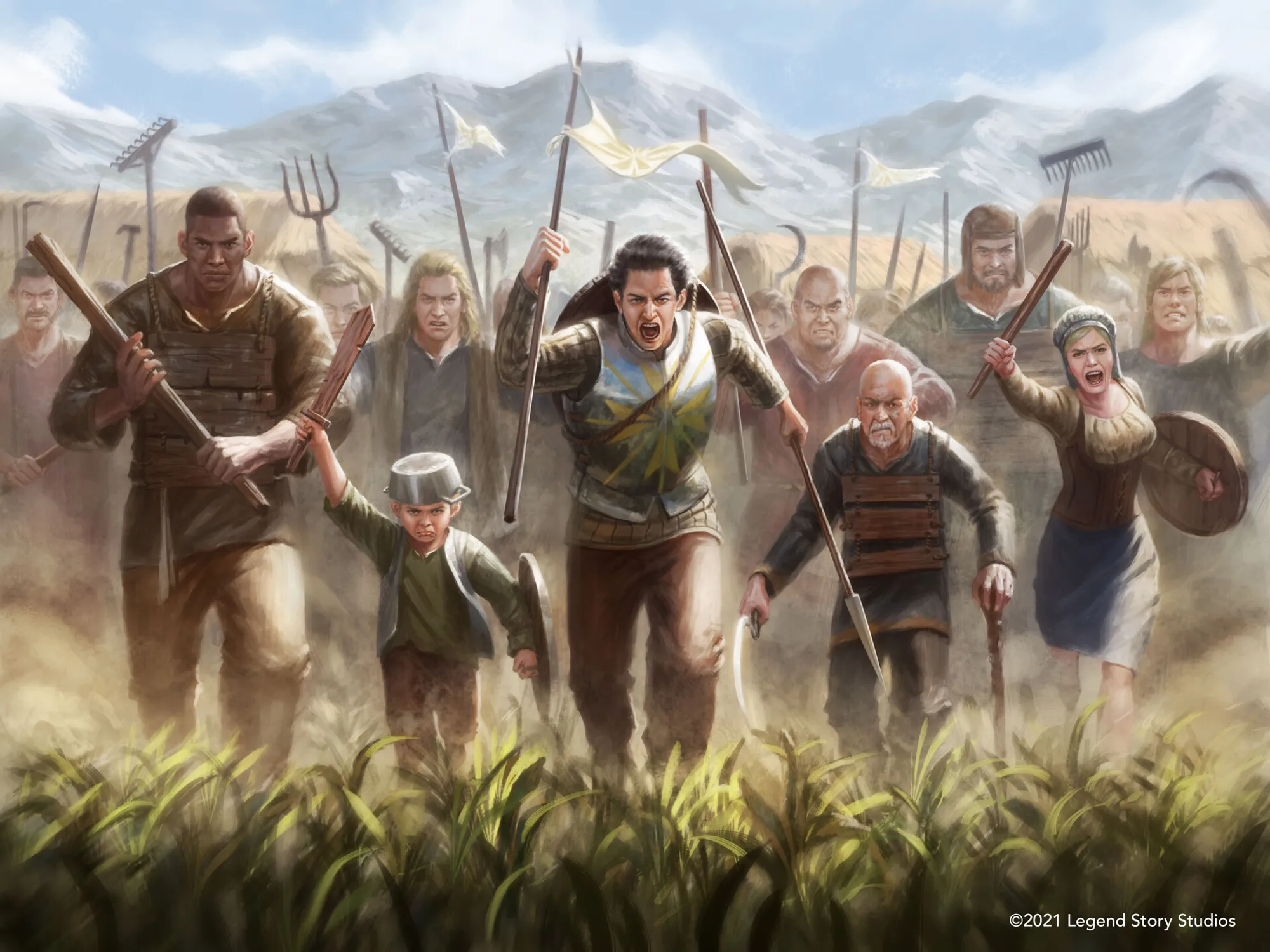
As the Silver Age election season approaches, all who engage with the format during ProQuest events have the unique honor–and civic duty–to cast their vote for the hero who most deserves to sit on the bench next SAGE season. That hero will take their well-earned seat in the audience, watching the proceedings unfold without the chance to participate. I have earned my vote this season, courtesy of a 9th-place finish at my local game store. I played against some of the top players in my area on the top decks in the format and there's no doubt in my mind about where my ballot will land come election day.
I don't vote out of spite. I am not voting for the deck I lost to twice on the day. I don't cast my lot because of bad beats or matchup failures. I won my matchup against this hero last weekend. Oh no–I vote out of principle. And because of that, Briar has my vote. No class has better tools, no deck is more uniquely pushed, and no hero is more dominant than our resident Elemental Runeblade. Allow me to take a moment of your time, dear reader, to make my case as to why you should join me in casting your ballot to remove Briar from this fledgling format next season.
The Briar Dilemma
As early polling data rolls in from week one of ProQuest season, Briar already sits atop the pantheon of heroes with an iconic 50 wins to her name. She outpaces her other top-tier metagame companion, Kayo, by a comfortable ten-win margin, and from that point, the results fall off precipitously. Dorinthea and Kano round out the third and fourth spots respectively, but early data is clear: Briar is Queen.
The question pollsters are asking themselves, though, is this–why? What is leading to this clear separation in power level? On the face of it, the answer seems simple, mundane even: Flesh and Blood is a game of math, and Briar has a unique ability to break the math in her favor. Here's how:
The Numbers Don’t Lie
Briar’s hero ability is twofold, and says:
“The first time an attack action card you control deals damage to an opposing hero, create an Embodiment of Earth token.
Whenever you play your second 'non-attack' action card each turn, create an Embodiment of Lightning token.”
Each of these effects bends the math of the game in Briar's favor, albeit in different ways. Let's start with understanding her second ability.
Flesh and Blood employs a unique mechanical system in which cards can extract value in myriad ways. Some cards produce more resources than others. Other cards have higher block values. Still other cards have more potent attack values. In general, the baseline value for an average card in Flesh and Blood often equals 3. A large swath of cards block for 3, blue-strip cards pitch for 3 resources, and a majority of attacks that cost you no resources have 3 power. Understanding this, it can be fairly easy to value your hand or the hand of your opponent at around 12 points of value. Things get more interesting when we look at how the game pushes this value system by increasing the attack value on cards. Some of the most potent attack action cards in Flesh and Blood history are those that attack for 4 and cost nothing to play. Cards such as Scar for a Scar, Ravenous Rabble, and Lightning Surge (to name a few) all attack for 4 points of damage rather than the traditional 3. They cost nothing to play and sacrifice 1 point of block value in favor of presenting more damage when played. This is what it means when a card is described as " above-rate”. This stat line incentivizes players to attack with the card rather than block, pushing them to either block with other cards and spend their turn sending an above-rate attack, or simply hold their hand, taking boatloads of damage, and send everything they can back.
Keep in mind that Flesh and Blood is also a game of managing your actions, and with only one action point available on any given turn, the go again keyword is vital in aggressive lists. All the cards I mentioned previously have either conditional or unconditional ways to gain an action point at the end of the combat chain link. Sequencing these attacks to continuously regain your action point is key to playing aggressive decks in Flesh and Blood, as if you don't meet specific requirements at the time of playing these attacks then your turn is cut short. This is also a balancing tool, a means of creating complexity and forcing players to “jump through hoops” in order to present multiple above-rate attacks each turn. But what if we didn't have to worry about any of that?
Enter Briar’s second ability. By playing two ‘non-attack’ action cards, Briar creates an Embodiment of Lightning token, an aura that destroys itself when an attack action card is played and grants it go again. All of a sudden, all the balancing that went into crafting these above-rate attacks is simply skipped over, courtesy of us playing on-rate non-attack action cards that each provide 3 value to our turn. Of course, if you've paid attention to the block value on non-attack action cards, you'll notice that most of them block for a measly two points of defense. Never fear, however, as you're playing Briar, and you get to break the rules once again.
As long as one of your above-rate attacks hit the opponent on the prior turn, you get to create an Embodiment of Earth token. This grants all of your non-attack action cards an extra point of block value, meaning that the balancing that went into creating each of these potent non-attack action cards also flies out the window and you get to dictate how the pace of the game will flow. Do you want to block with some of your non-attack action cards and maintain your life total? Then it's a good thing you hit your opponent last turn and created an Embodiment of Earth token! Is your opponent unable to keep up with your pace? Keep all the cards in your hand, take some damage, and throw four cards that average 14+ value. Either way, your hand is often creating more value over the course of the game than your opponent's. What does that mean? It means you're winning.
“Those Who Fail to Learn From History…”
I acknowledge that this is not news for those of you who've been playing the game as long as I have. If you were around when Tales of Aria officially released, you remember Briar's meteoric rise to dominance in the autumn of 2021. I had the honor of cataloging her run in the commentary booth throughout the Callings leading up to US Nationals that year. I watched as Tariq Patel put on a master class with “Cheerios Briar”, a nearly-fully redline version of the hero that pushed Flesh and Blood math to its limits. My co-casters and I marveled as Patel etched himself into Rathe’s compendium, earning his spot as the first US Flesh and Blood National Champion. I find it funny, looking back at his original, tournament-winning list and comparing it with many of the top performing lists we see in Silver Age right now.
Tariq Patel US National Champion
As a fun thought experiment, if you were to take Patel's exact list into silver age, remove all of the illegal cards, and then “trim the fat” a bit, you would have virtually the exact core that every Silver Age Briar list is running at the top tables. The concept hasn't changed between 2021 and now. If anything, the deck itself has gotten MORE powerful as time has passed. Here is Michael Feng’s Calling San Diego 2nd Place list in comparison:
Calling: San Diego 2nd 🇺🇸
The core is all there: Scar for a Scar, Ravenous Rabble, Snatch, Arcanic Shockwave, Entwine Lightning, Lightning Surge, Nimblism, Weave Lightning, and even a sneaky one copy of Arcanic Crackle. It’s deja vu all over again. The most terrifying part, however, is that the deck has arguably gotten BETTER over time.
“...Are Doomed to Repeat It.”
I spent a solid paragraph detailing why four-power attacks present above-rate value and how it enables Briar to play towards a superior aggressive strategy. I discussed how non-attacks carry a solid 3 value on their own and enable massive, damage-heavy turns thanks to Briar’s ability to create Embodiment of Lightning tokens. But what if your non-attacks represented 4, or even 5 value? That is what opponents are forced to contend with now that Briar has been imbued with a wealth of new card options thanks to sets such as Rosetta, Compendium of Rathe, and… checks notes… the Aurora Armory deck and Terra First Strike deck? Cool, that checks out…
The deck gets Static Shock, a 4 power attack that gives you an extra point of arcane damage if you’ve played a Lightning card. Which cards? You mean the cards that let you be incredibly aggressive? Ah yes, those ones. She gets Skyzyk, yet another zero for 4 attack with go again so long as you’ve played two non-attacks (the cards that make your attacks stronger). Oftentimes, Skyzyk represents a three card 10 value attack. Yet another casual, above rate sequence. Need more chain links? Play Second Strike. Didn’t draw it? Force your opponent to make a soul read that you’re fishing for the go again on Second Strike and bait them into blocking out. Sizzle seems on-rate on paper as a simple plus three buff to your next Lightning or Elemental attack, until you remember that you’re likely playing Aurora’s signature weapon, Star Fall (which, of course, Briar can play). That makes it worth 4 value as well.
And then we get to the most egregious card in the deck. Pardon me, the Wizard player, as I throw up in my mouth a bit when I realize that arguably the best Wizard card printed in the last three years is a Lightning Runeblade card called Burn Up//Shock. This card is quite literally a one card 5. Briar’s kit is so absurdly overtuned that it’s honestly laughable. Even her pitch cards are above rate. Briar now has access to Flourish in both yellow and blue, an Earth non-attack (yes, that’s right. Don’t even get me started on the fact that Briar gets to play with Earth and Lightning cards) that says in the blue:
“The next time an attack would gain power this turn, instead it gains that much plus 2.”
Keep in mind that this buff does not replace the buff that the attack would receive, it adds to it. Therefore, the blue Flourish represents three value on the aggressive side of the stats, as well as three value if you choose to pitch it. The yellow, in contrast, represents 4 value on the aggressive slant. 4 value when used on offense, 2 value if pitched, and either 2 or 3 value on defense, depending on your Embodiment of Earth generation. Also keep in mind that this modifier applies to any attack, allowing Briar to enhance the potency of Star Fall… This is farcical.
As an aside, I can already hear some of you clacking away at your keyboards in the comments section, furiously typing “you’re doing the value calculations wrong… Those cards need other cards to be played in order to get their value… So they aren’t really as good as you say!”. Look, you may not like my response, but here it is: This deck isn’t that deep. OF COURSE you need to play cards together to get their value. That’s most of Flesh and Blood. Briar isn’t rocket science. She’s two card 7s; she’s three card 11s. She takes skill, of course. There are sequencing decisions. There are fail states. But don’t try to downplay what this deck is. It is, unequivocally, a mistake. Its numbers are aberrant, its card options too prevalent. And perhaps the saddest part of it all is that, as we delve deeper into the Briar dilemma, we come to the heart of the problem: the Runeblade class.
You’re Probably Wondering How We Got Here
I feel as though I am one of the few Flesh and Blood old-heads left in my local sphere. I remember when Arcane Rising was just being spoiled. I had the privilege of spoiling two cards from the set (Death Dealer and Searing Shot, talk about a banger zero for 5 attack). I remember falling in love with the Runeblade class. I was smitten. Sword and sorcery. Might and magic. I was spellbound, and I wanted to know how the class would strike a balance between the two. Would the tension come from deciding to present arcane or physical damage on any given turn? Would it be a class that encourages you to seek a big “payoff” turn, or find ways to string together small attacks with the benefit of arcane damage to keep you on-rate? Back in the Arcane Rising meta, that’s what Viserai was. That’s who I played in the very first Skirmish season, while we were all still cooped up at home and playing via webcam. Runeblade was the first class I truly fell in love with.
Initially, there was a challenge; a challenge in gameplan (how do I win?), a challenge in deck-building (what do I need to win?), a challenge in execution (how do I win this matchup?). And then, set by set, card by card, the class changed. Crucible of War gave Runeblades new tools: Mauvrion Skies, Meat and Greet, Runeblood Barrier. Build-around cards. Glue cards. But it also gave us Bloodsheath Skeleta. The first in a long line of absurdly powerful cards locked in the Runeblade card pool. Was it bad at the time? Not right away. But then Monarch released and Chane bared his teeth. Then Tales of Aria dropped, giving us Cheerios Briar and Rosetta Thorn. Finally, on the heels of it all, Everfest delivered the coup de grâce: Vexing Quillhand, Swarming Gloomveil, Revel in Runeblood, Runeblood Incantation. That was the tipping point, and we all got our answer.
How would the class strike a balance between arcane and physical damage? It wouldn’t.
The Long Way Back
The history is clear: Runeblade is the darling class in Flesh and Blood. Five out of the six Runeblade heroes have reached the Living Legend status in Classic Constructed. Before the sunsetting of the Blitz format, Briar, Chane, and Viserai had all reached Living Legend status, while Florian dominated the final season of Blitz, and Aurora secured a respectable 4th place finish. The results are concrete: the class outpaces everything else.
And to their credit, Legend Story Studios has stepped in, again and again, to reign in a card pool that has, quite frankly, become a force of nature. A simple stroll down the banned and restricted list on the official Flesh and Blood website proves this. Bloodsheath Skeleta, Ball Lightning, and Scepter of Pain were all banned in order to realign the Runeblade class. Seeds of Agony lived on the banlist for as long as Chane remained legal. Other cards such as Art of War, Belittle, and Plunder Run also saw heavy play in Runeblade, and eventually made their way onto the list in part because of their use by the class. In fact, the Runeblade class carries the dubious honor of having the only card ever printed that was banned before it was actually released: Duskblade.
The restrictions don't even stop there. Flicker Wisp caught a ban in the Blitz format to prevent Aurora from completing the Living Legend speedrun. The unbridled power of Bloodsheath Skeleta catapulted Viserai to reach the Blitz Living Legend status before any other Runeblade in any other format. Sonata Arcanix had been suspended (back when that meant ‘temporary ban’) in an effort to curb the massive combo potential, but it clearly wasn’t enough, and Skeleta was subsequently banned in Blitz a few months later.
And of course it must be mentioned that at the genesis of the brand new Silver Age format, LSS has, with their inaugural hero ban, chosen to remove Chane from the format. They recognize what this class is capable of. We all do. It was on display in week 1 of this season, it will be on display throughout the season, and it will continue to take time, effort, and likely more bannings from Legend Story Studios in order to right the ship.
Is Briar toxic? No. Should the Runeblade class cease to exist? By no means. Just like so many others in the game of Flesh and Blood, the Runeblade class is brimming with flavor. The opportunity to present multiple types of damage, the tension in balancing one versus the other, in deck building, in gameplay… It's bewitching. But perhaps it shouldn't be easy. Briar is just one in a long line of Runeblade heroes that have been permitted to feast on the metagame thanks to a wealth of options inherent in their card pool. The class will reap what it has sown, and so too will Briar.
A Slight Change
Allow me to peel back the curtain for a moment. Although I had felt confident that Briar would be the subject of this diatribe, I was intent on writing this article after my own personal ProQuest took place. I wrote the article early last week, and the editing process carried on through the weekend. As we finished on Monday, a Silver Age ban announcement was made by LSS. As I am sure you are now aware, LSS once again took an axe to the Runeblade tree and banned Burn Up//Shock, Lightning Press, and Bracers of Belief, all with the effort of curbing the unbridled power of Briar. Indeed, it was necessary as the ProQuest results for week two of the season once again saw a dominant finish for the hero. Briar claimed a staggering 37% of the wins last week. Something HAD to be done, and LSS did it. These changes assuredly bring the deck down in power, removing a major chunk of the deck’s high roll potential. Therefore, the question we should ask ourselves is this: Should these changes influence our vote? Is everything I said above now, in some sense, invalid?
I considered scrapping this article entirely. I considered discussing how Kayo, the perpetual “bridesmaid” of the format, escaped the ban announcement relatively unscathed. After much thought, however, I came back to where I began in this article. I vote out of principle. We have the principle, no, the obligation, to steer this ship back on course alongside LSS. We've been given an opportunity, a say in what we get to experience when we sit down to play this wonderful game. No deck should be allowed to ravage a metagame as Briar has. No class should be allowed to warp a format as Runeblade has. This is our moment to stand up and say: enough is enough. If we don’t draw a line in the sand now, we may be faced with the reality of Chane, Briar, and Florian forcing all other heroes and classes to bend the knee.
We have a hand in what new players get to experience when they shuffle up for the first time in the Silver Age format. We owe it to them, to each other, and to Legend Story Studios to cast our vote and remove Briar from Season 2 of the Silver Age format. Don't sit idly by while a format warps and crumbles under the weight of the Arcanic Shockwave that is the Warden of Thorns. I will cast my vote. I will do my part. Come, join me and do yours as well.
Thank you,
DMArmada
P.S.: Also, screw Kayo that deck sucks.