
Aurora, Legacy of Tempest is the newest Runeblade in the world of Rathe. Even though she has a lot of similarities to Aurora, Shooting Star, she is quite different and requires some new trains of thought to get her ready for the Classic Constructed metagame. Unlike Shooting Star, Legacy of Tempest does not have access to the Elemental card pool. This gives us a new avenue to explore – and a fresh challenge – with Legacy of Tempest’s deck building and design.
The early consensus on new Aurora has been to play 0 for 4 aggro soup, just like old Aurora. While this deck has shown some impressive play lines, I believe there is a better version of the deck that allows us to play nine blues. The extra value we get from a flexible blue base includes using Aurora’s hero ability to make Embodiment of Lightning tokens to set up for next turn or extend our current one. It also opens windows to play cards like Tempestuous Kiss, Dashing Flashfoot, and Electryn Joltstep. This adds both power and consistency to our Aurora deck.
The Case Against Aurora: The Sequel
Everyone is convinced very early on that Aurora is not going to impact the meta and has some glaring weaknesses. I am going to show you why the community has been too quick to judge Aurora and why I’m confident that she will make her mark on the Classic Constructed metagame. The community tells me that new Aurora is bad for these three reasons:
1. She is easily fatigued
2. Non-attack actions slow her down too much
3. Losing Star Fall hurts the game plan
Allow me to address these in order:
Fatiguability
The community is convinced that Aurora can be fatigued by simply pitching to Arcane Barrier and laying 3 and 4 blocks on the combat chain, but I am here to tell you that we have a plan to beat fatigue decks. There is a fun combo that can be pitch-stacked and set up for the late game that includes Arc Lightning, Aether Ironweave, Crown of Dominion, and Vexing Quillhand. During the first cycle of play, we can pitch a couple of Arc Lightnings and some Go Again attacks, like Fry and Electrolyze, to set up a late game combo to kill our opponent. Aether Ironweave is used to gain two resources to destroy the Gold token that Crown of Dominion creates and draw a card. We also deal some arcane damage when we Go Again on use of our Gold token. Each copy of Arc Lightning is worth 1 damage every time we Go Again during the combo turn. This means we could throw 30 to 35 damage at your opponent in one big turn, just by pitch-stacking some attacks and a couple of Arc Lightnings together. The other piece of this combo that I have been enjoying is Vexing Quillhand. This equipment allows us to create two Runechant tokens and Go Again (triggering all active Arc Lightnings) by way of a simple, 0 cost activation. This means we are getting more Arc Lightning pings from the Go Again and adding more damage to the board with two Runechant tokens.
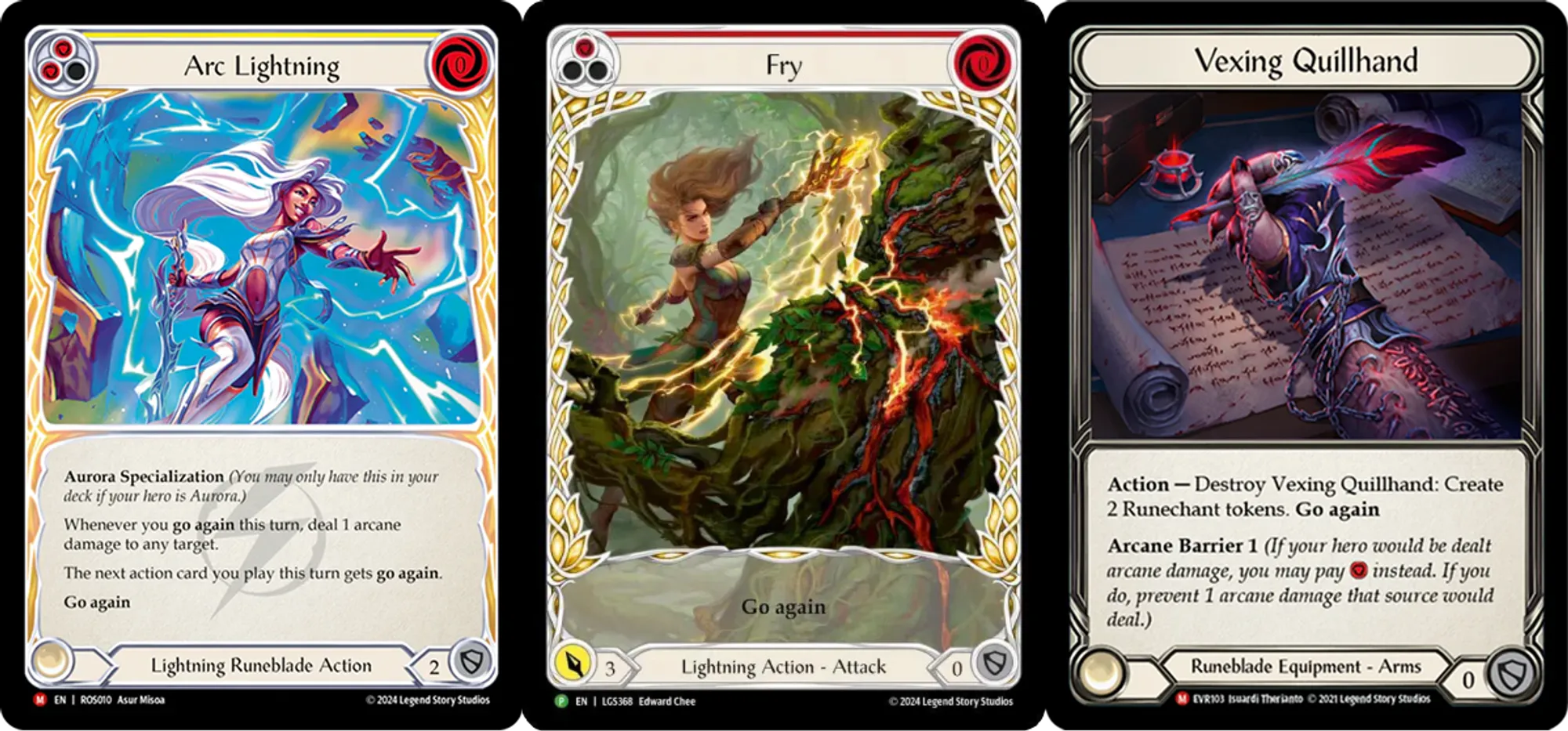
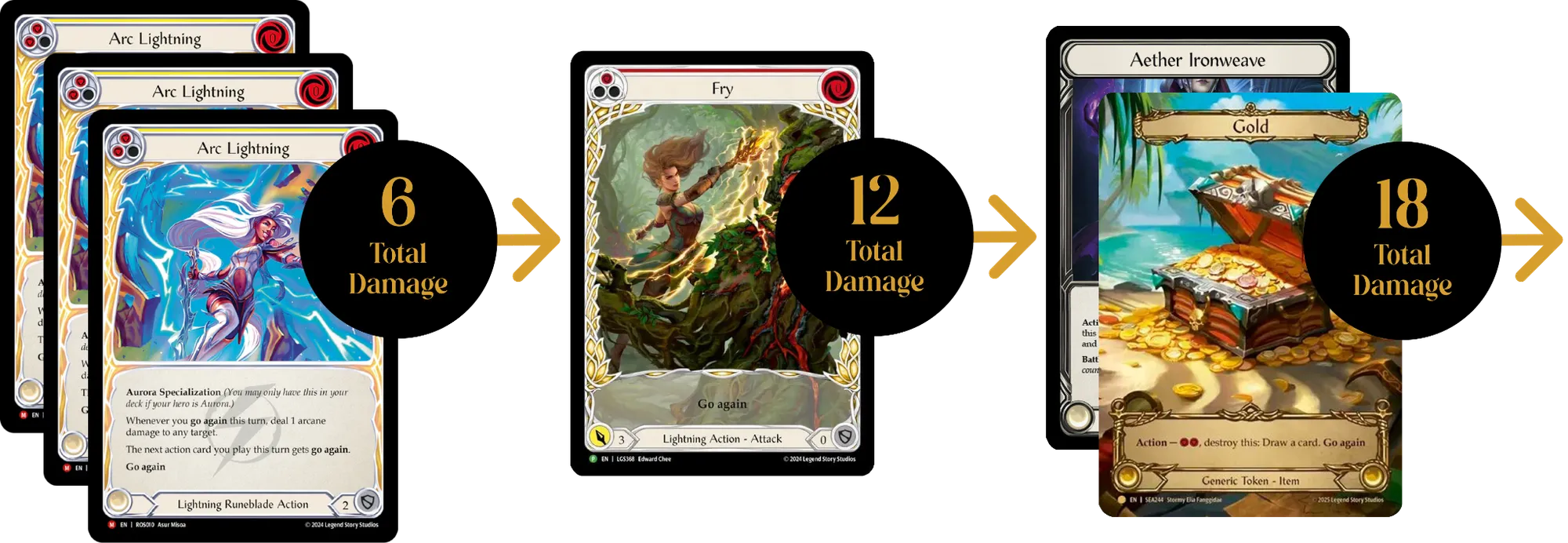
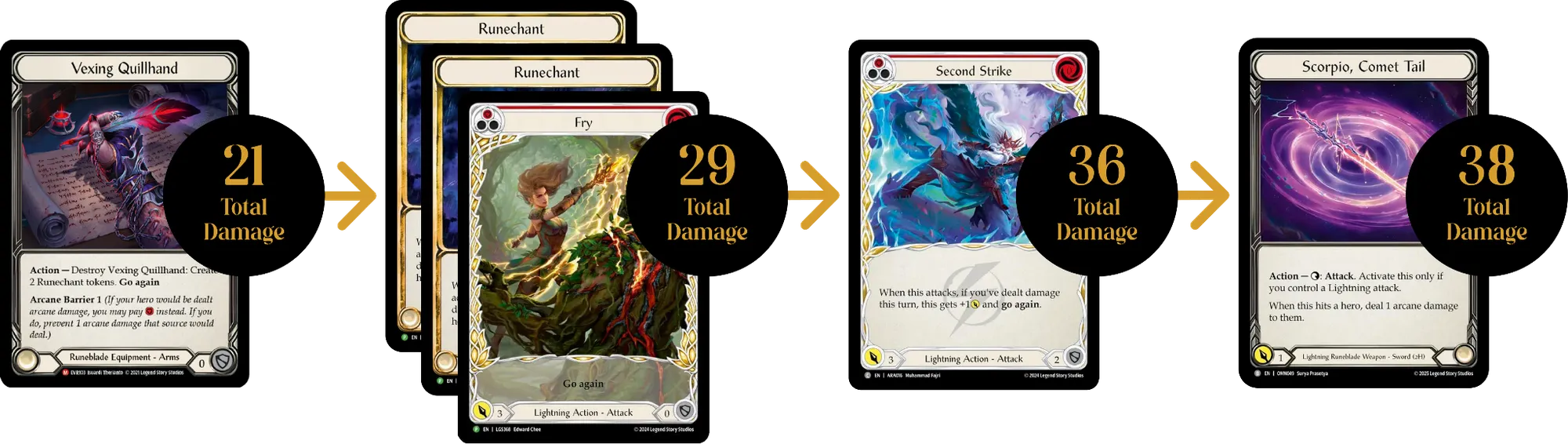
I mentioned the anti-fatigue combo and what it requires of us to set up. Now let’s talk about the exact combo and how to properly sequence the kill turn. An ideal combo hand will be three copies of Arc Lightning (two in hand and one in arsenal is the best), two copies of Fry (any 0 cost attack with Go Again will work), and a another Go Again attack on top of the deck (Second Strike is a great example that we can use after we have dealt damage). It is also important that we still have the starting equipment at our disposal. This is Crown of Dominion (Gold token is the relevant part), Aether Ironweave (we use these 2 resources to draw off our Gold token), and Vexing Quillhand. The steps for the combo and damage are below. The damage will be displayed as total damage first, in bold, and then how the damage is being applied second, in italics. The cards we have at our disposal in this example are three copies of Arc Lightning, two copies of Fry, and one copy of Second Strike.
- Play Arc Lightning. (1 damage) (1 arcane)
- Play second Arc Lightning. (3 damage) (2 pings of 1 arcane)
- Play third Arc Lightning. (6 damage) (3 pings of 1 arcane)
- Attack with Fry. (12 damage) (3 physical damage + 3 pings of 1 arcane)
- Break the chain and use Aether Ironweave to gain 2 resources. (15 damage) (3 pings of 1 arcane)
- Use the 2 resources to destroy the Gold token and draw a card. (18 damage) (3 pings of 1 arcane)
- Destroy Vexing Quillhand to create 2 Runechant tokens. (21 damage) (3 pings of 1 arcane)
- Attack with Fry. (29 damage) (3 physical damage + 2 Runechant tokens + 3 pings of 1 arcane)
- Attack with Second Strike. (36 damage) (4 physical damage + 3 pings of 1 arcane)
- Attack with Scorpio, Comet Tail (38 damage) (1 physical damage + 1 ping of arcane from on hit effect)
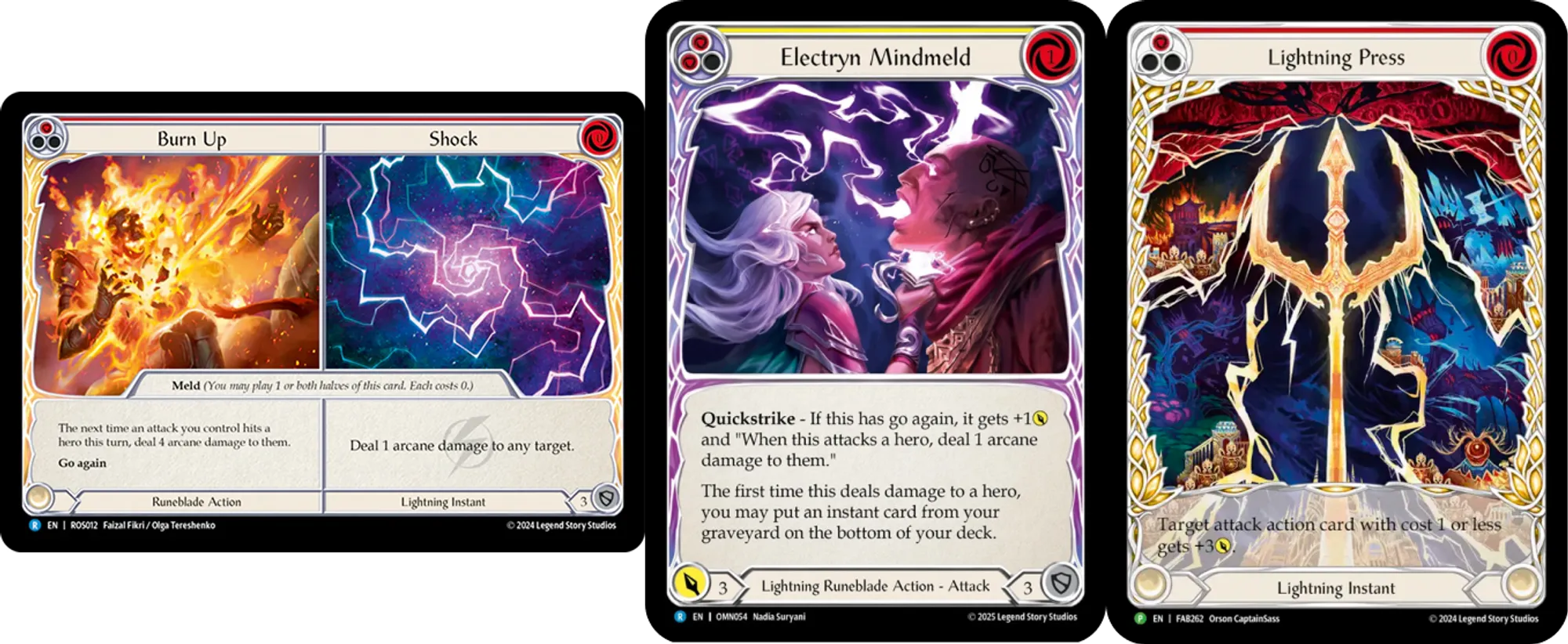
I understand that pitch-stacking is not the easiest for everyone, so I have added some other tech to our sideboard to help us with our second anti-fatigue plan. The second anti-fatigue plan we have is pairing Burn Up // Shock with Lightning Press. These two cards go a long way in making sure that we can push big hits of arcane damage in one turn. Electryn Mindmeld is a Quickstrike attack action card that gives us an opportunity to put an instant card on the bottom of our deck the first time it deals damage to a hero. We can utilize this attack to put cards like Burn Up // Shock or Lightning Press on the bottom of our deck, after we have already played Electryn Mindmeld. There is a good chance that late in the game our opponent will have used all, or almost all, of their defense reactions. If all our opponent’s defense reactions are gone, we can use our extra copy of Lightning Press to go over the top and finish the game. There is also a world where we hit our opponent with two copies of Electryn Mindmeld during the game and we can put one copy of Burn Up // Shock and one copy of Lightning Press on the bottom of our deck. These two cards make an excellent late game pairing.
Non-Attacks are the Way
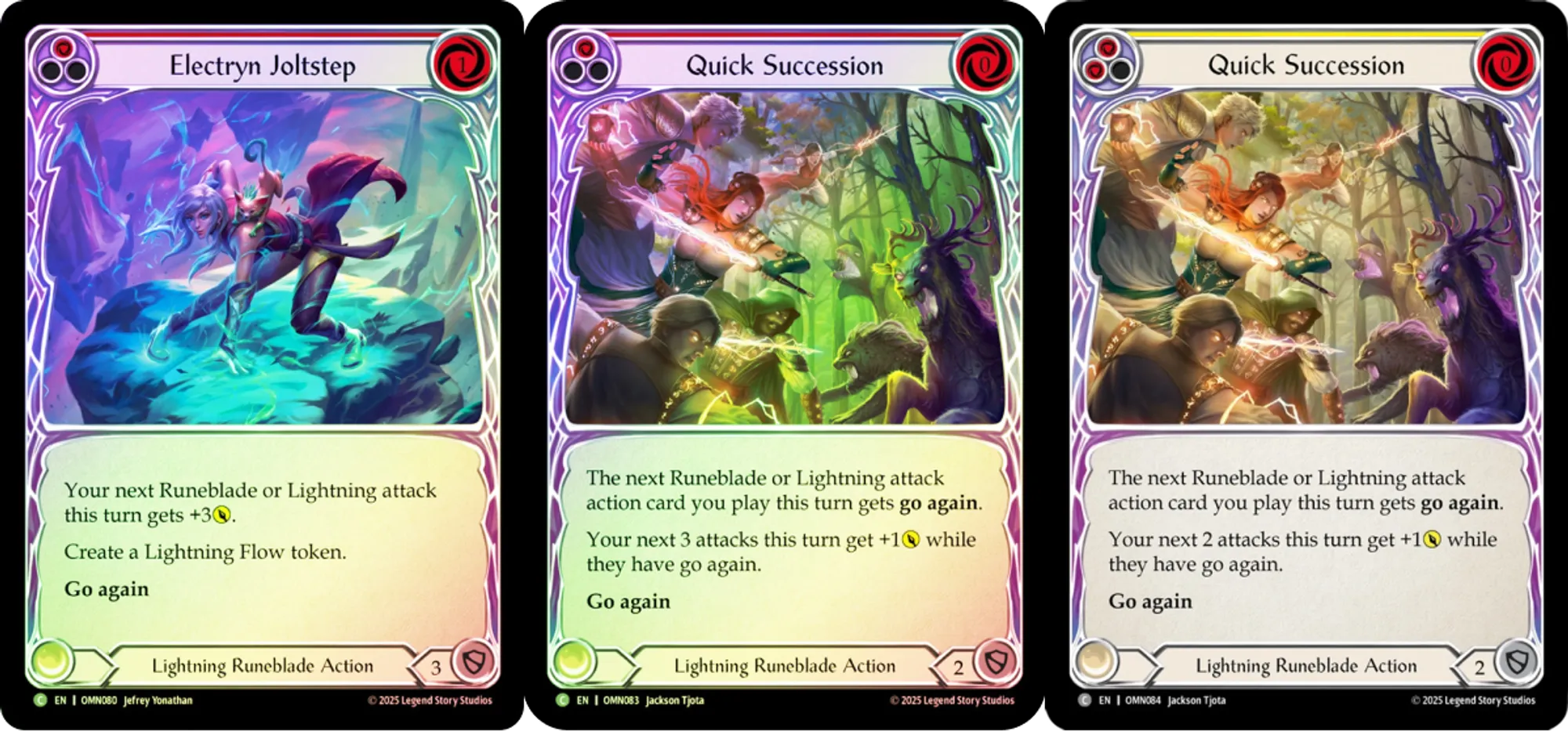
Do non-attack actions slow down Aurora? The answer is very simple and straightforward – no. I would argue that there are two powerful non-attack actions that help us with Go Again consistency and damage. The first is Electryn Joltstep. This non-attack action buffs our next Runeblade or Lightning attack by 3 and creates a Lightning Flow token. Using Electryn Joltstep to buff an attack like Rush of Power or Dashing Flashfoot gives us a better chance of pushing the on-hit effect each card has. The Lightning Flow we create also plays into our game plan by allowing us to activate Aurora, now or later, to set up the Embodiment of Lightning token and make sure we have Go Again when we need it. If all else fails, we can fall back on the fact that Electryn Joltstep is a 3-block and can effectively flex to defense in a pinch.
What if I told you we could play mini Art of War in our Aurora deck? The moment you start looking at Quick Succession as mini Art of War, and not just a one-card Go Again enabler, your win percentage with Aurora will rise significantly. Quick Succession not only gives your next Runeblade or Lightning attack Go Again, but it also gives your next three attacks with Go Again plus 1. Pairing a Quick Succession with a Rush of Power, Fry, and Path of Same Ends will allow you to push more damage and extend your turn without much effort. Anytime I draw Quick Succession and do not have a hand that immediately utilizes its full power, I will look to arsenal it and set it up for another turn. I like this card so much that I am playing the yellow version of it as well. The yellow version only buffs your next two attacks with Go Again by 1, but it is the perfect flex slot card. Yellow Quick Succession is an excellent card to pitch during first cycle when you do not have a blue card. You are not only continuing to apply pressure by pitching your yellow to attack with Dashing Flashfoot or Electrolyze, but you are also pitch-stacking a solid Go Again card for second cycle. The value of having consistent Go Again and attacking with break point attacks in second cycle is not to be trifled with.
The Sword we Lost
I must admit, Star Fall was a very powerful weapon and losing it does feel bad, but Scorpio, Comet Tail is better than you think. The value of a free attack, with an on-hit effect, is incredibly potent. Scorpio, Comet Tail allows us to utilize our pitched resources with the rest of our hand and not worry about using resources on our weapon. This means we can add in more one and two cost attack actions to help us push more damage and on-hit effects. Cards like Dashing Flashfoot and Tempestuous Kiss are great examples of powerful attacks that utilize pitch cards very well and help us keep our opponent back pedaling. If we have a turn where we play red Quick Succession, then pitch a blue to attack with Tempestuous Kiss, we already have a situation that is forcing our opponent into a quandary. After Tempestuous Kiss, we can attack with Electrolyze, pushing more damage and utilizing all 3 resources this turn. After our Electrolyze, we finish up with Scorpio, Comet Tail to push some extra damage for 0 resources. Scorpio allowing us to add more 1 and 2 cost attacks to our deck gives more consistency across an entire game and puts our opponent into awkward blocking situations.
Blues? Never heard of them!
While I prefer the nine-blue version of Aurora over the redline build, it would be remiss of me to not talk about both versions. The redline version of Aurora is an homage to the deck that people remember fondly from Shooting Star, but Legacy of Tempest requires some new tools to make it work. Without cards like Entwine Lightning and Arcanic Shockwave, we need to find new ways to generate value and keep our opponent blocking.
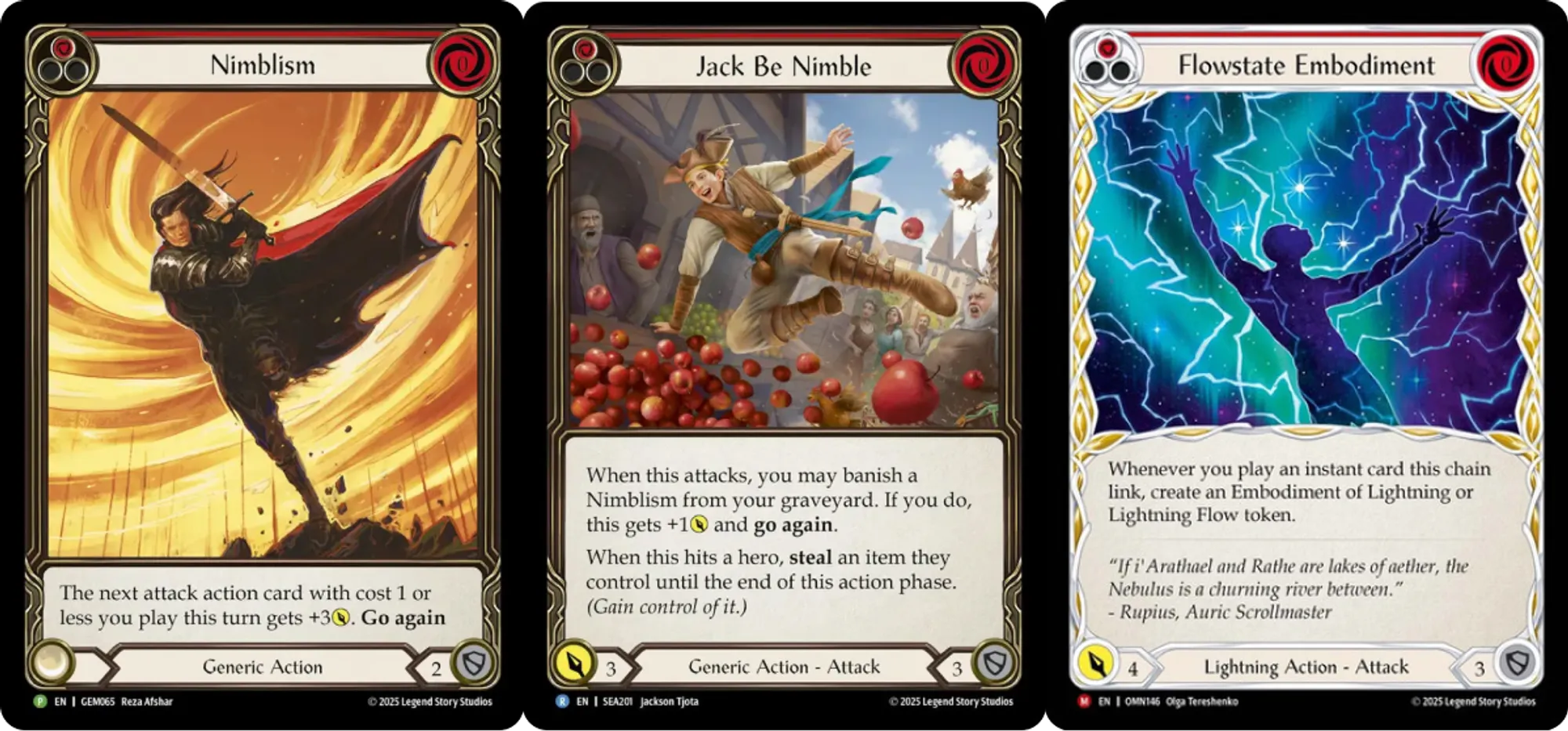
The first card that helps us do this is Flowstate Embodiment. Even though you will find Flowstate Embodiment in both versions of Aurora, this card shines the most in the redline build. The redline version does not play any cards that set up a Lightning Flow token, outside of Flowstate Embodiment. This means that there are nearly zero ways to activate Aurora’s hero ability to set up an Embodiment of Lightning token. That is why Flowstate Embodiment pulls so much weight in this version of the deck. Playing an instant on the Flowstate Embodiment chain link allows you to set up an Embodiment of Lightning for the next turn or the next attack this turn. If you have two instants in hand when you attack with Flowstate Embodiment, you can play both and still get value. The first trigger will create you an Embodiment of Lightning token and the second will create you a Lightning Flow token, which you can use later.
Nimblism is a card that I feel is often overlooked when players start building aggro decks. While Nimblism is not always the flashiest card to play, it often adds consistency and helps push relevant on-hit effects. Nimblism shines even more when you add in a card like Jack Be Nimble. Jack Be Nimble, being another 0 for 4 with Go Again, will help us extend our turns and add consistency to our deck. The combo of Nimblism and Jack Be Nimble is quickly dismissed because of how awkward it can be when you draw Jack Be Nimble before you have seen any copies of Nimblism. Even with this potential downside, we can block with Jack Be Nimble if necessary or park it in our arsenal until we find a Nimblism to enable its effect. There is also always the upside of stealing an item until the end of the turn. If we have a Current Funnel in our hand that normally would not convert, for example, we could use it to pitch to a Gold token we steal from our opponent with Jack Be Nimble.
Current Funnel is the only blue that makes its way into the redline version, but it earns its keep every step of the way. Current Funnel is a 0 for 2 with Go Again if the last action card you played this turn was Lightning. The fact that Current Funnel gains Go Again itself is good, but the real value is that it gives Go Again to the next action card you play after it as well. Utilizing Current Funnel as an extender will open lots of doors on your turn. Using Current Funnel to give a Snatch Go Again forces your opponent to decide if they want to let you draw an extra card. You can also give Rush of Power Go Again to help push more damage and look for that extra ping of arcane damage when it hits the opponent. The floor of Current Funnel is that it blocks 3, which is never a bad option to have.
Sparking Joy (AGE)
Flows & Embodiments & Blues, Oh My!
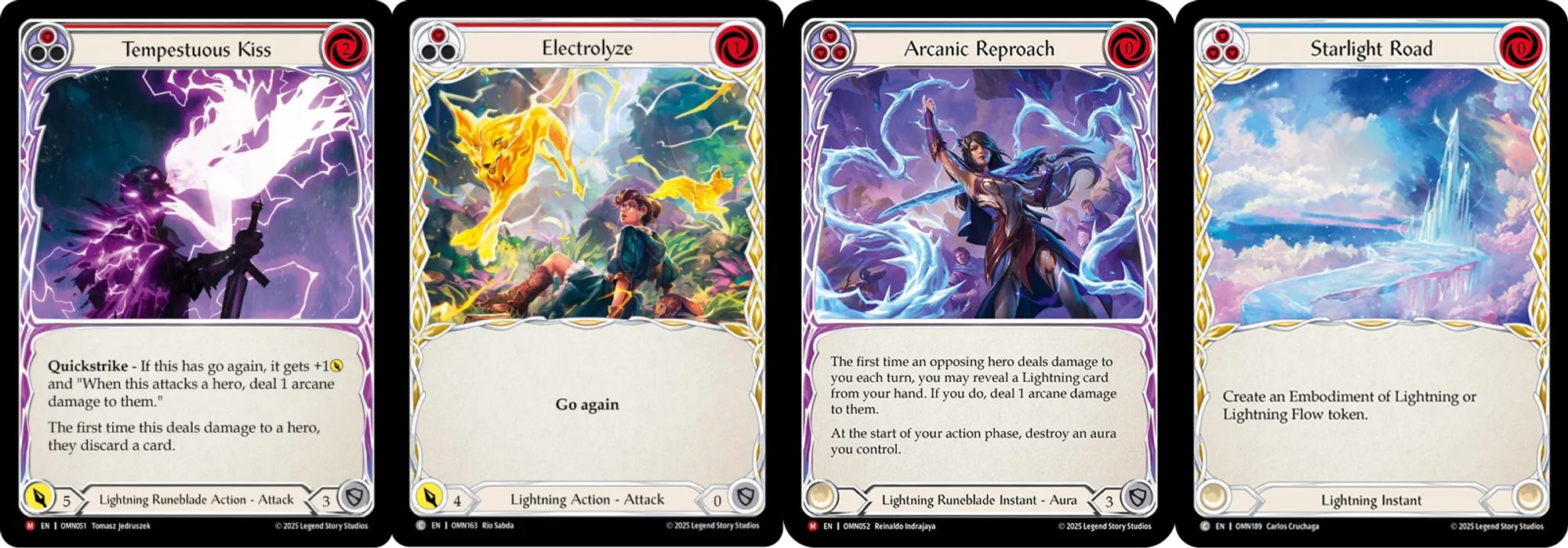
I might be a little biased – it was my spoiler card after all – but the best reason to be on blues for pitch value is Tempestuous Kiss. It’s a powerhouse of a card that forces our opponent to discard a card when it deals damage to them. Against other aggro decks is where Tempestuous Kiss really shines. Aggro mirrors are all about racing your opponent and working to get more value than them every turn cycle. What better way to do that than by forcing them to discard or give up multiple cards from their hand to block out your attack? The one place that I will tell you to be weary of playing Tempestuous Kiss is into fatigue matchups. A lot of fatigue decks are in the Guardian class, and a fatigue Guardian would love nothing more than to pitch a blue to the arcane damage and then play a Staunch Response to cover up the physical damage from Tempestuous Kiss. Despite the drawbacks, I am still a fan of it into fatigue decks as a tool to gain tempo for our pitch stack. If we are pitch-stacking our Arc Lightning combo turn, we can pitch Tempestuous Kiss in the hand before our combo turn to take all the cards out of our opponent’s hand. This helps us guarantee we have full tempo when it matters most.
Electrolyze is not very flashy, and does have some downsides, but fills the role of consistency in such a strong way. Unconditional Go Again is something that we need in Legacy of Tempest to make sure that we can consistently push damage and race our opponent to 0 life. Electrolyze is the perfect card to fill this roll. A break point attack that always has Go Again, and works well with our nine blues as a pitch outlet, is a flex slot dream come true. The biggest downfall of Electrolyze is that it blocks for 0. Even so, it does technically have a block value of 0, which means it cannot be taken from our hand by The Weakest Link.
The versatility that our nine blues add to our deck is the missing piece for Aurora’s plan. Current Funnel, Arcanic Reproach, and Starlight Road are excellent utility blues that we also do not mind pitching for second cycle. We have talked about Current Funnel and its value in redline Aurora. We like it in this variant for all the same reasons.. Arcanic Reproach is a blue 3-block instant. If you knew nothing else about this card, I believe that would be enough reason to play it. Arcanic Reproach lets us cheat out 1 arcane damage the first time an opponent would deal damage to us each turn. This means we can use Arcanic Reproach to end games at instant speed when our opponent is attacking us or dealing damage to us Starlight Road is a powerhouse at common that we do not mind using early in the game to set up Go Again or using late in the game for Go Again after our natural sources of Go Again have been depleted. This card lets us make an Embodiment of Lightning or a Lightning Flow, making it the perfect utility blue.
Wait, we need blues? (AGE)
Equipment Matters
Running the right equipment in your deck can be the difference between winning and losing. Trust me, I lost my win-and-in to Pro Tour London top eight off using the wrong equipment. Let’s start with our leg slot and what equipment piece will best serve us.
Legs
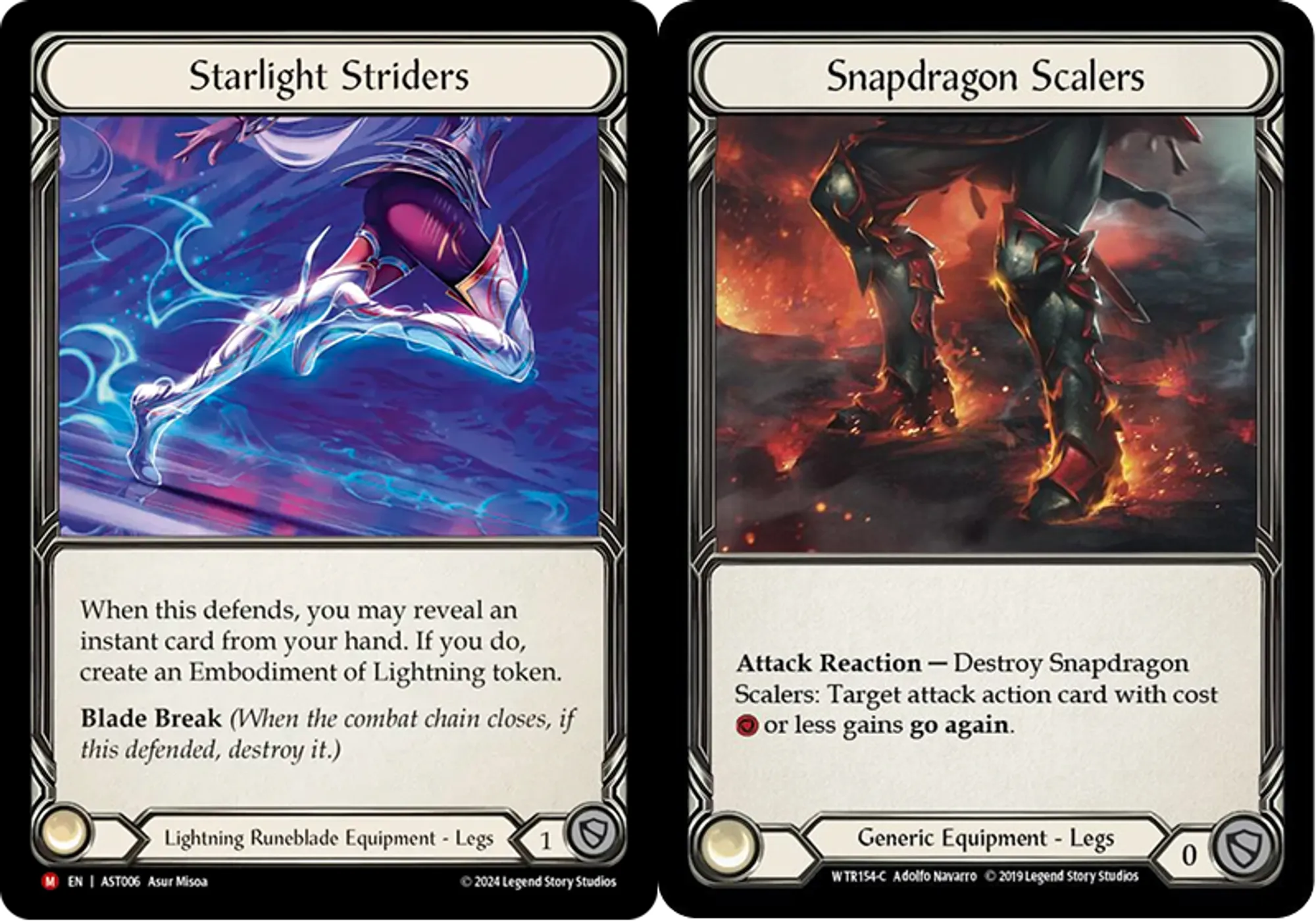
Your mind might immediately drift to Snapdragon Scalers, which is not a bad pick, but I am going to implore you to look at Starlight Striders. Starlight Striders was released in the Aurora Armory Deck and says “When this defends, you may reveal an instant card from your hand. If you do, create an Embodiment of Lightning token.” Being able to use your leg piece to create an Embodiment of Lightning token is arguably better than Snapdragon Scalers, because of the Quickstrike keyword. The Quickstrike keyword checks for Go Again when you attack, not if you are attacking, most of the time. This means that the Embodiment of Lightning token will get more value when we attack with Quickstrike, as opposed to giving an attack Go Again in the reaction step. The biggest work around for playing Starlight Striders is making sure your deck has enough instants to use it effectively. The nine-blue version of our deck is on fifteen instant cards, making our Starlight Striders effective and easy to use. Since we play less instants in our redline version, and our only Quickstrike card is Rush of Power, we play Snapdragon Scalers instead.
Arms
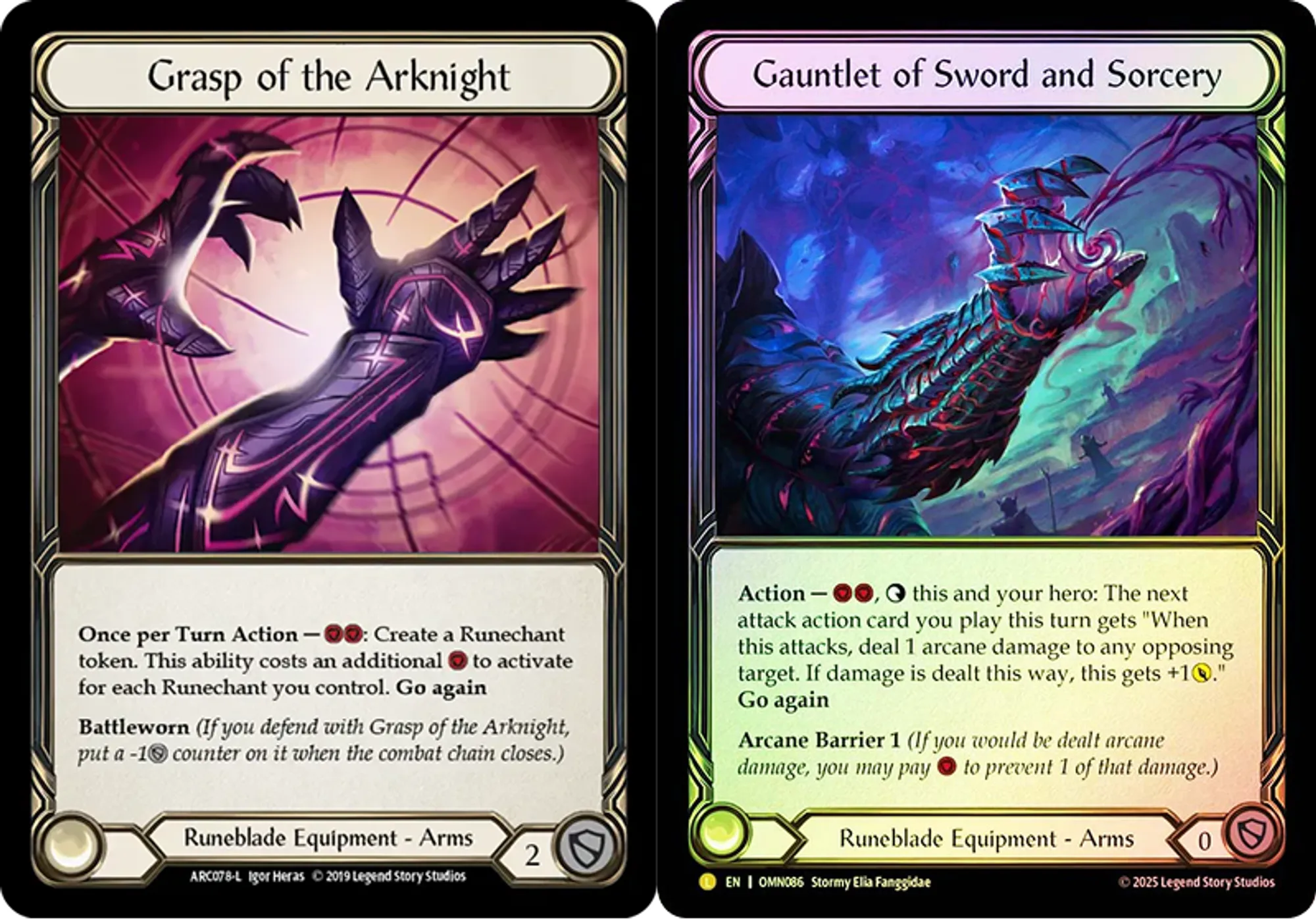
Grasp of the Arknight was always a staple of Shooting Star and looks like it will be just as useful for Legacy of Tempest. However, there is a new contender that we must consider from Omens of the Third Age – Gauntlet of Sword and Sorcery. Gauntlet of Sword and Sorcery gives our next attack action card “When this attacks, deal 1 arcane damage to any opposing target. If damage is dealt this way, this gets plus 1 power.” This has a powerful effect and can help us push extra damage along the way, but it does require us to tap our hero. This means that we no longer have a way to use Aurora’s hero text to set up an Embodiment of Lightning. The other big downfall of Gauntlet is that it does not block. Runeblades often lean on their fridge of equipment to cover up powerful on-hit effects. Only time will tell if Gauntlet of Sword and Sorcery will be strong enough to beat out Grasp of the Arknight, but I am sticking with the latter for now.
Arcane Barrier
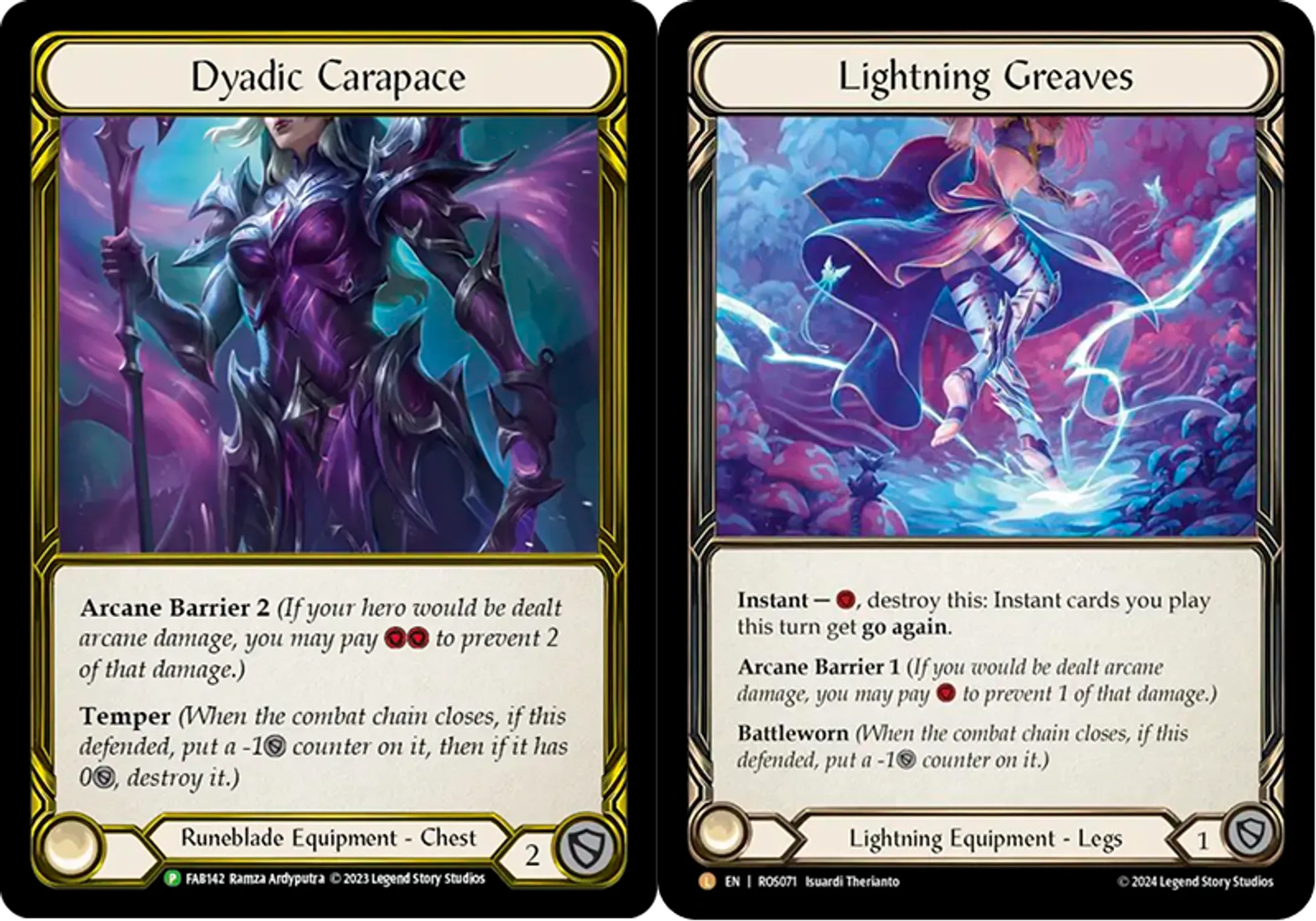
No matter what metagame we are in or how many Wizards hit Living Legend, there is always a new Big Arcane Baddie to deal with. This means we need Arcane Barrier to help protect us from the evil Wizards of Rathe. Dyadic Carapace and Lightning Greaves are the perfect equipment for this. Having access to Arcane Barrier 3 from only two equipment pieces saves us sideboard slots and protects our life total. Having Lightning Greaves in our sideboard also helps against heroes like Vynnset. We can bring in our Lightning Greaves to make sure we have Arcane Barrier 1 and can pitch to Runechant tokens when needed.
Head
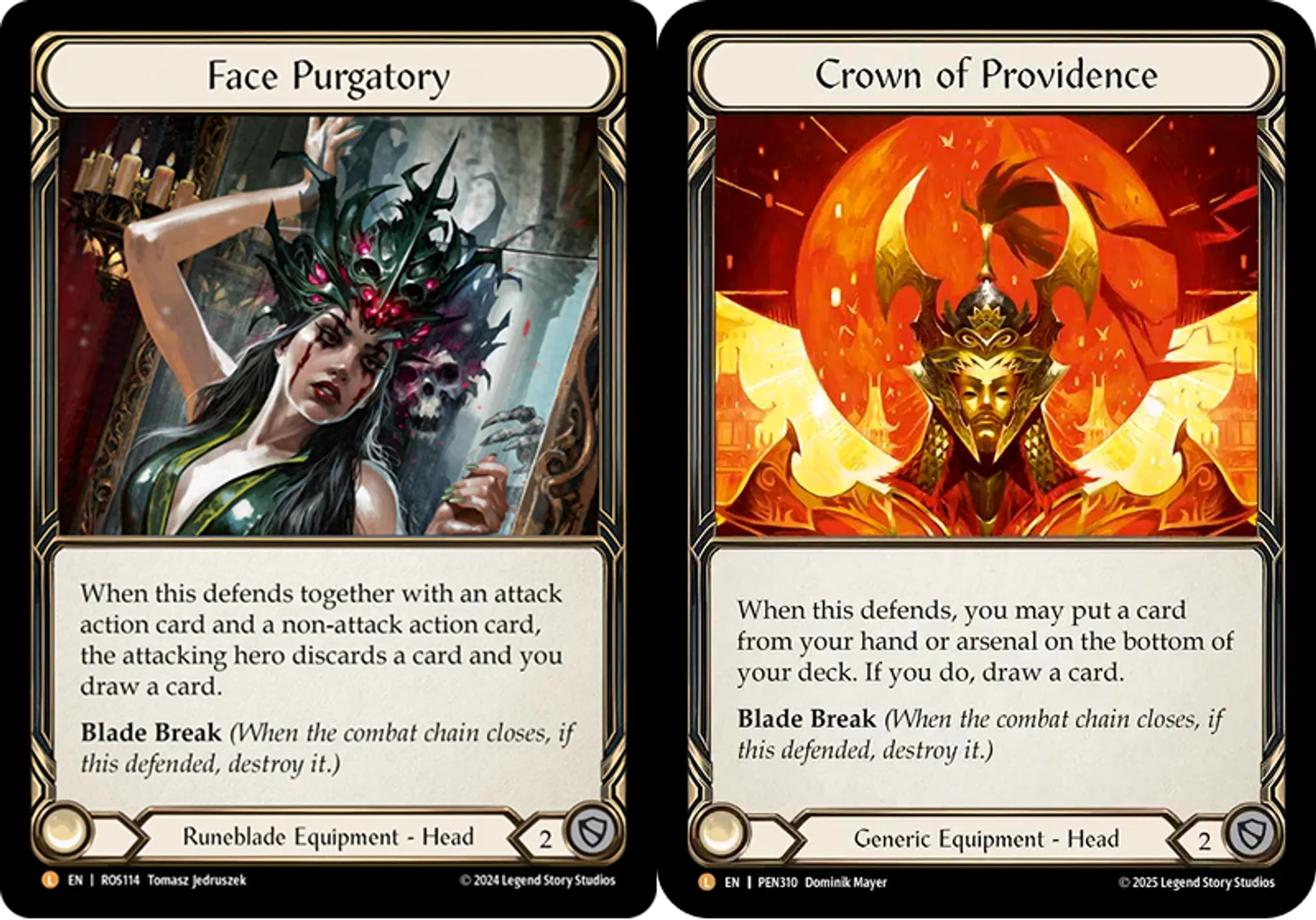
We have access to two of the best head pieces in all of Flesh and Blood with Face Purgatory and Crown of Providence. Face Purgatory is a powerhouse of an equipment with the ability to block a tall attack and force the opponent to discard a card. We also get to replace one of the cards we blocked with, meaning we can keep up the offensive pressure on our own turn. Crown of Providence also plays a strong role as a Get Out of Jail Free card against arsenal disruption. Against decks like Victor and Gravy Bones who want to blow up our arsenal with Command and Conquer and Conqueror of the High Seas, having even a single bail out can be a huge help.
Aurora’s place in the metagame
Does Legacy of Tempest recreate the same lightning surge of feelings that Shooting Star did? There are definitely some hoops to jump through with Legacy of Tempest, but that has been the best part of this journey. The joy of testing new cards to find that same spark of joy that Shooting Star brought me has brought me back to Team Lightning. I understand that Legacy of Tempest loses some powerful tools that Shooting Star had access to, but the new cards in Omens of the Third Age bring a whole new puzzle to the table. While this puzzle may take some time to solve, there will be a wonderful reward waiting.
How will Majestics and Legendaries from Shooting Star hold up in Legacy of Tempest? Cards like Channel Lightning Valley and Skyward Serenade catching the ban hammer does not feel great, but there are still plenty of Aurora classics that carry over. Majestics like Arc Lightning and Current Funnel will be staples for Legacy of Tempest, just like they were for Shooting Star. There are also plenty of Legendary equipment pieces that will shine in Legacy of Tempest. Cards like Face Purgatory, Grasp of the Arknight, and Lightning Greaves will easily slot into Legacy of Tempest.
Are there any edges to be gained from playing Legacy of Tempest in a week one Classic Constructed meta? A lot of the player base was terrorized by Shooting Star during her reign over the Rosetta metagame and will be expecting a low to the ground aggro deck. We can surprise our opponents by being on a version that runs more blues and wants to play a longer game. There is always the alternative route of complete surprise, accessible by playing Cash Out Combo Aurora at the first event you attend. Cash Out Combo requires patience to pitch stack Arc Lightnings and set up items throughout the game while protecting your life total. The final combo offers upwards of 35-40 damage in one turn and can catch the unknowing off-guard. Cash Out Combo will be the most effective way to utilize the element of surprise in the early weeks of the Omens of the Third Age metagame.
I would currently put Aurora in the B tier of a tier list, if I were doing one. Her natural ability to apply pressure with break point attacks and on-hit effects gives her an edge into a lot of matchups. Aurora’s biggest issue in Classic Constructed is going to be Victor. Victor loves to play against aggro decks and can cover break points easily. Once Victor hits Living Legend, we could see Aurora stonks shoot up!

Zack Phillips
Avid Flesh and Blood enjoyer, competitor, and content creator. The love of the game takes me around the world and I want to share that journey with you