
What Is (And What Isn't) Working With FAB Broadcast
Flesh and Blood is, above all else, a game for competitors. The game system ensures that, a significant portion of the time, the better player will win. As a result, watching the game is engaging and dramatic. When two titans of the community have a showdown with high stakes it almost always comes down to the wire. There are clean plays, risky gambits, and grindy gamestates but, above all else, it’s about two people having a conversation in the common language of great games. When an ambitious card gamer sees this live on screen, it’s impossible to resist the call. That is the reason players like myself have flocked to Flesh and Blood over the last six years. Sure, it all starts with a backyard brawl of Blitz decks, but when you see the pinnacle of TCG competitive excellence live on screen, that’s when you really start buying in. In my view, Flesh and Blood’s broadcast is what makes and keeps the promise for players new and old.
While the fabtcg Youtube streams are some of the greatest shows in TCGs, I believe they could be improved by a re-examination of governing philosophy. More on that later.
First, allow me to explain what gives me the gall to make such a claim. In the outside world, I am a cameraman in the Film and TV industry in Los Angeles. This year I marked a decade of working full time on documentaries, TV shows, feature films, commercials, music videos and everything in between. Besides all that, I am heavily involved in Flesh and Blood broadcast (both bootleg and legit) by way of my role as lead caster and equal partner of Arcane Games and Events and also by way of my side job as a freelance caster working for LSS (most recently for Calling: Seattle and Calling: Hong Kong). Based on my credentials, I’m probably more qualified to discuss broadcasting than anything else related to Flesh and Blood.
Before I get down to it, I do wish to say plainly that I love what we deliver on screen as it is right now. I also love and value working with everyone involved with Flesh and Blood production. I think the people who bring FAB events to life on stream are among some of the most passionate in the game. So, when I criticize what we do I hope it will be viewed as what it is: an equally passionate person challenging his colleagues to push the bounds of what is possible in TCG broadcast. Justin Liwag (founder and co-owner of AGE) and I often ask ourselves what we would do with more resources (money, time, expertise, etc.) and it is in this vein that I both commend and critique below.
Furthermore, I consider it of paramount importance to offer a solution for the issues I present in any criticism. Stick with me until the end of this piece and I’ll put myself out there. Alright, on with it:
What Is Working with Flesh and Blood Broadcast
The Casters
Yeah, I’m gonna pat myself on the back first. The guy with the microphone appeals to his own vanity from the get-go, you all saw it coming. I'm joking, of course. In all seriousness, I hereby remove myself from this aplomb. When I gush about FAB casters below, I’m talking about the people who have immeasurable talent and passion that I have been lucky enough to witness both firsthand and via my screens. I speak as someone who is endlessly inspired to do better because of the people referred to below.
The vast majority of people that step into the booth at any level of LSS-sanctioned broadcast both know what they’re talking about and care a lot about delivering a good show. Sam O’Byrne (Coverage Producer and Lead Caster at LSS) has done an astounding job of curating consistently solid casting talent all over the world to adorn the already magnificent games that we get to see on stream. Long behind us are the dark days where I, and so many others, had to watch FAB streams on mute for fear of losing our sanity.
So what’s different about this “new generation” of casters? If you ask me, today’s casters possess an undeniable emphasis on the craft of casting itself. By “craft” I’m referring to the minutia of doing the job at a proficient level, the subtle but all-important details of doing the job that stack up to form a professional. More than ever, FAB casters are focused first and foremost on committing cards to memory, learning the ins and outs of the top-dog decks, and on working together as a team to sally forth a delivery that is as insightful as it is entertaining. There was a generation of FAB casters that left the craft behind and hoped that their charisma and on-screen personality would carry the day, but they’re out and the tryhards are in.
A few examples:
- Scott Mines spearheaded the knowledge at the World Premiere of The Hunted set in Prague. I haven’t talked to him about it personally, but based on my experience working with LSS, I doubt Scott was privy to the contents of the set much sooner than the players. It’s no surprise that Scott has been tapped for every single World Premiere since.
- Elly Bird has crazy deep insight on just about every class. Sitting next to her in the booth at Calling: Kansas City made me feel like I got an education while doing the job. She is also one of the very few casters in the “color” role that has the chops to jump into “Play-by-play” and manage the broadcast cleanly and efficiently (like she did at Battle Hardened: Minneapolis).
- Mitch Leslie brought home one of the most exciting finales in Flesh and Blood history and he’s not even a consistent FAB caster. He’s been an esports caster for over twelve years across more than ten titles so it’s not a surprise that he has the experience to do it well in our game, but this was still the call of the century and props are deserved for him and also the man that Mitch always insists is really responsible for “The Sigil” moment, Pankaj Bhojwani (Pankaj was watching the match from the sidelines and fed Mitch critical information through his headphones).
There are so many knowledgeable people playing this game at present that none of the casters in my orbit are under any illusions that there aren’t other people who could do the job. That might sound bleak in a way, but I think it keeps Flesh and Blood casters honed to the degree of sharpness that our viewership expects and deserves.
Kudos to the casters.
The Games
Holy cow do we get to watch incredible games on coverage.
A lot of this success boils down to the game system itself. If you’re reading this article then I probably don’t need to say much to sell you on Flesh and Blood’s game design, but it’s so important to reflect on how damn good this game is. Games of Flesh and Blood are engaging to watch, and the more you understand the game, the more true this is.
Next, credit is due to the player base. Even though Flesh and Blood has a standout game design, it takes a serious commitment to play the game at such a high level. The buy-in from players all over the globe is such that we get to enjoy the pinnacle of talent on our screens every time the fabtcg Youtube Channel goes live. Not only does it ensure that our audience is entertained, but it also guarantees that they are able to learn something as well. Aspirational games are what inspire players to pick up a new deck and get themselves on a plane to the next big Tier 3 event and the players are ultimately responsible for making that happen.
Finally, I’ve got to throw a bone to the production team again. The casters, Ethan Van Sant (Technical Production Manager at LSS), and Sam work very hard to select games based on watchability. We’re not always right, but if you could see the energy and anticipation that thunders through the booth when new pairings are up, then you would know how much your crew cares about bringing you matches that are worth the audience’s time and energy. Everything that works about Flesh and Blood comes down to a simple fact: the people who do it love it.
Case in point: the Vile Savant and the Underhanded Cheat were the talk of the booth at Callings Hong Kong and Seattle, respectively. Thanks to their pilots, we got killer games with Chanon Puttaree and Tader Kammeyer, showcasing not just incredible games, but ones that highlighted some oft-overlooked heroes.
The Flow
There is so much that can (and does) go wrong in a live production. I don’t necessarily think that the mark of a solid show is that nothing went South, but rather that the people driving the bus knew what to do and responded accordingly when they hit bumps along the way. I promise I’m done with driving metaphors now, but thanks for joining me down that road.
Adapting to variables gets all the more difficult when you introduce shiny new tools on stream with each passing month. Ethan has become the guy that can not only take a literal beating in terms of his itineraries and man-hours, but also the guy that finds time to add more to his own plate. Each feature comes with an extra headache for production, but that hasn’t stopped Ethan from tacking on backup matches, caster picks, a turn indicator, and so much more.
From a caster’s perspective, knowing what to expect from a production is of utmost importance. In any craft, you put an inestimable amount of time into repetitions so that you can respond well to variables and interruptions in the pattern. When we know, for example, where the hand cam button is on our stream deck (a little switcher that allows casters to live cut during a match), we know we can reach for it without thinking when the Marlynn player on stream draws up a cheeky pummel. That confidence is born of consistency from the people and the process that we depend on to do our jobs. That consistency is brought by Ethan the Man Sant.
For the viewer, a consistent flow is no less important. You can depend on games being covered from beginning to end without interruption due to technical issues. You know for certain when breaks are going to happen and how long they’ll be. Heck, you even know that you can watch the finals after the fact because the chapters won’t contain spoilers. Building towards success is all about establishing a clear cut language. If it isn’t quite right it can always be changed, but being able to hatch and enact a gameplan is what makes for stellar Flesh and Blood broadcasters and players alike. From the audience’s vantage, I view this “flow” as the basic unit of trust required for you to confidently click on any of the LSS broadcasts. It’s akin to the wary traveler stumbling into a Starbucks on a long journey because they “know what they’re going to get.” It’s not a flashy thing, but it is ever so important to long term success.
What Isn’t Working About Flesh and Blood Broadcast
The Philosophy
This’ll be the hottest take I have for this piece. I don’t think that “more games, fewer breaks” should be the main driving force behind all decisions pertaining to live broadcasts. I believe that this ideology has become the predominant gatekeeper for implementing features that would further enfranchise the viewer.
I know, we’re all here to see games of Flesh and Blood, so why do anything that siphons off our ability to achieve that one singular goal? What could possibly be more important than injecting as many hours of gameplay directly into our eyeballs and earholes?
Let me concede, first, that we have come a long way in lessening the downtime in Flesh and Blood streams. You know that twenty to thirty minutes of purgatory you experience in between rounds at a Calling? At the venue, boredom and tension can be mitigated by milling about with friends and teammates. It is a different story for the at-home viewer. Not too long ago, they would experience the lull between matches watching an endlessly looped graphic, listening to nauseating royalty free music (or worse, painful ad rolls), and depending on a stream timer that they and the producer knew meant absolutely nothing. All this to say that, even if I don’t think that every aspect of our live broadcasts should be informed by eliminating breaks and showing more games, I am very thankful that the maxim has had some influence on the way we do things.
What follows in this section is, essentially, a list of everything that I think we miss out on as viewers because the philosophy behind the decisions in FAB broadcast need reexamination. I’ve had my hot take and juicy hook, now allow me to argue my case.
The Caster Shot
The caster shot, since the beginning of FAB broadcast, has always been two talking heads in front of a flat backdrop. This is one of the biggest missed (and most easily rectified) opportunities in Flesh and Blood broadcast.
If we are flying casters and production all over the world in order to participate in these events in person, then why the heck aren’t we showing the people at home what it’s like to actually be there? Whenever I’m watching an event at home, I feel so short-changed because the caster shot is the one opportunity to see the venue and take it all in (besides recent b-roll interstitials, but those are only available at Tier 4 events). All this would take to change is the banishment of the backdrop, a little reframing, and more focus on proper lighting–which brings me to my next gripe.
Our technical choices, overall, need some help. This is where my career experience kicks in. It’s also where I could be overly sensitive based on my expertise. You be the judge:
These are three separate screenshots of myself in the caster booth during FAB broadcasts. The first is a caster shot that I lit, dressed and framed at AGE Studios. The Second is from an LGS in California where we hold AGE LA. The third is from an LSS event that I casted as a hired gun. I encourage you to peruse them real quick to catalogue the differences and then to refer back to them during the discussion that follows.
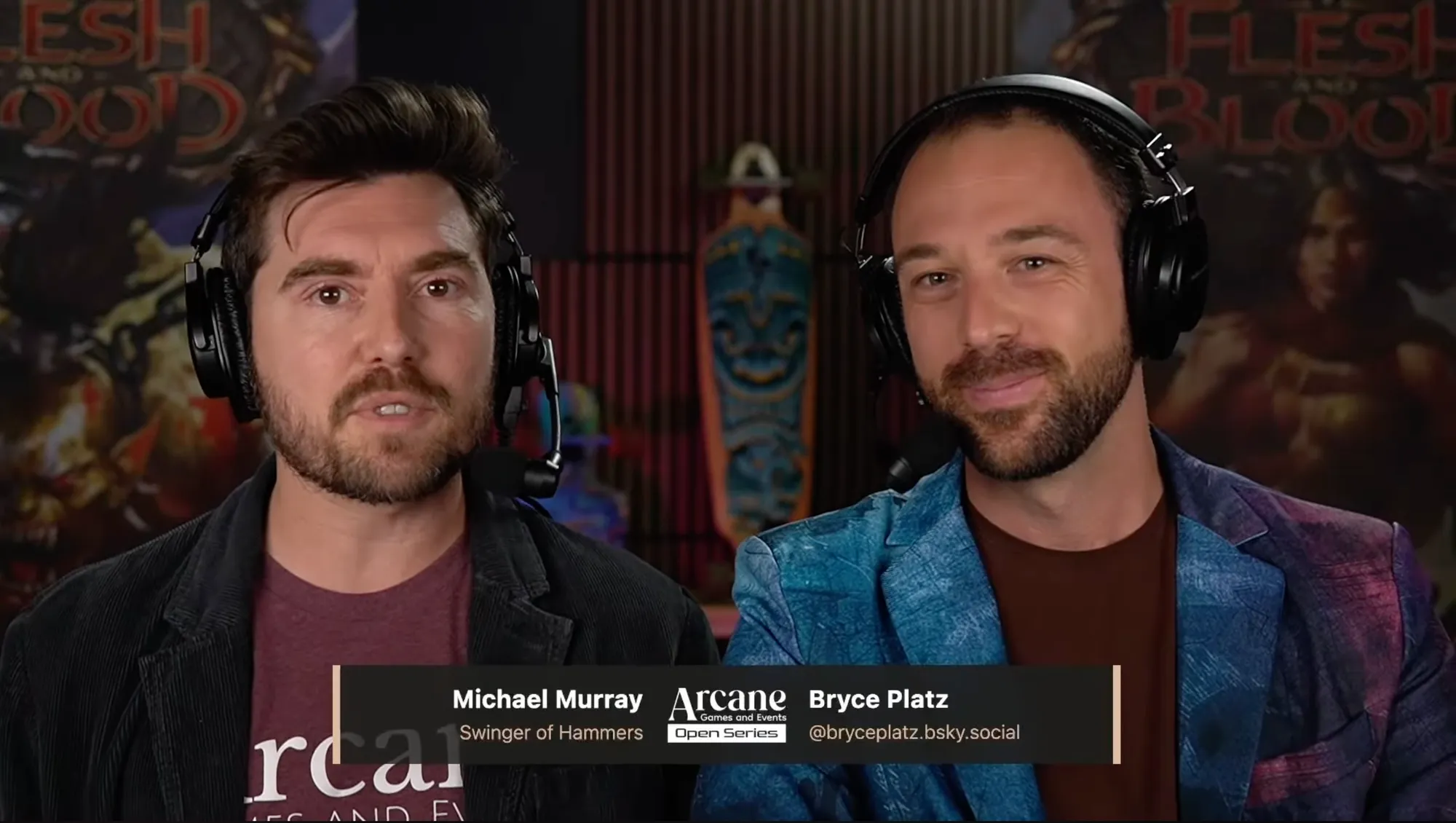
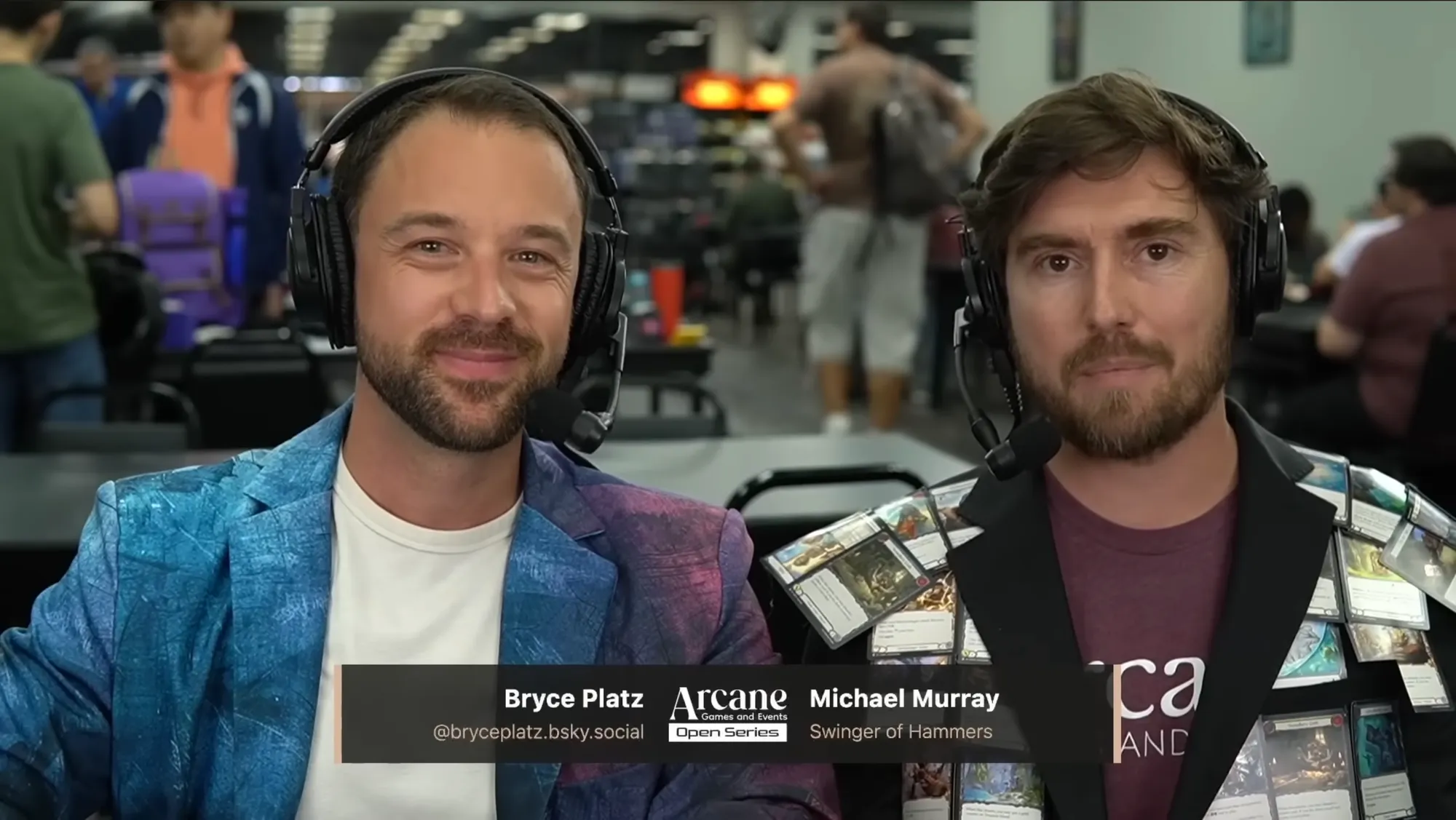
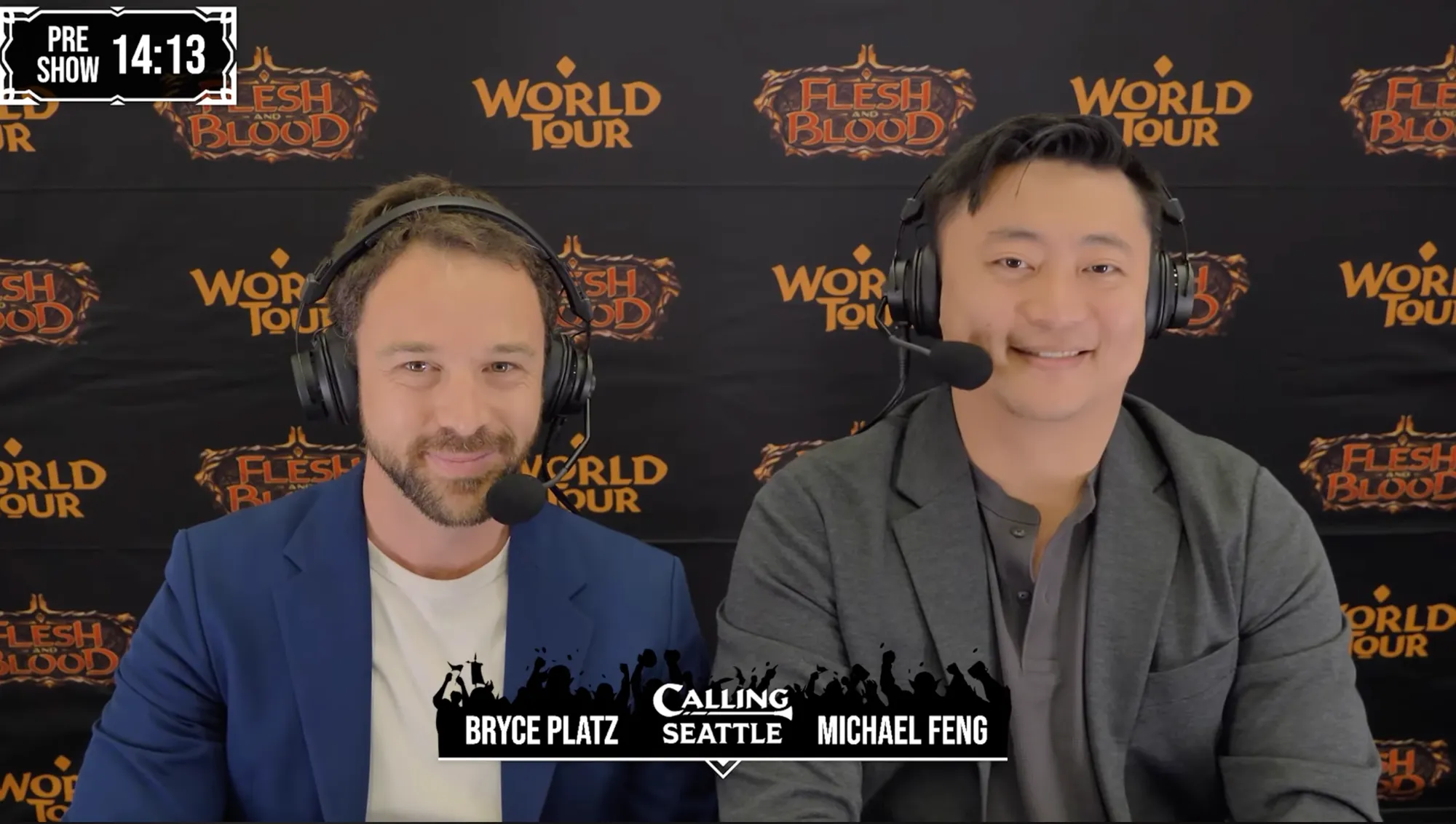
One of the trickiest things about visual mediums like photography and cinematography is that you are lying to your audience by presenting three dimensional art on a two dimensional canvas. A photo print is flat and so is any screen that you watch a FAB broadcast on. The challenge for the photographer, filmmaker, or broadcaster then becomes to create depth in an otherwise flat medium, much like you did in grade school when you learned how to transform a drawing of a square into a cube. Executing this well is one of the ways you can make photos look better, even if the viewer can’t put their finger on why it looks better. If you’ve ever taken a picture on your phone and wondered, “why doesn’t it look the way I saw it,” the answer is often that your photo is lacking depth.
The way we create depth, when lighting humans, is to create a gradient on the face from one side to the other (known as the “key” and “fill” sides) and then to separate the subject from the background with a backlight and/or color contrast. If you, on the other hand, blast the face with equal amounts of front light, it should come as no surprise that your subject looks like a cartoon character, lacking the definition and depth of the three-dimensional world. Ultimately, these are basic lighting principles that are incredibly easy to implement, but, as I mentioned in the previous section, I think that it’s just viewed as incredibly low priority in the face of broadcast’s current philosophy.
On the camera side of things, there are also some variables that can be adjusted to avoid “flat” shots. The camera person can literally create depth by getting their subject(s) away from their background. They can also employ a longer and/or faster lens to create a shallower depth of field. Simply put, this means that less of the shot is in focus and so the viewer's eyes are drawn more directly to the thing they should be looking at. Again, easy but also trivial if you don’t think there’s anything to be gained.
Star-Building
The people that play Flesh and Blood are fascinating, kind, and driven. This applies to the local armory heroes as much as it does to those that are loading up their coffers with gold foils and cash. Despite that, I never would’ve known that Majin Bae loves reading more than life itself or that Brynn (from The Banished Zone) is responsible for inventing a crazy cool DJ sound machine without asking them myself.
We all love to play Flesh and Blood. It goes without saying that, above all else, this is the singular thing that binds our community together. BUT, I don’t think it needs to be the only thing we highlight when it comes to coverage. When the broadcast team finally started mixing interviews back into bigger events, I was stoked. Then I was met with the same questions over and over again–“Why did you pick X hero?” “How do you feel about the next round?” “Why did you include X card in your deck?”
There’s an opportunity to create more depth here as well, but it requires something other than better lighting and lenses.
The Spectator Experience
In this section, the “spectator” I’m referring to is someone that wants to engage with the main event physically at the venue. It’s applicable because the live spectator experience, in my view, has slowly degraded over time due to the philosophy of “more games, less breaks” and can drastically improve the viewing experience on Youtube if tended to properly.
For a long period of time, Tier 4 events would include a raised stage around the feature match area(s) where anyone in the venue could look down on the titans of our game and not miss a single game action. It was a spectacle that took up a good chunk of the hall and was clearly showcased as the real reason we were all there. If you didn’t feel like clamoring for a spot on the risers, there were monitors set up where you could watch the broadcast theatre-style. One of my favorite moments of US Nationals in 2024 was watching the final blows of the Top 8 match between William Bradshaw (Azalea) and Andrew Rothermel (Kayo) on a little screen at a vendor booth with twenty or so people behind me all experiencing the action together. We called out misplays, talked about possible outs, and cheered for the player we wanted to emerge victorious.
The World Championship in Philadelphia, in contrast, treated the feature match area as though it was the footnote of the event. Sequestered in the far back corner of the venue (behind the enclosed World’s competition area) were three cubicles, about ten feet or so wide, separated by branded dividers. This is where the three feature matches were played. Several feet away from the edge of these cubicles was a long line of stanchions separating the feature match areas from onlookers. This was as close as you could possibly get to the action at the biggest event of the Flesh and Blood year. Besides that, there were no monitors or projectors in the venue displaying the broadcast. Lame.
My understanding is that the reason for having three feature matches was so that the coverage team could guarantee (because they operate on a delay of a couple hours or so) that they would always have a really stellar game to showcase on the live stream. This, in itself, is a perfectly reasonable goal when it comes to adhering to the aforementioned philosophy. I would assert that while supporting a reasonable goal it also misses the point entirely.
The Solution
I never want to be someone that tears down the hard and admirable work of others without putting out a potential fix, so here goes:
First: the casters should not be placed in front of a flat backdrop and hidden in an unseen corner of the venue. Instead, they should be situated accessibly in the hall on a slightly raised stage so that the background of the caster shot is a panorama of the competitors and convention-goers. The viewer at home shouldn’t just get to feast their eyes on great games, but also the atmosphere that delivers on the promise of the mantra “Play the Game, See the World” for everyone that pursues it.
This will also have the added benefit of making it easier to employ backlights and tighter lenses since the casters won’t be squished up against a backdrop
Second: directly behind the casters should be a live viewing area for anyone in the room that would like to spectate the main event. It should be equipped with multiple monitors and speakers that relay the audio from the main broadcast. As a spectator at home, I’ve cried out in agony as a pummel finds home and crossed my fingers when a Kano player decides it’s time to go. As a caster, I’ve always craved the chance to play to a live audience and share directly in these moments with the people that love them as much as I do. When I’m in the booth, I want to hear the agonized and jubilant reactions from the crowd behind me. When I’m at home taking in the action, I want to see the excited faces of spectators when the stream comes back from break.
Third: we need more face time with the players, which means more interviews. Adding on more segments is a daunting task when production has to contend with a broadcast delay, a tournament that must stay on the rails and on time (thank you Judges of Rathe), and all of the potential curveballs that an average day in the hot seat can pitch. It’s so much for one person to handle that ultimately, the only way that this part of the scheme works is if we add more personnel. If all other aspects of the broadcasts remain as they are, I’d venture to say that we’d need an extra camera person and an extra talent (in other esports, this person is often known as a host).
It’s impossible for the casters to interview players after their rounds because production is on a time delay and, oftentimes, the players in question are in the middle of a round when the live stream is in between them. That dynamic changes if you have a host who is responsible for capturing and recording interviews (with the help of our extra camera person) directly upon the conclusion of a match. Furthermore, these two people would then have the opportunity to record interstitial moments in the venue when they’re not interviewing players. Say they grab a quick chat with Max Ferocity as she waltzes by in her latest cosplay creation, or record a quick game of pick a card any card as a vendor plays with a passerby, or even catch some lunatic ripping a cold foil Scabskin Leathers in half for some barbaric reason. All of these moments, in my opinion, lead to a more enfranchised viewer at home. No, they haven’t bought a plane ticket and flown out to the event themselves, but they should absolutely be brought into the fun and also (more importantly) know what they’re missing.
Fourth (but still kinda third): the methodology of our interviews needs to change. I want to know more about our best and brightest than why they brought their deck to the tournament;, heck, I want to know more about them outside of their relationship to Flesh and Blood. Who are the people they care about most that supported them in making it to the event? What was their lowest point in the testing process and what pulled them through? What’s the greatest thing they have eaten so far this weekend?
I think that esports broadcasts, in general, take too many cues from physical sports. The two things are just not the same, no matter how much game companies would love to have the network contracts, sponsorships, and audiences that the NFL has. If you don’t believe me, look into the tragic history of the Overwatch League. TL;DR, they thought they could bring the ad revenue, broadcast contracts, and Lambos from the NFL to a video game. Spoiler alert: they went bust.
This may seem like a non-sequitur, but I bring it up because our player interviews, in their current state, remind me so much more of a mid-game hockey interview than any of the incredibly engaging conversations I’ve had with fellow FAB players.
Yelling at the Moon
The aforementioned ideas are ones that I’ve discussed with colleagues, bosses, and FAB-associated passerby alike. Basically anyone that will listen gets an earful of what I think we could be doing better in FAB broadcast. They’re also ideas that Justin and I put into practice every month at the AGE Open Series. Our little stream has certainly had its influence on the big dogs, but I still don’t think it’s enough.
I have one simple hope for this piece: that it will inspire the kind of change that my musings and AGE’s example could not and that FAB broadcast will only get better and better as a result. Even if I disagree with the powers that be about their current approach, I do know that ultimately we’re on the same team and we want the same thing.

Bryce Platz
Bryce Platz is one of Flesh and Blood's biggest fans. Since he was a child he's loved TCGs in general. From Pokemon and Magic to Hearthstone and Slay the Spire, Bryce has always been drawn toward the endless iterations that card games offer and, more importantly, the rush of bending fate to his will.
Even though he's always loved card games, they took a backseat for a number of years while Bryce established a successful career in the Hollywood film industry and sunk deeper into marital bliss with his high school sweetheart. Nevertheless, Bryce was drawn right back in after he happened upon a niche TCG straight out of New Zealand. From his first game of Flesh and Blood (Monarch blitz Chane v. Monarch blitz Prism), it was all over for Bryce. He had finally found a game that, he felt, rewarded good decisions and insulated players from bad variance.
Then and there, a love affair started between Bryce and FAB that continues to this day. Ironically enough, it has gone so far that Bryce now has precious little time to play the game he adores. He is a co-owner of Arcane Games and Events and also an accomplished freelance FAB caster. All that plus being a new(ish) father means Bryce's time has never been more strained. Nevertheless, he finds his moments to engage meaningfully with the things he cares most about: his wife, his child, his friends, and Flesh and Blood.