


You’re at the armory, and it’s round 2. You have been playing a grindy matchup for the past 40 minutes, and you go to draw your hand. To your surprise, it’s four blues: three Wounding Blow and a Brutal Assault. You then get hit with a question that makes the hair stand up on the back of your neck, as a million years of evolutionary instinct kicks in.
“How many cards are left in the deck?” Your hands shake as you spread out your deck, miscounting the first two times but then finding the strength to say “Five. What about you?” Your opponent has a glint in their eye, and they’re practically licking their lips. Your question is irrelevant, but they respond because they are legally required to.
“Twenty”
Your ears start ringing. How did you even get to this point? You pitched these cards; this is your fault. It’s okay, we can salvage this. All you have to do is win in the next few turns. That can’t be hard, right? You’ve been throwing heaters all game; your opponent is on their last legs. You are a killing machine, finish them! You look over at the life totals, and your heart falls through the floor, passes through the center of the earth, and ends up in Australia. If you are not in the Northern Hemisphere (the author apologizes for self-inserting bias here), flip this story.
41
You pass out on the table, and paramedics have to carry you out on a stretcher. Unfortunately, only part of you is in the land of free healthcare. All of this over a Gem pack and two boosters. Surely this kind of primordial evil needs to be wiped from the Earth. You silently hope for a Sumerian flood of Biblical proportions that will water-damage every copy of Fiddlers Green and Sink Below on the planet.
But now there’s a scarier thing happening. Unsuccessfully, you try to fight off a dark, intrusive thought. What if you were the player with 41 health? Wouldn’t that be kind of fun? What if you were born to be a sicko who liked being the indestructible wall rather than the killing machine?
To you, the reader: Perhaps you are a “degenerate” who likes fatigue strategies, or you are a purist who believes that a game of Flesh and Blood is won in bloody combat by trading epic blows back and forth. Either way, card games are a public playground with the rules and guidelines set by the developers. When you step into your shop for a weekly armory, a mid-sized tournament, or onto the highest stage at Callings, the Pro Tour, or even Worlds, you are gonna have to learn how to adapt and have fun with the decks and strategies your fellow players want to bring. We are going to discuss what “fatigue” strategies are, how you can wield or combat them, and what their place is in the game of Flesh and Blood.
What is Fatigue?
fatigue - noun
fa·tigue fə-ˈtēg
Weariness or exhaustion from labor, exertion, or stress
We were overcome byfatigueafter the long hike.
When your deck has no swag left
Fatigue is a community term that tries to conceptualize a very unique thing in Flesh and Blood: When your deck becomes less powerful or downright ineffectual. This happens for a few different reasons.
- You’ve run out of cards that deal damage
- You’ve gone into the second cycle of your deck and you lack power this go-around
- You don’t have enough cards in your deck.
This is a combat game, and you have to reduce your opponent’s life total to 0 to win. Sending your big attacks is expected. We often advise new players that “reds are for playing, blues are for pitching.” You naturally send your best stuff with the resource cards required to fuel those plays. However, when you start to run out of those big haymakers, you start to deal less and less damage.
Because you have been pitching blues, when you start to redraw your pitch cards (referred to here as the second time cycling through the deck), instead of drawing hands with powerful red bombs, you draw blues that often deal way less damage than their 1-pitch counterparts.
Finally, you don’t have the cards left in the deck to close the game out. 40 life can be a lot when your opponent is also able to block, and you lack the critical mass of ways to leak damage before your deck count hits zero.
When you lose to fatigue decks, usually a combination of all three things happens. In the endgame, you are reduced to a deck with no damage, all blue hands, and not enough cards to win. This is the win condition of the fatigue deck. Their intention is to make all of these things happen to you. They win when you can’t kill them. The easiest way to explain a fatigue player's perspective is “make you run out of cards before they die.”
Fatigue players achieve this by having multiple tools at their disposal. The best fatigue decks include many different answers to the questions your deck asks. Do you send a lot of damage? That is where high-value blocking cards such as Sink Below, Fate Foreseen, and now Shelter from the Storm come in. Sigil of Solace can help recover some leaked damage and cards like Unmovable answer tall damage, especially if it’s Dominated. If you are a combo deck, fatigue decks can have answers to disrupt your combo. Recently, fatigue decks have sideboarded in Amulet of Echoes to answer the multi-Gone in a Flash combo turns from Oscilio. Before, they would run cards like Poison the Well or even item destruction like Imperial Warhorn to break Verdance’s Healing Potions and turn her life-gain against her. As stated previously, the best of these decks will include both. A well-tuned fatigue deck is one that answers every point of the meta the best it can.
We’ll start with the most common thing fatigue decks do: block a lot. Imagine your turns all follow the same game pattern - send three Head Jabs (anything in this instance with 3 power and Go Again) into a 0 for 4 finisher. This is a total of 13 damage. Now, assume the fatigue player has a deck of Sixty Titanium Baubles and proceeds to block 12 each turn. You only deal 1 damage. They are now at 39, and you need to do this 39 more times. The only issue is that it would require you to have 156 more cards (39x4), so that’s not possible. This is often why fatigue decks take a defensive approach. It’s much easier to run your opponent out of cards via blocking, as they expend their power cards and fail to connect for meaningful damage.
Step 1 of Beating Fatigue?
No decks in the game only play head jabs and finishers, so fatiguing is not such a simple and deterministic process. The first thing you often see is that some decks go very wide and don’t present clean blocks for the fatigue player. Take Fai, for example, the king of “Head Jabs and finishers.” He’s somehow one of the hardest decks to fatigue, deploying a few potent anti-fatigue strategies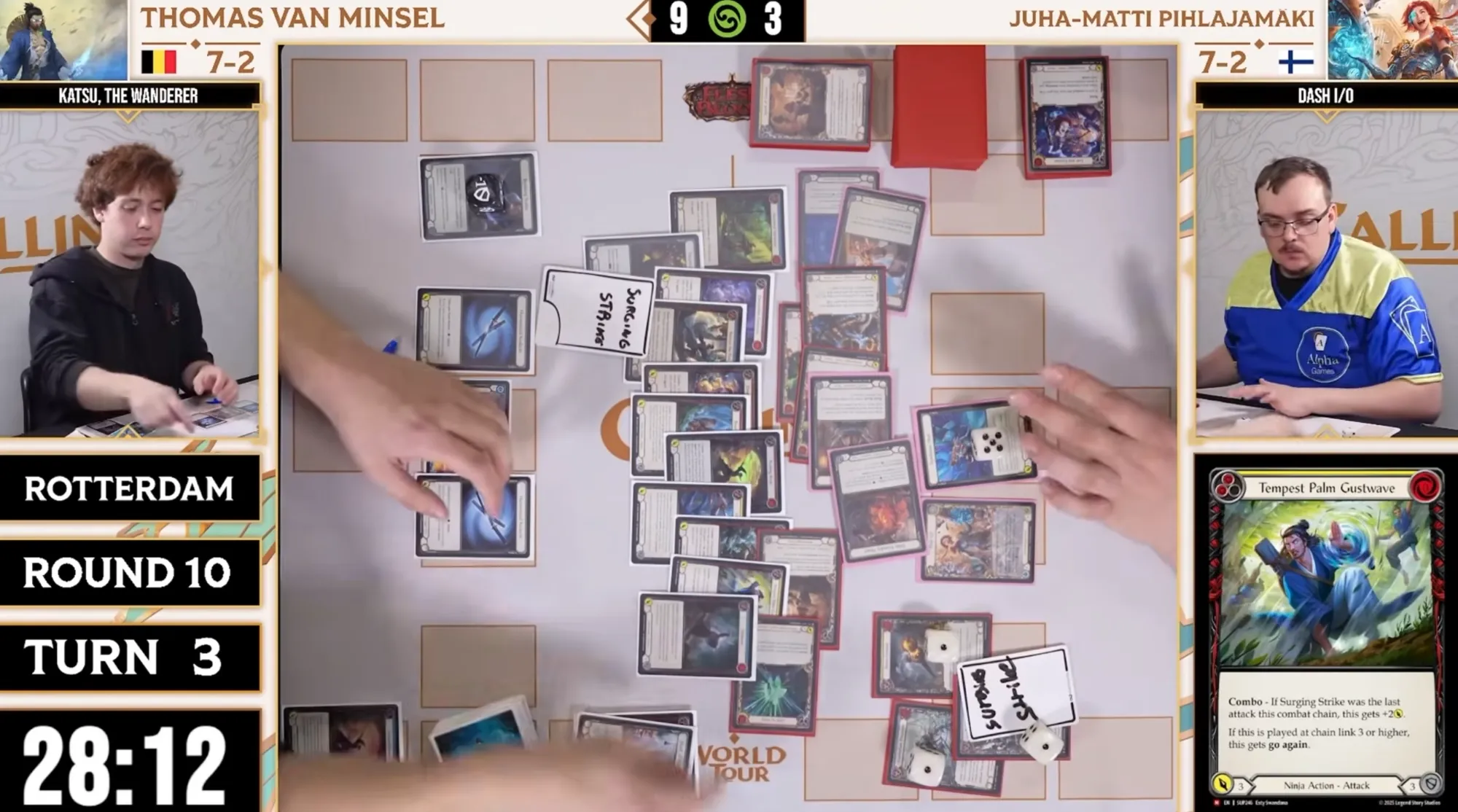
The first is what we call Damage Compression. If you set up, how much can you deal in a single turn? This is the first trick for overcoming fatigue. Let’s go back to our example of a deck only filled with blocking cards. If you, as a player, do a setup play like: play an Energy Potion and arsenal an Art of the Phoenix: War, the fatigue bauble player cannot do anything to also make use of the setup turn. Now, on the next turn, you can throw 30 damage (with the help of Mask of the Pouncing Lynx), and the fatigue player will block 12 and take 18. Do this a few times, and now you’ve successfully beaten them. Adopting a simple heuristic of “play three cards, arsenal the fourth, play a five card hand next turn - repeat” is an easy way to start practicing against fatigue. You’ll start to see how you can alternate serious damage turns to push over the blocking from the opponent. Dash I/O players recently have started to adapt their decks for a harder anti-fatigue plan by setting up multiple Teklo Pounders with the aid of a Convection Amplifier and Plasma Mainline. Once these pieces are established, then the real game begins. Into an aggro race, taking all these off turns would never work, but the fatigue decks are slow enough that giving them four cards to use on offense doesn’t result in problems most of the time. However, now we’ll jump back to our fatigue player to see how they can respond.
Fatigue in many Flavors
Our fatigue player has now come to their senses and remembered that 60 Titanium Baubles is not only bad deck building, it’s also not even legal. They now include cards like Sigil of Solace, defense reactions like Sink Below, and, notably, disruptive cards that block 3 like Command and Conquer. Now, when they get put in the hot seat by our Fai player passing instead of playing their fourth card, they instead arsenal that Sink Below or Sigil, which in a sense “counters” the card the Fai put in their arsenal. Larger setup turns can now be punished by throwing Command and Conquer, where it otherwise would block. Let’s look at a few different styles of fatigue decks and get a better idea of how people deckbuild successfully.
Calling: Columbus 5th 🇺🇸
We see a blend of high defense cards, disruptive effects, and recursion. Fatigue Pleiades is able to counteract setup turns with cards like In the Palm of your Hand by pulling the last suspense counter off at instant speed and drawing an extra card during her opponent's power turn. Command and Conquer punishes setup turns, but so do cards like Pulverize. You also have access to a few unique tools, the first being a blunt object. If the non-fatigue player wants to cycle 5-card hands, that often leaves Pleiades with a single card. If those players correctly block down to have their last card in hand, either a blue or an arsenal target, they can swing Miller's Grindstone. This not only presents damage, but also the possibility of destroying the top card of the deck. This is important because not only do you permanently remove a card from their deck (moving ever closer to the wincon of fatigue), but you also deal damage. This gets into another concept defensive decks can always pivot to: Fatigue by Damage.
Imagine your weapon is a 0-cost attack that puts itself on the bottom of your deck after playing it. Now imagine you can draw one of those with each hand. Seems pretty busted, right? That’s the power of an efficient, serious damage weapon. If, during a 20-turn game, a Guardian swings their hammer for 4 each turn, they threaten 80 damage without ever losing a card from the deck to do it. Compare it to Ranger – a class with no weapon. Every time they want to threaten damage, it comes at the expense of an entire card from the deck. Threatening 80 damage may cost them 20 cards. This is often why Guardians are synonymous with fatigue; their weapons are efficient enough, both math-wise and card economy-wise, to stand the test of battle. This becomes very potent in the endgame when a hammer for 4 each turn, when the opponent is at 1, often requires two blocking cards from them for your zero cards spent to attack. You’re up two cards each turn in the endgame, which means it's very easy to fatigue them unless the dregs of their deck can keep up. Pleiades can even go a step further with the combination of Hostile Encroachment + Remembrance and Up on a Pedestal. In a low-life gamestate, she is able to recur the same copy many times and force the remaining four cards from the opponent's hand, making them unable to attack with their weapon when they otherwise would be out of cards to play. The cool part is that no two fatigue decks are truly the same, despite their shared wincon. Pleiades is able to manipulate Clash information with 9 copies of Tough Smashup, which paves the way to having 100% success rate on other clashes in that turn cycle such as Test of Iron Grip and helps you decide if swinging Miller’s Grindstone is worth it. As we said, the best fatigue decks are toolboxes with answers to many kinds of decks and different gamestate permutations.
Calling: Brisbane 3rd 🇳🇿
Now, let’s check out a unique style of fatigue deck: Arakni Huntsman. Arakni often takes slightly proactive lines because their cards have effects similar to Miller's Grindstone, where damage results in banishing cards from the deck. This, plus being able to see the top card of the deck, is a powerful combo. The Arakni can see a powerful card on top and either choose to bottom it so the opponent doesn’t get to play it till much later, or leave it on top if they have a card like Coercive Tendencies and can guarantee they banish it from the deck forever. This is still combined with the classic defensive package of cards like Sink, Shelter, Sigil, and more. In particular, the defense reaction Hunter or Hunted lets you trigger Arakni before naming the top card, which makes it very simple to banish four cards each time you play one. The best fatigue decks hit on multiple axes.
Breaking the Wall
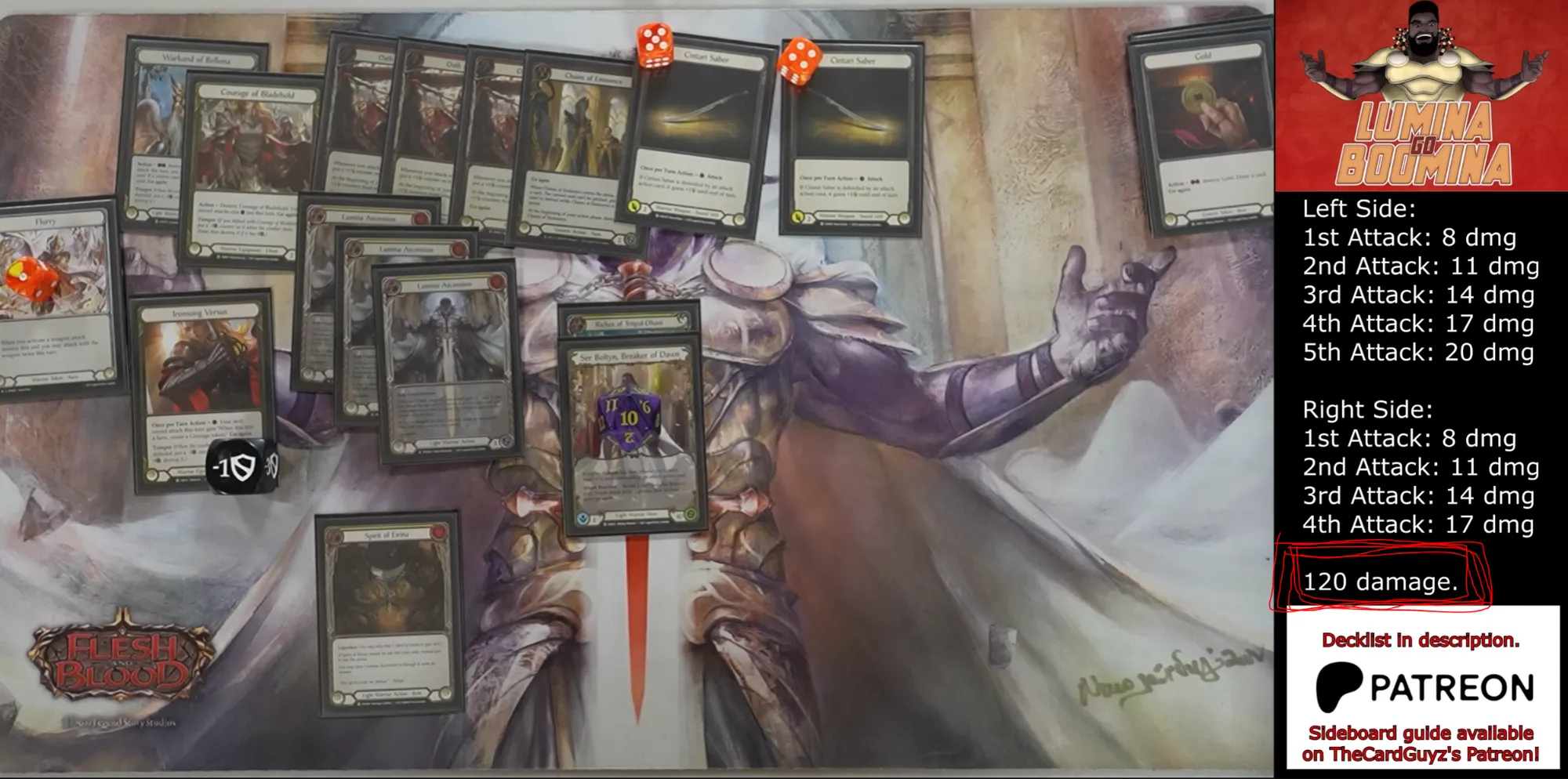
So what kind of decks beat fatigue? We spoke earlier about Fai, a deck that goes wide and can compress lots of damage into bursts that hit over the blocks from the fatigue player. Going wide often makes it difficult for the fatigue player to get full value from defensive cards, and usually involves chipping damage in. Another very powerful anti-fatigue strategy is a combo deck that plays on a different wavelength for their wincon. A recent example (although no longer legal) would be Verdance’s Healing Potion combo. With this, she was able to take many off turns and wasn’t as concerned with turn-to-turn damage, but a single turn at the end of the game that would present lethal. An even more ancient example is pistol Dash, where after establishing all the pistol-buffing items necessary, she could send 16-20 damage every turn without losing any cards from the deck (I miss her). Josh Lau recently piloted Saber Combo Boltyn at Pro Tour Yokohama, a deck that (when pitchstacking the perfect setup) could deal over 100 damage in a turn. Whether it’s Cindra going wide and activating Flick Knives to leak unpreventable damage each turn, or combo decks like Boltyn setting up an OTK, there are answers to fatigue decks. Watch this Swiss game from Yokohama where Teklovossen transforms against fatigue Victor. Of course, the eternal back and forth will exist, since the best fatigue decks don’t sit idly while you set up a killshot, and will fight you in ways you don’t expect.
Lumina Go Boomina in 2026 (Public)
Pro Tour: Yokohama 5th 🇯🇵
Is Fatigue Valid?
With those details in mind, what is the place fatigue holds in fab? Is it a valid strategy, or something that the devs need to eradicate? From the start, FAB has been a game that incentivizes attacking over blocking. Many cards attack for 4, but only block for 3. The natural state of design lends itself away from fatigue. There are many combo cards that deal damage, but the one that existed for fatigue decks is one of the most hated cards in the history of the game. It’s understandable why. When you play against a fatigue-oriented opponent, it almost feels like they are insulting the game. Instead of dealing damage the way James White possibly intended, they simply block all game until you have nothing left. It almost feels like dirty fighting. However, I would like to cite an ancient philosopher on this, Coach McGuirk.
“Punch Low. Always punch low! That means, below the waist. Get 'em in the leg, or in the crotch. Do stuff like that!
‘Do you think that is dirty fighting?’
Yes. Yes, I do. But there's nothing wrong with dirty fighting. You know why? Because fighting is wrong. Right? So, if you're gonna fight, you're already wrong. Sooo - if you’re gonna dirty, might as well dirty fight. 'Cause you're already there, you're already at the party.”
As long as aggro strategies exist, players can find unique ways to combat them. I can speak directly on this, as someone who registered fatigue “slop” Oldhim for the pro tour Silver Age rounds. While my classic constructed vet list was midrange and I only played fatigue against Dio and Gravy, my Oldhim deck was built to do nothing but stop damage until my opponent could no longer do anything. Part of the reason was that I didn’t want to answer the aggro meta of Ira and Kayo by playing another aggro deck. I did that in the ProQuest Vegas season, playing Kayo when Briar was at max power. The experience of stressing about the die roll outcome and often “comparing” the top 12 cards of the deck to see who drew better hits early wasn’t enjoyable. Fatigue was a way to answer the aggro decks in a more controlled and higher agency way. Playing a fatigue deck is hard, despite how it looks. Your opponent gets to resolve every card in their deck, so you need to block perfectly or else you lose. One mistake can cost you the game when you play like this. This involves you knowing basically every common decklist for a given hero, and a macro plan for how the matchup works. I play differently versus Kayo than I do with Ira. Kayo has a higher value per card, and you need tall defense to answer one card of his with one card from your deck. Ira goes wide, and you rely on pitching Earth cards to Oldhim's hero ability and anti-wide cards like Calming Breeze and Battlefront Bastion. It’s surprisingly fun to pilot a fatigue deck, as the final few turns really put you on the spot and are a culmination of all the decisions you and your opponent have made in the match. Winning a fatigue game as either side feels rewarding. Either you successfully parried every blow, and your opponent lies down for a nap, or you overcome the immovable object and successfully take down Goliath.
Personally, I love a good fatigue deck. They offer unique play patterns and require you to sink countless hours understanding the meta inside and out. You get to include a lot of deliberate tech options for the meta, and being rewarded for the right meta read is a high you can’t get anywhere else. Within the games themselves, you constantly need to evaluate the gamestate and any pivots you might need to take. A classic example is the dynamic of the other player slowing down their damage in order to pitchstack and take more selective power turns. As the fatigue player, you can now try to answer by sending damage. This can end up with a unique ending where you drop the other player low enough that you can pivot your gameplan away from pure fatigue via defense. While it sometimes rhymes, many fatigue games don't truly repeat, and you get a fun puzzle to solve each game. A single mistake can snowball into a loss, and it’s exciting to break out of a traditional way of thinking about Flesh and Blood: figuring out how to take the least amount of damage possible, instead of the common inverse. To anyone who accuses these decks of being mindless “block slop,” I would challenge you to try playing a few games with them. There is a good chance you will be surprised at how intricate these decks play. If you decide you don’t enjoy the experience, you still gain new knowledge by playing the other side of the matchup. This can be important for aggro players, since you will recognize mistakes you might make in future games. It is a lot simpler to play the fatigue angle and realize when your aggro opponent threw the game, so when you play the other side, you can avoid the same mistake.
Some Say “Slop,” Others Say “Fun” - So Deal with it
As long as the sandbox exists, we all have to play in it. Unfortunately, this means we all have to get along and learn how to beat each other's decks. Whether you want to play as the unstoppable force or the immovable object, there are great games to be played. You may even be surprised that the change in game plan compared to a standard back-and-forth is actually a fun puzzle to solve. There will always be metagame evolutions, and sometimes fatigue will be the premier deck; other times it will fade into obscurity. Your task as a competitive Flesh and Blood player is to figure out how to win any game. On either side, keep in mind concepts like card economy, setup, Damage Compression, cycling arsenal, and deck choice. Remember how fatigue can combat your game plan and get ready for the fight of your life.