
Structure of a Judge Call
Delving into competitive rules enforcement Flesh and Blood tournaments can be daunting in many ways. One thing that all players in a competitive event should feel comfortable doing is calling a judge. Whether you or your opponent has made a gameplay error, you want the true text of a card, or you just want to double check that a card works the way you think it does, calling a judge is an inevitability in your TCG career, so it is important to know what to expect and what you can do to make the call go smoothly.
The job of a judge is to offer customer service to those playing in the event while maintaining tournament integrity. While judges do have to issue penalties, these penalties are not arbitrary and they occur solely to maintain the tournament environment and standard of gameplay that LSS has outlined in their rules and policy documents. Before addressing the structure of a judge call, there are a few broad recommendations that I have for players in regards to calling a judge. These heuristics will be relevant for every step of the judge call process:
- Better safe than sorry
- If you find yourself at all hesitating on how certain cards will resolve or if the play you are attempting to do is legal, call a judge! It is easiest to fix a situation before an incorrect gamestate is reached or information is revealed. Even if you have asked a judge before, it never hurts to double check. Judges are human and rules change, so any ruling you receive is not necessarily evergreen.
- The sooner the better
- If you do find that you or your opponent have made a mistake, the sooner you get a judge involved, the quicker you will be able to resume your game. If you try to fix an incorrect gamestate on your own and find yourself in a messier situation later because of it, that will be much harder to correct than if you call a judge when the error is noticed.
- Honesty is the best policy.
- If you are honest with a judge while they are trying to help you resolve an issue, you are very likely to receive the most minimal penalty necessary to balance the gamestate. Conversely, if you lie while trying to resolve a situation, the chances that your punishment will be more drastic increase significantly. An intellect penalty never feels good, but a disqualification always feels worse.
On Penalties
A relevant point in the discussion of calling a judge is what penalties are and why they happen. Most penalties are issued to offset an advantage gained unfairly or to remedy disruption to the environment of the tournament. I highly recommend at least skimming the Procedure and Penalty Guide to gain an understanding of the types of infractions and their associated penalties.
The most severe penalty a player can incur is disqualification from a tournament. There are several straightforward and generally well-understood reasons why a player can be disqualified from a tournament, such as unsporting conduct, aggressive behavior, or theft. The most commonly misunderstood reason that a player can be disqualified is cheating. Cheating is an infraction that has a very specific definition, which has some nuanced differences from how the term is used colloquially. The definition from the Procedure and Penalty Guide is: “The player, by their own intentional action or inaction, to their or a teammate's benefit, lies to a tournament official, breaks rules of the game or tournament, or intentionally ignores an infraction”. This is understood to mean that, for a player to be considered to have cheated, three things must be true: the player broke a rule, doing so was advantageous to them, and they knew that they were breaking a rule by doing it. This can be confusing because of a specific type of cheating referred to as “cheats of opportunity”. The colloquial definition of cheating is often associated with premeditated methods of gaining an unfair advantage, such as learning sleight of hand to shuffle cheat. Cheats of opportunity occur when a player finds themselves in a situation that they know to be incorrect but do not take action to change it because it is advantageous to them. A simple example of a cheat of opportunity is a player who plays Fate Foreseen and, while resolving the Opt effect, sees two cards instead of one. This player knows that they should have only seen one card, but does not call a judge to offset the advantage they have gained by seeing two cards. Sometimes, a cheat of opportunity happens because a player is worried about what penalty they might incur if they call a judge and bring attention to their situation, but the penalty for cheating is always worse. There are no gameplay infractions that will get a player disqualified, but if a player is found to be cheating, the penalty is always disqualification.
Why might you call a judge?
In terms of the game you are playing and your experience at the event, there are no bad reasons to call a judge. There are a few broad categories that most judge calls can fall into: gameplay errors, rules questions, checking the true text of a card, and accommodations.

Photo © John Brian McCarthy
Gameplay errors are actions that lead to the game being in an incorrect or impossible state. Calling over a judge means that they will be able to apply the fix that policy dictates for your situation, whether it is a missed trigger, someone drew too many cards, or a card was resolved incorrectly. It is crucial to call over a judge as soon as the error is noticed. Calling a judge for a gameplay error can be intimidating, as it is likely to result in a penalty for the offending player. However, if you knowingly make a mistake that you benefit from and do not make efforts to offset that advantage, that falls under the definition of cheating.
Rules questions can cover card interactions, how cards resolve, or what windows you have to play or activate your cards. It is important to note that, for questions of this nature, judges cannot give strategic advice. This seems obvious, but a common example of when this is relevant is when a player wants to play or activate a card during a particular phase in order to achieve a specific effect. If you call over a judge and say, “I’m attacking with a Gone in a Flash that triggered an Embodiment of Lightning, when should I play my instant?”, you will not get the answer that you want because the judge would be offering strategic advice by providing it. A better question to ask is, “I’m attacking with a Gone in a Flash that triggered an Embodiment of Lightning, if I play my instant during the damage step, will I still get Go Again?”. It may be tempting to shortcut your question, but it is important to let the judge know that you know what playline you want to take and that you are simply verifying that it will resolve how you intend it to.
Checking the true text of a card is one of the most straightforward reasons for a judge call. The true text of a card can be relevant if you or your opponent are playing foreign language cards, if you are playing an older version of a card that has been errata'd, or if you want to check the text of a card that you believe your opponent has in their deck in order to play around it. The last example is the most complex, as the player asking for true text must be able to either name the card, or provide a thorough enough description of it that the judge can identify the card they want to see with certainty. If a player has just hit with Censor and they call a judge to ask “What is the name of that one card that combos with Gustwave?”, their question is too ambiguous for the judge to answer it. However, if that player were to ask “What is the name of the attack that combos with Gustwave that lets them banish a combo card from their graveyard and search their deck for a card?”, the judge would then be able to confidently narrow down that the player is asking about Bonds of Ancestry.
Accommodations are straightforward enough that they can be summarized with the following: if you think something will make your tournament experience better, it is worth expressing to a judge.
Before You Call the Judge
When you have identified that you need to call a judge, there are a few things to consider. Firstly, it is courteous to notify your opponent that you will be calling a judge over. An explanation is optional, but can help keep them at ease. Oftentimes saying something to the effect of “I didn’t know that worked that way, I’m going to call a judge over just to double check” or “I have a playline in mind, but I want to double check that it’ll work how I want it to before playing” can prevent your opponent from thinking that they unknowingly did something wrong.
Another aspect of making a judge call is that you will have to be loud. It is good to be mindful of those around you while doing this. It can be worthwhile to let those around you know that you will be calling a judge, as to not startle them when you do raise your voice to get the judge’s attention.
Calling the Judge
When you call over a judge, loudly say “Judge!”, raise your hand, and keep it raised until a judge is at your table. Each of these steps is crucial to getting a judge to your table quickly, which will allow you and your opponent to get back to your game sooner. Use your best judgement to determine the volume you need to use. You might not need to raise your voice much to get a judge’s attention at a 16 person ProQuest, but you may need to use your top volume to be heard at a 900 person Calling. You should only be yelling “Judge”, never a specific judge’s name. There’s a few reasons for this. Firstly, all judges are going to be listening keenly for the word “Judge”, but paying less attention to catching their own name being said. Secondly, this also maintains trust in unbiased rulings. Calling out for a specific judge by name can make it seem to your opponent like you want that judge in particular to take your call, which can lead to some unsettling suspicions. Keeping your hand raised is crucial as it allows the judge to identify your table and find you quickly, instead of having to look around and guess where the call came from.
Asking the Question
When the judge reaches your table, the time has come for you to ask your question. Remember that it is always okay to ask for a judge that speaks the language you are most comfortable with. The judge that initially took the call is likely to remain there and be the one to issue the ruling, but you are entitled to a translator if you would benefit from one. It is common practice that the first judge to approach the table is the judge to issue the ruling.
The nature of your question can cause the structure of the judge call to vary, but there are some things that are always good practice. Starting by explaining the state of the game can help your judge get up to speed with your situation. Relevant information usually includes: whose turn it is, what phase the game is in, any card effects that are ongoing (ex. Warmonger’s Diplomacy, Red in the Ledger, etc.), and if there is anything on the stack. If you have a question about a card in your hand, feel free to ask to talk to the judge away from the table so you don’t reveal any information to your opponent. If you end up leaving the table, please remember to grab every card that is relevant to your question. If there is some reason that you can’t bring a relevant card with you, make sure to remember its name so the judge can look up its true text. Taking the card with you is typically better as it ensures that there is no confusion with similar card names. It can be hard to remember if Vynnset just banished Vantom Wraith or Vantom Banshee, or if Prism just put Herald of Judgment into her soul as opposed to Herald of Tenacity, and if your judge is operating with incorrect information, the chances that your question gets answered accurately are decreased. Similarly, explicitly point out all relevant cards when you are asking your question. If you say to your judge “I hit with Rising Resentment, how much does the attack action card that I banished cost?” you will get an answer, but if you follow it up with “but my opponent has Channel Lake Frigid out”, the judge will have to revise their answer.
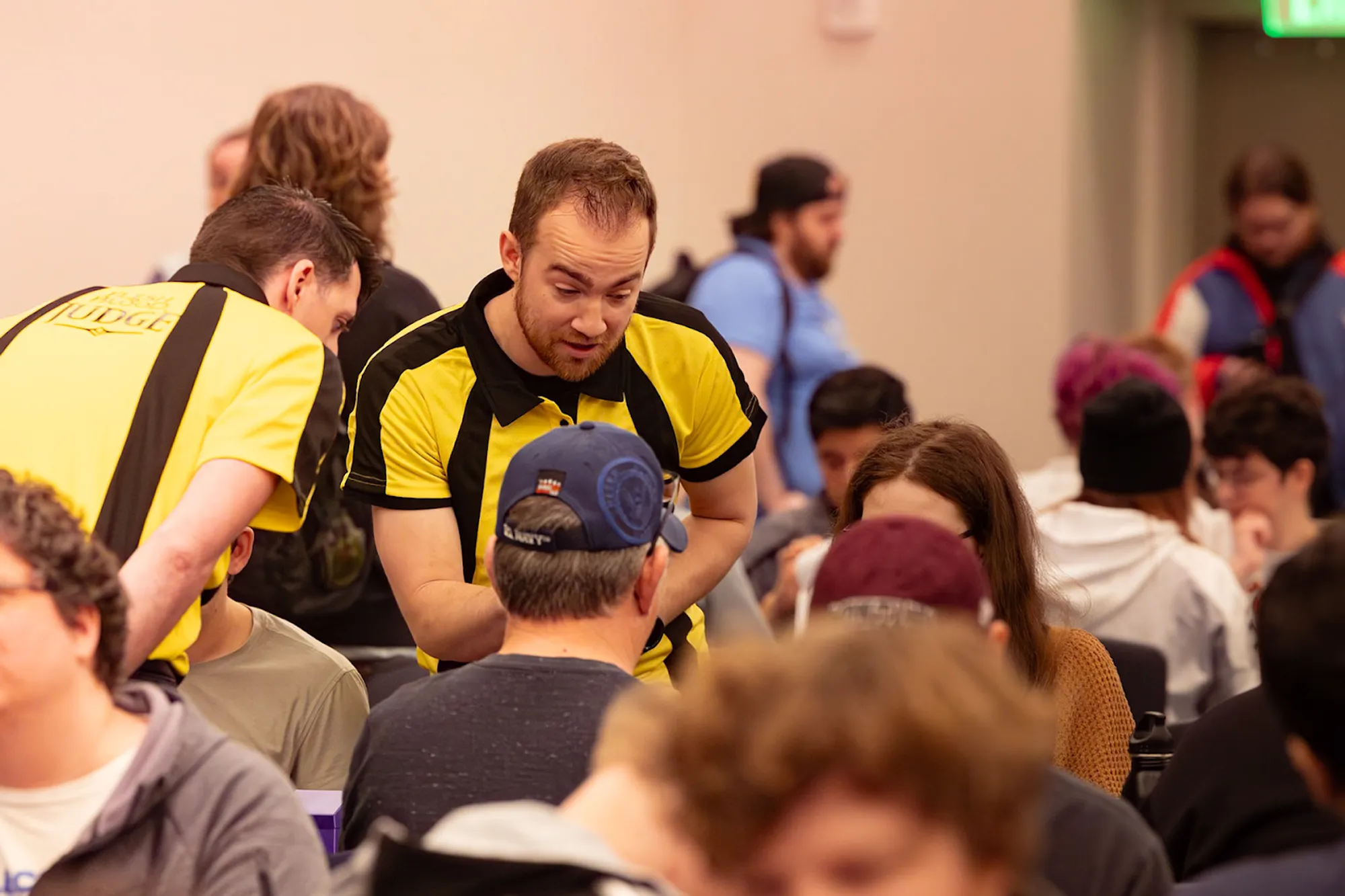
Photo © John Brian McCarthy
Keep in mind that, while everyone involved is working towards resuming the game, you will get a time extension and it is okay to take some time to ensure things are explained clearly and accurately. It is never helpful to talk over your opponent or the judge. It is common for judges to explain the situation back to you so they can be confident that they understand the state of the game and the question asked before issuing a ruling. Listen carefully and correct their understanding if needed.
At many tier 3 and 4 events, judges are advised to double check their rulings with another judge, even if they are 95% sure that they are correct. A correct call is always worth the extra few minutes it can take to verify the ruling. If your judge excuses themselves from your table to speak with another judge about your question, try not to assume that it means they are uninformed or lacking confidence.
Getting an Answer
When the judge has determined the correct course of action, they will explain it to you. For rules questions, this will often be a simple “yes” or “no”, but for gameplay errors, the process is more in-depth. If the gamestate needs to be fixed, the judge will explain what the procedure is to reach the most accurate gamestate before the players start doing anything. It can be tempting to “follow along” with the procedure as the judge explains it (such as moving cards to different zones, revealing cards, etc.), but it is important to wait until you’ve heard the full ruling before making any changes to the game. This is in part because both players have the right to appeal any ruling they receive, and if the ruling gets appealed then there is no reason to carry out the procedure until the Head Judge has weighed in. Waiting until you know the whole ruling also gives you and your opponent time to ask questions about any part of the procedure that is unclear or confusing. You are always free to ask your judge questions, and it is highly encouraged that you do so. One of the goals of judges is to educate, so your judge will be happy to explain how they reached their conclusion.
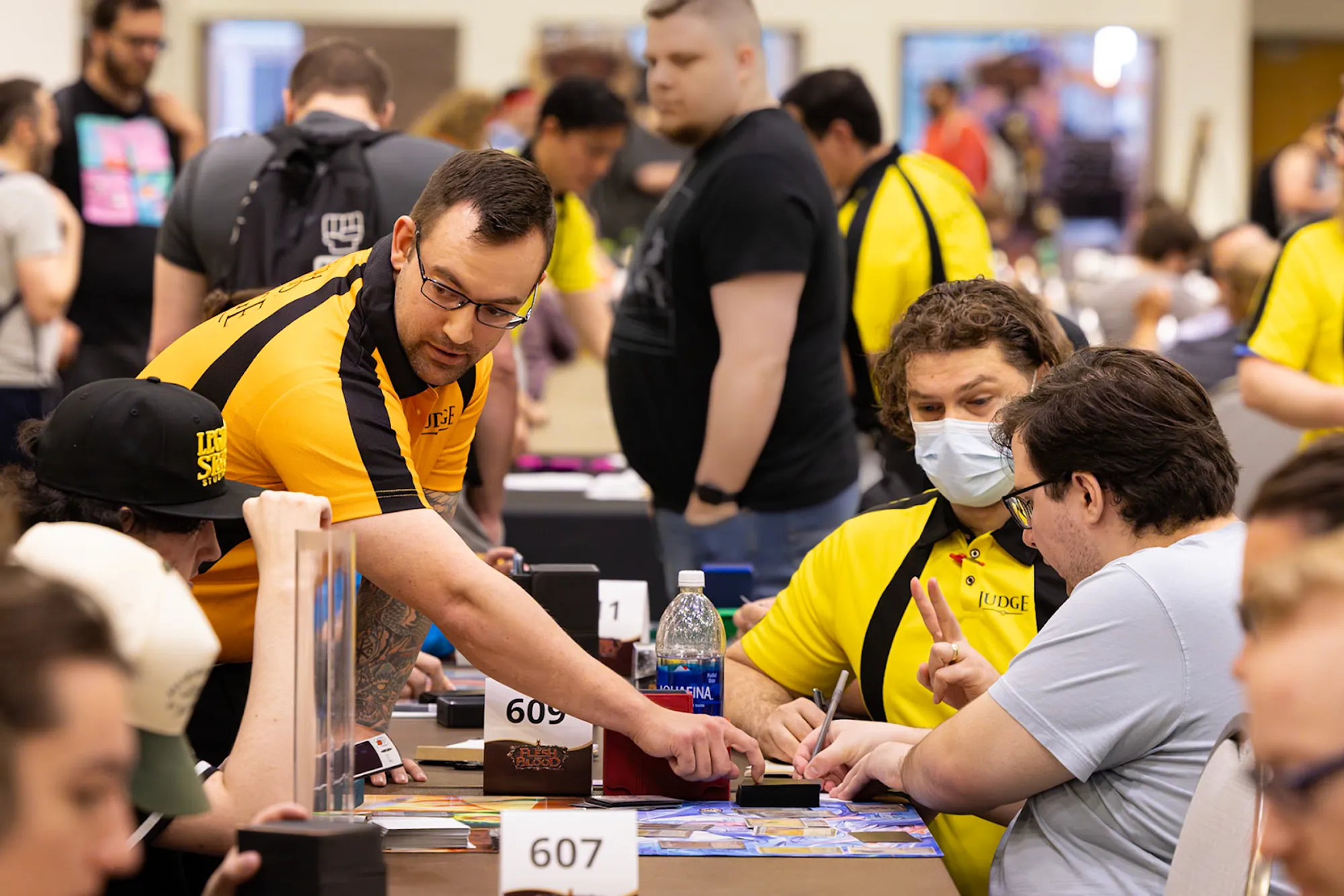
Photo © John Brian McCarthy
A player cannot appeal a ruling before the judge has finished explaining what their ruling is. This may seem intuitive, but it can be easy to jump to conclusions in the heat of the moment and try to request an appeal too quickly. Doing so is in and of itself a penalty (Unsporting Conduct - Minor) and will not help your situation. When the judge who is taking your call has finished explaining their ruling, you are welcome to ask to appeal. The judge will consult with the Head Judge, the Head Judge will speak with you and assess your situation, and decide how to proceed. The Head Judge will either uphold or overturn the initial ruling. The Head Judge’s ruling is final, meaning you cannot appeal again once they have reached a conclusion. Once the final ruling is reached, the procedure is carried out, a time extension is issued, and the game is resumed.
Closing Remarks
Calling over a judge can be intimidating or awkward, but it is important to know that judges are there to be a resource to players and to the tournament as a whole. You and the judges have the same goal in mind: that great games of Flesh and Blood get played and that people get to enjoy a day spent with their community.
Still have questions? Feel free to get in touch! I want to be featuring topics that are relevant to the interests and education of the FAB community. I would love to hear any questions that you would like to have answered in future articles. Submit your questions to info@arcanegamesandevents.com with the subject line: “Judge Question” or ask me directly at an event and I’ll get you the answer you need.