While I was busy finishing a respectable 3-3 at the April Los Angeles AGE Open the weekend of April 17, the best in Flesh and Blood were competing in Pro Tour: Yokohama. The Pro Tour would give us 10 swiss rounds of Classic Constructed and 6 rounds of FAB’s newest format, Silver Age (or SAGE).
PT Yokohama was the first Tier 4 event to feature SAGE. As card game players know, formats have a tendency to become “solved” once the incentives line up for the best players in the world. Would our brightest find a new, unexplored best deck (like, Florian, maybe)? Or would they fall back on the decks that consistently provide the best rate (like Kayo or Briar)? Before we could get into the weeds of FAB’s newest format, we were treated to five rounds of FAB’s ol’ reliable—Classic Constructed.
DAY ONE
We have existed in this current Classic Constructed metagame relatively undisturbed for some time now. Most were expecting two decks to show up in the largest numbers: Arakni, Marionette (“Mario”) and Oscilio, Constella Intelligence.
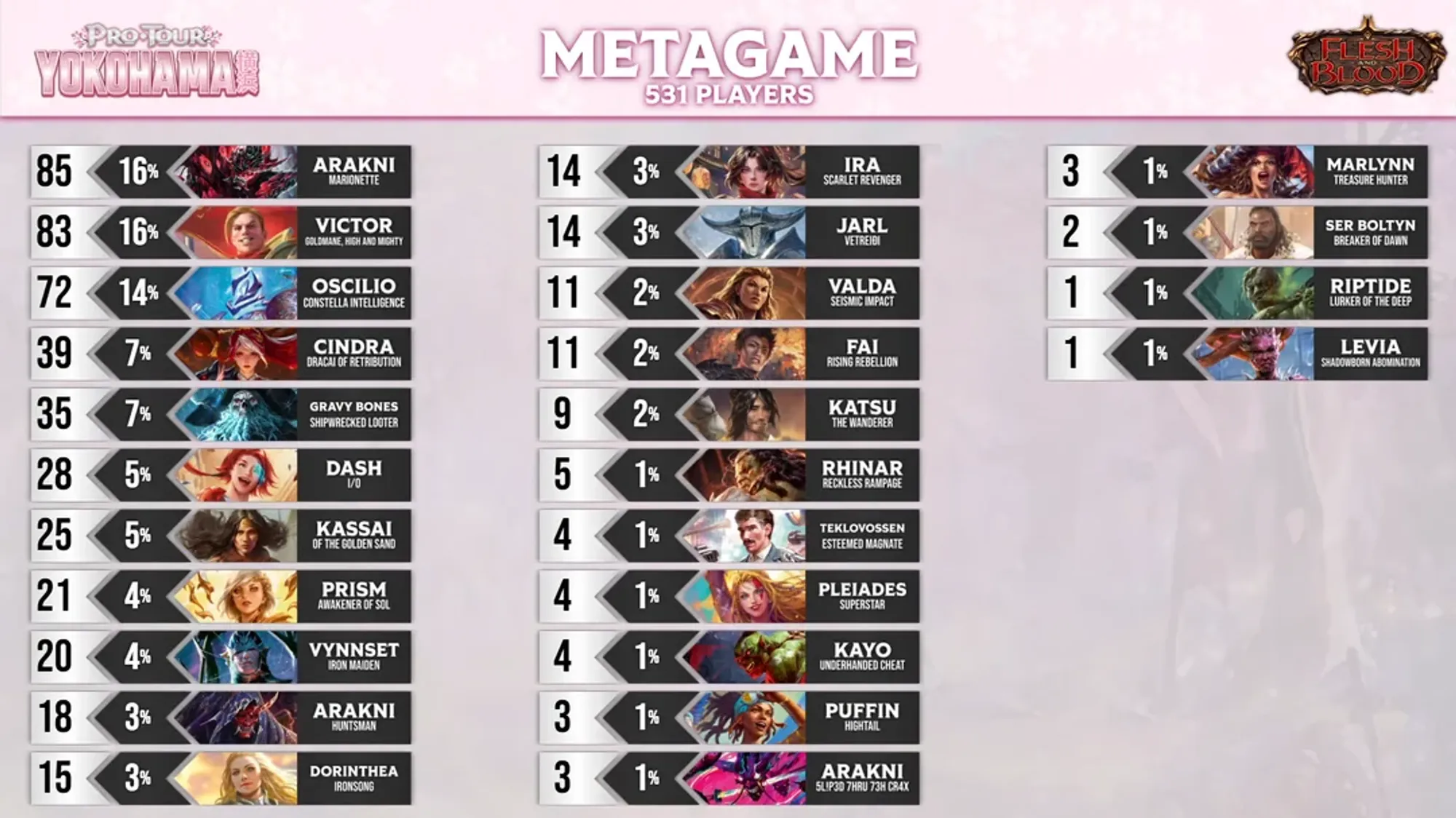
Interestingly, however, Victor Goldmane, High and Mighty toppled Oscilio to become the second-most represented deck in the field, behind only Mario. While this was surprising to some, I felt that Victor was very well-positioned in a post-Verdance metagame, and at least 83 Pro Tour attendees agreed, including teammate Wesley Dong. Wesley recently took the faux-five intelligence Guardian to a Top 16 finish at Calling: Memphis.
Victor aside, the top of the metagame share did not upset any major expectations. Cindra, Dracai of Retribution, Gravy Bones, Shipwrecked Looter, Dash I/O, and Kassai of the Golden Sand are all to be expected when competing for the game’s highest honors. Yet, there was still plenty of room for the specialists and moon shooters in the depths of the least-represented decks to provide a shock to the metagame’s system—your Eugene C’s of the world, if you will. More on that later.
Round 1
Round 1 gave us an immediate peak at Victor, in the capable hands of former Pro Tour winner Shirui Wu. His opponent, Masaru Yoshizawa on Vynnset, needed something special to win. According to our friends at Fablazing, this proved to be a favorable matchup for Victor, as the golden guardian won 65% of these encounters across the entire Pro Tour. Fortunately for Masaru, this was one of the 35%. While Shirui’s Victor was able to present lots of damage early on (even forcing Masaru to utilize Face Purgatory early to play around a potential Pummel), Masaru set himself up beautifully at a 25 life deficit and rode his momentum to victory.
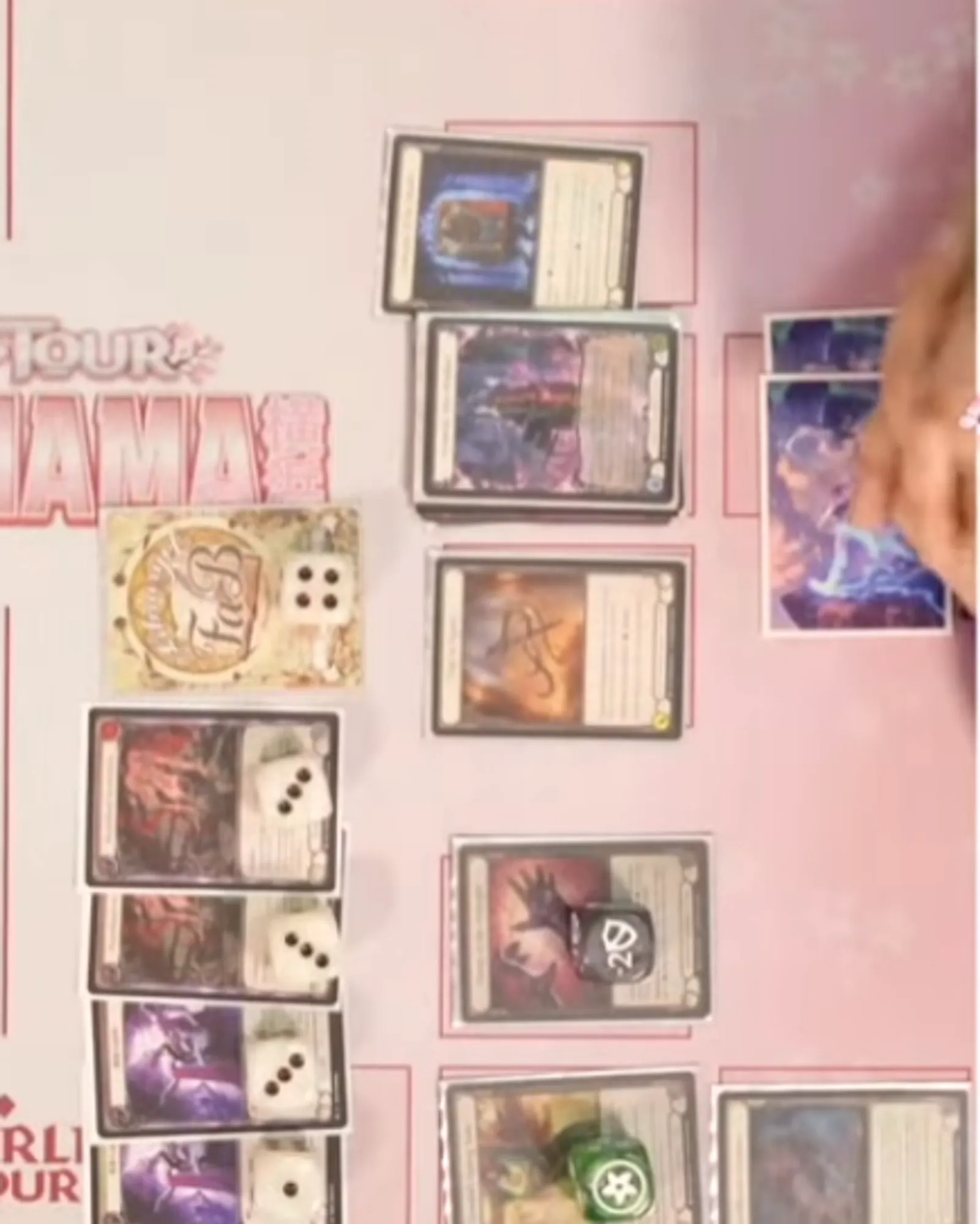
My biggest takeaway: Shirui Wu appears to have brought Pokemon sleeves to the Pro Tour. In my experience, these sleeves cut your hands more frequently than you can cut your deck, but who am I to question a champion?
Round 4
Round 4 brought the first Pirate on stream. It was not Gravy Bones, but rather Guntekin Koc’s Puffin, Hightail against Liam Bennett on Prism, Awakener of Sol. Funny enough, Puffin boasted the best win-rate of the Pro Tour, going 11-7 (61%) across the tournament. Guntekin opted for a Pirate Puffin list, which seeks to live the dream of Pummel’ing a Conqueror of the High Seas and Palantir Aeronought. On first blush, I would think this is a Puffin-favored matchup for two primary reasons. First, Pirate Puffin is almost guaranteed to play at least 15 poppers (Cogwerx Zeppelin, Command and Conquer, Conqueror of the High Seas, Palantir Aeronaught, and Golden Skywarden). Worse yet, 6 of those will be 7-power poppers. Second, while Puffin lacks the Action Point generation of some other Mechanologists (Cog in the Machine aside), she still has access to an essentially free weapon activation, making clearing of Spectra auras an easy task. Guntekin’s Puffin operated smoothly throughout this whole game, as he was able to trigger Puffin’s ability each turn. Despite his deck’s density of poppers, he never had to use one, instead pressuring Liam’s life total all game until the Prism player was forced to play Arclight Sentinel at 1 life just to buy some time. Notably: Guntekin chose to activate his Balance of Justice immediately after Liam drew two cards from Suraya, and our Puffin player was immediately punished by the Arclight Sentinel, essentially losing Guntekin the entire value of the drawn card. Ultimately, it was all for nought, as Guntekin’s fully-powered Palantir Aeronought swiftly ended the game.
Silver Age Debut
After five rounds of CC, we finally reached the SAGE portion of the tournament. While CC is (and probably always will be) the marquee format of our game, I was thrilled to find out how the best players in our game would innovate upon such an immature format. Right off the bat, the metagame breakdown revealed a huge surprise:
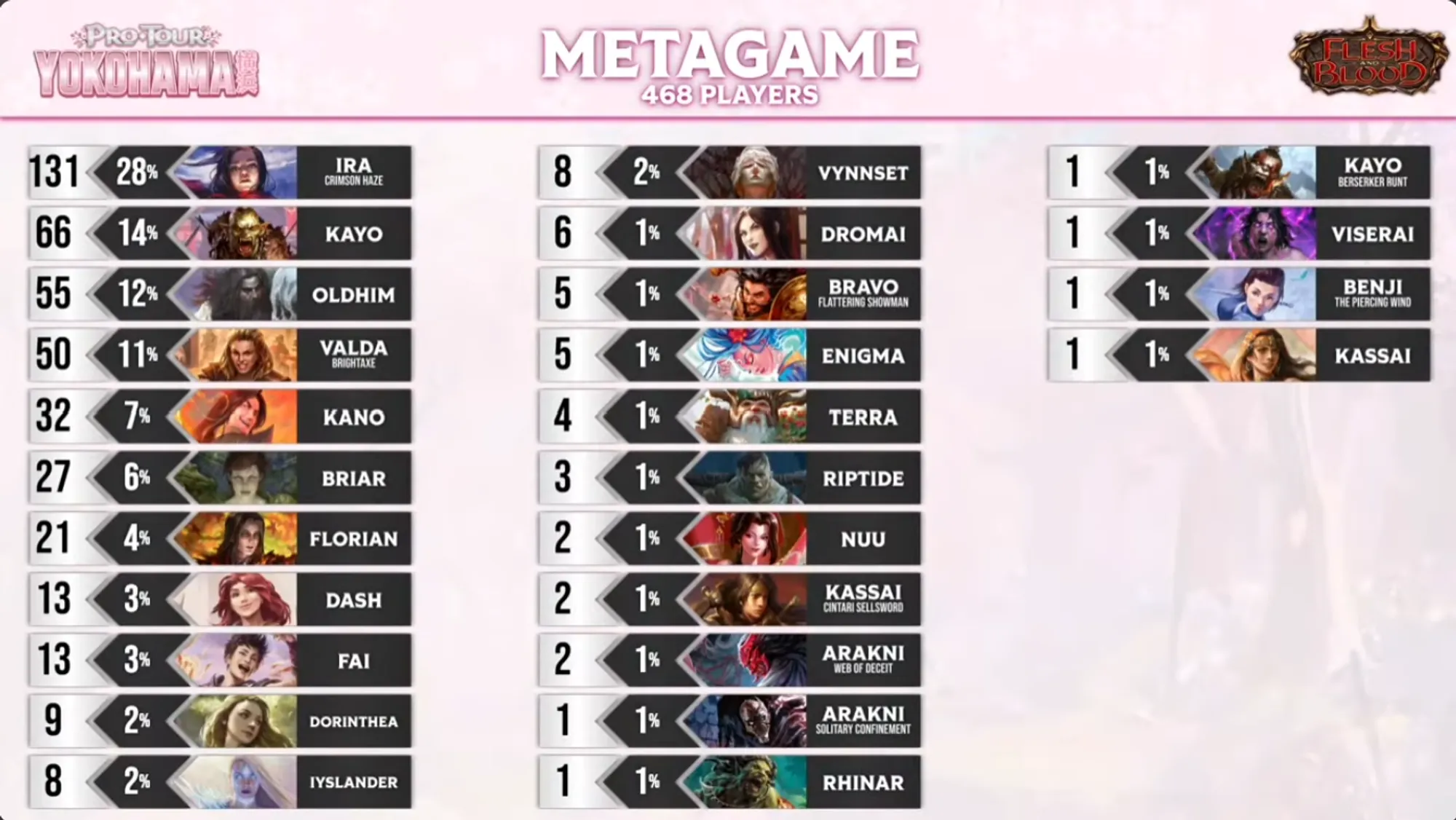
While there was much dialogue going into the Pro Tour that SAGE was a Kayo vs. the world format, Kayo wasn’t even the most represented deck. Instead, Ira, recently piloted to a Sunday Showdown victory by Shoma Yamamura, was the most selected option. I suspect this was, at least in part, due to the public perception that Ira had a favorable Kayo matchup. This ended up being technically true, as Ira boasted a slightly-above 50% winrate into the metagame-defining Brute across the tournament. Despite her popularity, Ira was not featured at any point during the Pro Tour.
Round 7a
Instead, we immediately got to see the perceived boogeyman, Kayo (Matthew Harris), into the perceived #1 boogeyman slayer, Valda (Brodie Spurlock). While Matthew was able to set up a Pummel in arsenal on Turn 0, Brodie skilled into a Boulder Drop + Pummel on his very first turn. A Guardian opponent leading on a disruptive attack Turn 0 (with Pummel represented) always presents an interesting question. As I see it, a Kayo has three choices: (1) blocking exactly (usually either with two equipment or one card from hand + equipment) to avoid the disruption; (2) presuming the opponent has a pummel and no-blocking; or (3) blocking with two cards from hand. If you go with Option 1, and they don’t have the Pummel, you are richly rewarded with an efficient block. If they do, though, then you have wasted precious equipment block to no gain, as you are forced to effectively discard two cards anyway. If you go with Option 2, and they don’t have the Pummel, you look very silly, as you took on easily avoidable disruption. If they do have it (and choose to use it, instead of going to arsenal), then you are signing up for a truck load of damage, but you’ve also kept the maximum number of cards in hand (in the case of Boulder Drop, two). If you go with Option 3, however, and max block, then a resulting Pummel will take away the rest of your hand, but you would be saving the most life, while simultaneously surrendering tempo to the other player (or making it incumbent on them to use all of their remaining cards). Unfortunately for Matthew, the decision was essentially made for him, as his hand contained two red Bare Fangs (which do not block). While this is Kayo’s strongest card on rate, here, it meant blocking with even a single card from hand would render Matthew’s turn inert following the Pummel / Boulder Drop combo. Matthew sensibly opted to min block with just equipment, meaning Brodie’s follow-up Pummel stripped two cards and left Matthew able to follow up with a Bare Fangs. A few turns later, Brodie won this game in much the same way it started: a devastating Pummel.
Round 7b
Round 7’s second match introduced one of my favorite players/people in the game—teammate Colin Eriksen on Arakni, Solitary Confinement (“ASC”). He is the only person bold enough to have brought the young Slippy to the Pro Tour. How did Colin end up choosing this deck? Late last year, AGE Pro Team founder Justin Liwag started playing around with what he called an “ultra consistent” version of the deck, playing Stealth 0 for 3s with an on-hit (like Infect) and efficient 0 for 4s (like Fleece the Frail), all of which block 3. He also added a couple of 1-cost attack reactions (Spike with Bloodrot, Two Sides to the Blade, and Razor Reflex) to give some of that evasive damage Assassins are known for in Classic Constructed. Unfortunately for Justin, he was trying to play fair Flesh and Blood at a time when Chane was still legal and Briar was fully-powered. On top of that, the deck lacked a consistent way to get past Guardian fatigue. Colin refined and updated that list in a post-Chane and OP Briar world, eventually settling on this ASC list, with which he went an impressive 4-2 in the SAGE portion of the Pro Tour. Not too shabby for a hero in a class that has largely been ignored in SAGE, with the exception of Taotao Chu’s performance on Nuu at Calling: San Diego.
Ben Dodd’s Fai list was also inventive. While most Fais opt for the recurring and significant damage from Searing Emberblade, Ben decided to play one Kunai of Retribution and one Bloodied Oval. The Kunai seems to exist solely to be utilized with the resource generated from Blood Scent to get one “free” Draconic chain starter per game, while playing an otherwise mostly redline list. This was a short game, and each deck really got to do its “thing.” I’m obviously biased, but I think Colin played this match pretty close to perfect. Perhaps my favorite play was when Colin allowed himself to go down to 1 to effectively nullify Ben’s to-that-point unused Bloodied Oval block. Paired with the fact that Ben popped his Tiger equipment early (for just their offensive value), meant Ben only got 1 total block out of his entire equipment suite.
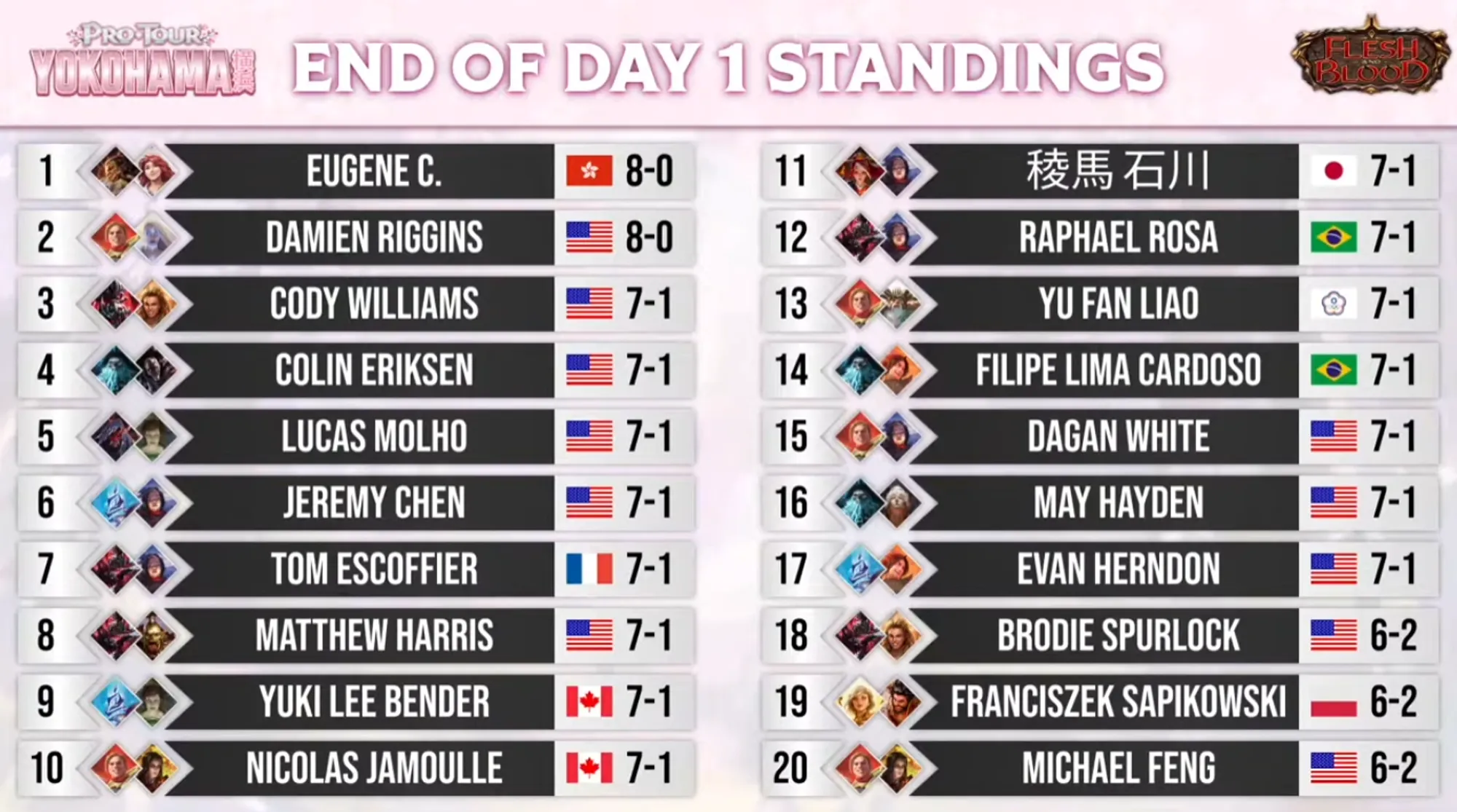
Just two players survived the gauntlet of the first day with a perfect 8-0 record. The first we witnessed bully two Valdas into submission on stream, as The Card Guyz’s fatigue aficionado Damien Riggins perfectly piloted Victor and Iyslander. The other was the well-known and even more well loved Eugene C, playing Dash and, as expected, Rhinar. Several notable players were just a shade off perfect, finishing the day at 7-1: the Runaways’ Cody Williams, Team AGE’s Colin Eriksen, Lucas Malho, Team Invasion’s Yuki Lee Bender, Team Sigil’s Filipe Lima Cardoso, and Team PCG’s Evan Herndon.
DAY TWO
Round 9
Round 9 featured a player we saw a lot of in Day One: Cody Williams on Valda. Cody found himself up against another crowd favorite in Team Invasion’s Yuki Lee Bender on Briar. Cody seemed to commit himself early to the fatigue gameplan—sort of like a worse version of Oldhim. But even a worse version of Oldhim is an effective tool against Briar, who, despite the hero’s unmatched offensive upside, can be extremely vulnerable to fatigue. Like Chris Iaali had done at Calling: Shanghai, Yuki chose to rely on Harness Lightning as a tool to push a bit of extra damage into fatigue-oriented matchups. Unlike Chris, however, Yuki chose to play not just one, but two of the tall arcane spell. Yuki opened the game on a massive first turn, threatening 21 damage with just four cards. She was able to keep this momentum over the next few turns, prompting commentator Brian Gottlieb to remark that “everything [was] coming up Yuki.” Despite these spike turns from Yuki (paired with her usual high level play), this game was still extremely close. Yuki ultimately won with no cards left in her deck, which I think is a testament to (1) how difficult it is for Briar to get over fatigue and (2) how well Cody enacted his gameplan.
Round 12
While Round 12 was a re-introduction of Classic Constructed, it was a debut for Teklovossen, Esteemed Magnate. Teklo presents a pickle for Dash I/O. This is because Teklo can be played in a hyper-defensive, control variant (as championed by teammate Evan Bridges) or a more aggressive Boost-oriented version. But no such Boost-oriented Teklo decklist had ever broken through at a top event. That is, until Chanon Puttaree arrived in Yokohama. Assuming Sam Sutherland had not scouted Chanon’s decklist, Sam had to make a tough choice in the dark: (1) plan for a control, fatigue-y Teklo and just try to race if you guess wrong; or (2) hedge for an aggressive Teklo, but keep in a small amount of anti-fatigue tools. Sam went with the first option and, given the metagame at the time, I totally agree: playing against a control Teklo without Dash I/O’s full anti-fatigue suite is a harrowing proposition. And, even with the fatigue package, Dash still has a decent chance to out-race an aggressive Teklo.
Unfortunately for Sam, Chanon’s boost Teklo deck was singing. Chanon boosted multiple Evos, pressing offensive pressure while netting defensive value on the back end. Meanwhile, Sam’s deck seemed to punish him for hedging, as Sam likely wished his Prismatic Lens’s were just about any other card in the deck every time he drew them. A late game Demolition Protocol essentially destroying Sam’s Cerebellum Processor was the icing on top for Chanon, one of our breakout stars of this Pro Tour.
Round 14a
Evan Herndon returned to the stream in Round 14, but this time with his CC hero, Oscilio. His opponent was Team Sigil’s Filipe Lima Cardoso, winner 0f 2024’s Battle Hardened: Sao Paulo and a pillar of the game’s exuberant Brazilian community. Unfortunately for Filipe, his hero, Gravy, has an extremely difficult matchup against Oscilio. To Filipe’s credit, though, he managed to defeat the only Oscilio he had faced in the tournament, albeit all the way back in Round One. Still, I view this matchup as very much the Oscilio’s to lose (or the Gravy’s to luck into). Unfortunately to Felipe, a few early, clumped up Conqueror of the High Seas and a far-too-late Amulet of Echoes was not quite what he needed to halt Evan’s hot streak.
Round 14b
Round 14 also provided Nicolas Jamoulle’s Victor against Bartosz Dobrowolski’s Mario. Bartosz reached an impressive 11-2 record up to this point despite the fact that this was his first ever Pro Tour event. Nicolas and Bartosz each played this game at a very high level, and if you are looking to improve your familiarity with this matchup on either side, I would recommend watching this match in full. In the end, Nicolas sealed the victory with evasive damage from The Golden Son.
Round 15
Round 15 was a real treat: two high-profile players in a win-and-in to Top 8 of the Pro Tour. And, despite doing well throughout the entire tournament, neither had been featured on stream thus far. Flesh and Blood’s first World Champion, Michael Hamilton brought the tournament’s third most represented deck, Oscilio. His opponent: Table One’s Max Klein, runner-up at 2024’s Pro Tour: Los Angeles on Victor, the second most-represented deck. Max’s Victor list was heavily slanted toward fatigue. Appearing to recognize this, Michael played thoughtfully and deliberately throughout the entire match. Pardon the sports analogy, but I think of fatigue strategies in FAB sort of like the New England Patriots in the 2000’s: I do not like them and I actively root against them, but I appreciate the flavor they add to the game. To see one of the best players in our game in Michael Hamilton expertly navigate his deck into a fatigue gameplan is a treat for the real FAB sickos.
The Final Round
The final round of Swiss was yet another win-and-in. Damien Riggins was 9-0 to start, but went 2-3 in his last five rounds, putting him in a need-to-win position going into the last round. His opponent was the standout Teklovossen player of the tournament, Chanon Puttaree. Like Max Klein, Damien brought a fatigue-oriented version of Victor to the Pro Tour. Unfortunately for Damien, Teklo is one of the best available deck choices into a fatigue strategy, as the Mechanologist hero can mostly just bide his time while setting up Evo equipment, culminating in massive damage once he has resolved Singularity. And Chanon did exactly that, carefully adding material on top of his equipment slots before resolving the Teklo specialization on Turn 25 of the game. While Damien was still at a healthy 35 life at that point, Chanon’s Mechropotent disruption and damage meant that it was Damien, and not Chanon, who was fatigued to the end the game.
Day 3: TOP 8
With Swiss now concluded, we had our Top 8:
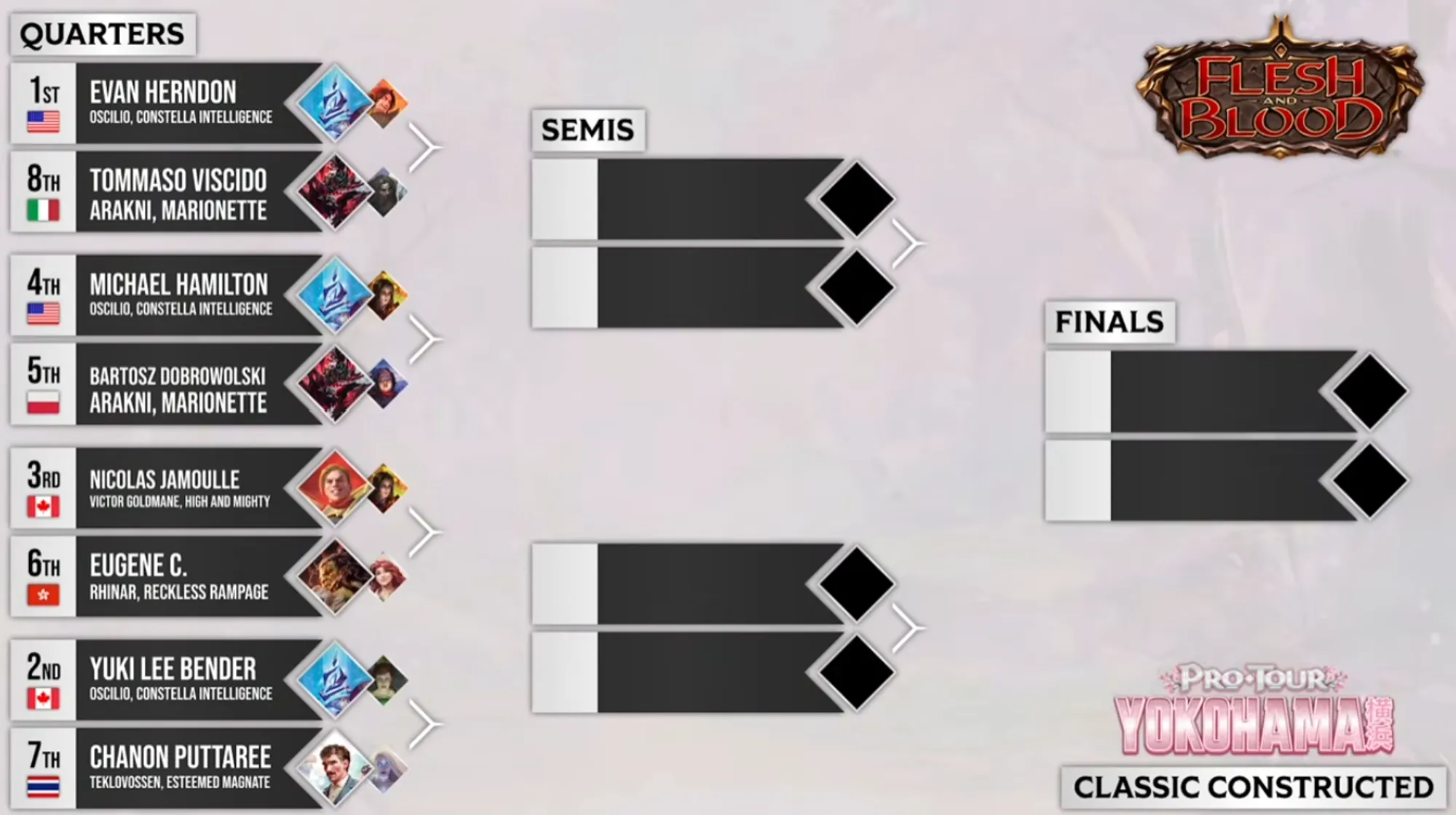
- Evan Herndon 14-2 (Oscilio [9-1] and Kano [5-1])
- Yuki Lee Bender 13-3 (Oscilio [7-3] and Briar [6-0])
- Nicolas Jamouille 13-2-1 (Victor [8-1-1] and Florian [5-1])
- Michael Hamilton 13-3 (Oscilio [8-2] and Florian [5-1])
- Bartosz Dobrowolski 13-3 (Mario [7-3] and Ira [6-0])
- Eugene C 13-3 (Rhinar [9-1] and Dash [4-2])
- Chanon Puttaree (Teklo [7-3] and Iyslander [6-0])
- Tommaso Viscido 13-3 ([Mario [8-2] and Oldhim [5-1])
QF1: #1 Evan Herndon (Oscilio) vs. #8 Tommaso Viscido (Mario)
Pankaj mentioned very early on in this game the perceived #1 seed “curse”—that is, the common perception (or, perhaps, anecdotal understanding) that #1 seeds at big FAB tournaments tend to lose the moment they reach the Top 8. An Amulet of Echoes in Tommaso’s opening hand seemed to suggest that Evan could be heading for Cursetown. After sending an offensive onslaught (sending Evan down to just 21 life), Tommaso ended his first turn with the Amulet. Evan’s second turn provided Tommaso his first chance to activate Amulet of Echoes, as Evan played a Gone in a Flash (given Go Again with an Embodiment of Lightning), bounced the GIAF with an Electrostatic Discharge, and re-played the GIAF. Tommaso responded with an immediate activation of the Amulet (in the Layer Step, before GIAF was on the chain link and could be bounced). Evan’s response? Play out all three cards in his hand (Sigil of Lightning, Sigil of Brilliance, and Sigil of Aether).
Evan’s Turn 3 was the “big” turn, as the 2024 U.S. National Champion started by activating both his Aether Bindings of the Third Age and Lightning Greaves, with Tommaso at 17 life. Evan’s first attack for the turn was a Blast to Oblivion. Importantly, however, Evan was marked. That means that, by blocking with Mask of Deceit, Tommaso may choose to transform to whichever of Arakni’s Agents of Chaos best fits his gameplan. Tommaso spent some time thumbing his Mask, before deciding to simply block with a card from hand and his Fyendal’s Spring Tunic. Evan’s follow up was an amped Etchings of Arcana, which leaked 9 damage and allowed Evan to recur Sigil of Brilliance. After Evan followed up with another Blast to Oblivion, Tommaso was placed in the same position as before: whether or not to block with the Mask of Deceit and, if so, which Agent to transform into. I see only two viable choices in this spot: (1) Arakni, Black Widow, Tommaso’s most disruptive option on offense; or (2) Arakni, Trap Door, which would provide Tommaso with at least 3 extra blocking value on defense. After Tommaso blocked with the Mask, he chose the first option, and transformed into his most offensively potent threat. Unfortunately for Tommaso, Evan’s top deck from the Sigil of Brilliance draw was Gone in a Flash, which allowed Evan to attack for 4 two more times, forcing Tommaso to block with all but 1 of his cards in hand and Flick Knives, going down to 4 life. Evan’s next turn was able to muster a Shock for 6, ending Tommaso’s tournament run.
QF2: #4 Michael Hamilton (Oscilio) vs. #5 Bartosz Dobrowolski (Mario)
If Bartosz wanted to keep his Cinderella first PT run alive, he would have to defeat Flesh and Blood’s first ever World Champion, Michael Hamilton. This game was the very first time a Temporal Wobble had ever been played on an LSS streamed game. On his Turn 2, Bartosz started with a Cut From the Same Cloth. While commentator Sam O’Byrne immediately noted the Temporal Wobble in Michael’s hand, co-commentator Hayden Dale was quick to point out that Cut is perhaps not sufficient enough “value” from an Oscilio player’s perspective to warrant the counterspell. (As we will soon find out, Hayden is dead on, but what does that say about the value proposition of an Oscilio hand?) Michael chose to play the Temporal Wobble, fizzling the Cut. Bartosz immediately followed up with a Savor Bloodshed, punishing Michael’s early use of his counterspell. Like Cut From the Same Cloth, Savor Bloodshed is a 4 power buff, but with the added benefit of (essentially) guaranteeing an extra card drawn for Bartosz. So, by playing his Temporal Wobble too early, Michael got just 4 value, when he could have gotten 7.
After two more turns of action, Michael (at 4 life) was able to get Bartosz down to just 1 life. Crucially, however, Bartosz had already used his Stalker Steps, meaning that he had no Arcane Barrier. Therefore, absent any unforeseen trickery, Michael would win the game the moment he drew a Shock (or any other action-speed arcane spell, assuming he survives to his own turn). Michael’s first hand drawn (post-Oscilio activation) after taking Bartosz to 1 was as follows: two Etchings of Arcana, Entwine Lightning, and Sigil of Solace. No Shock yet. Bartosz attacked with a Kiss of Death for 7, but with a Scar Tissue in hand, representing a total of 11 damage. Michael, at just 4 life, and having already activated Oscilio for the turn, was forced to block with the three cards in his hand that have a value in the bottom right corner. When Bartosz threatened lethal damage over the three blocks, Michael was forced to play out Sigil of Solace, dwindling down to just 2 life.
At the start of Michael’s next turn, he drew off a Sigil of Brilliance leaving the field, and found a Temporal Wobble. Michael cycled the instant with Oscilio’s ability, but found another Sigil of Brilliance. Still no Shock. Michael passed, and drew up his next four cards: Channel Lightning Valley, two Blink, and Mind Warp. When Bartosz attacked with a Graphene Chelicera (with Go Again, due to Michael’s Mark), Michael activated Oscilio, ditching one of his Blink. He found a Gone in a Flash. Still no Shock. Worse yet, Michael’s hand only blocked 6 in total. Michael blocked just 3, and Bartosz pumped the dagger up to 7. The game was over. In total, Michael was able to dig 11 cards deep to try and find a Shock once Bartosz went down to 1 life, but could not get there.
QF3: #2 Yuki Lee Bender (Oscilio) vs. #7 Chanon Puttaree (Teklovossen)
Our third Quarterfinal game, our third Oscilio match. On his first turn, Channon was able to go three Boost attacks wide, finishing on a Pulsewave Harpoon. Yuki’s immediate response is intriguing: she quickly puts a Gone in a Flash down (face up, so Chanon can see the card), before picking it back up, and then putting down three cards: the aforementioned Gone in a Flash, Consign to Cosmos // Shock, and Channel Lightning Valley. Only the first two are legal targets for Pulsewave Harpoon’s effect. This presents Channon with an interesting question. Which of the other two cards are more important to Yuki’s next turn? Typically, Gone in a Flash is a key ingredient to some of Oscilio’s largest turns, but, if it were really so necessary, why would Yuki put it at risk by showing it to Pulsewave Harpoon’s effect? And why would it be the first card Yuki put down? Of course, with a player of Yuki’s caliber, that could have been a sly trick, designed to induce Chanon into thinking the GIAF was not needed when, in fact, it was. Chanon ultimately chose to force the block of the Consign to Cosmos // Shock and Yuki proved that was the right call, as she blocked with Flash of Brilliance, discarding the Gone in a Flash anyway.
On Chanon’s next turn, he played Evo Recall in his head slot. This is good news and bad news for our Teklo player. The good: Chanon now has access to equipment with Arcane Barrier that will remain on the field. The bad: well, the Evo Recall will remain. Since Evo Recall is not a piece of Base equipment, no further Evos may be played on top of it, rendering many of the cards in Chanon’s deck effectively textless. But Chanon’s equipping of the Evo Recall had two other important consequences. First, since Chanon transformed his head slot from Evo Steel Soul Memory, his hero would go up to five intellect until the end of the turn. Second, due to Evo Recall’s effect, Chanon placed a War Machine from his banished zone on top of his deck. After triggering a draw from Teklo’s hero ability, Chanon draws that War Machine and tucked it into his arsenal for the next turn.
Yuki’s subsequent turn was relatively small. Perhaps figuring that the math was not ideal for pushing damage when Chanon had five cards in hand, Yuki opted only to play Gone in a Flash and two Sigils of Brilliance. While this turn was small, her next turn had the potential to be an effective 7-card hand. Also, knowing Chanon had access to War Machine, Yuki chose to arsenal Channel Lightning Valley, which may be played in response to War Machine’s trigger. On his turn, Chanon activated Teklo’s ability to draw a card and found Terminator Tank, the best disruptive card available to him. Yuki chose to simply take the damage and disruption, discarding one card, but with access to 6 more on her next turn.
Turn 3 for Yuki was finally time to pop off. Yuki started by breaking both of her key pieces of combo equipment, Lightning Greaves and Aether Bindings of the Third Age, and ended the turn ahead 25-16, with all but one card gone from Chanon’s hand. With only AB1 accessible (via Evo Recall), Chanon was extremely vulnerable to amped arcane spells, which ultimately ended the game a couple of turns later.
QF4: #3 Nicolas Jamoulle (Victor) vs. #6 Eugene C (Rhinar)
Despite being the 6th seed, Eugene C matched Evan Herndon as the only players to drop just one game in the CC portion of the Pro Tour. So, in terms of the format that would be played in Top 8, Eugene C was actually one of the hottest players in the entire tournament. And Eugene carved this path by feasting on Victors, defeating four throughout the tournament. Eugene’s success makes sense; Victor is a deck that requires blocking to generate full value (i.e., by netting an effective 7 value from Test of Strength) and Rhinar’s Intimidate effects make it much more difficult to block. Additionally, to the extent the Intimidate will incentivize an opponent to keep larger hands on offense, as Brian Gottlieb mentioned during the first turn of the game, one of Victor’s weaknesses is his inability to convert such large hands (assuming the absence of the few chain extenders within the deck, such as Enlightened Strike).
As the players began the game, I immediately noticed a change in Eugene’s equipment. While Eugene had chosen to play Crown of Providence against Michael Feng’s Victor in Round 5 (and, indeed, had used it to get partially bailed out of a Command and Conquer + Pummel), against Nicolas’s Victor, Eugene opted for Scowling Fleshbag. Whether this change was the result of a change in philosophy on Eugene’s part or some knowledge he had about both decks is unclear to me. In my view, either is a defensible choice and can play around major disruption. Crown of Providence bails Eugene out of one Command and Conquer per game, whereas Scowling Flashbag theoretically insulates him from a Pummel. I say “theoretically” here because players of Nicolas’s caliber can simply plan for the Scowling Fleshbag by tucking the Pummel in arsenal.
On his turn 7, Nicolas finally played a Visit Goldmane Estate, which Eugene promptly Rippled Away, forcing Nicolas to IP one card. Then, on Eugene’s Turn 9, he finally drew and resolved a Bloodrush Bellow, while trailing 11-20. Dissatisfied with his one Bloodrush Bellow, Eugene decided to follow up with his patented special move: Sand Sketched Plan to tutor another Bloodrush Bellow and hope he does not randomly discard it. The random discard instead hit Skull Crack, generating Eugene a resource and allowing Eugene to play another copy of his power card. But before he did so, Eugene had a bit more risk in him, reaching for his Scabskin Leathers. (Notably, activating Scabskin Leathers is a bit lower risk than normal here, as Eugene is currently on two Action Points due to Sand Sketched Plan, so a roll of 1 would not just automatically end his turn.) Eugene was handsomely rewarded for his risk-seeking behavior, rolling a 6 on the die, leaving him a grand total of four action points. With only one viable Brute attack action in hand after drawing two cards from Bloodrush Bellow, Eugene uses three of his action points to attack with each of his weapons, and then Splatter Skull, pushing 25 total damage (with three Intimidates and a destroyed Intimidated card).
By the end of Eugene’s turn, Nicolas is down to 3 life and 3 total cards to use on offense. Worse yet, the two cards remaining in Nicolas’s hand are both red, forcing him to use a precious Gold to dig for a blue and send something back Eugene’s way. But the draw is yet another red. With all of the tempo and Nicolas at 3 life, Eugene was able to finish the game a couple of turns later. Eugene C’s Rhinar is now 10-1 across the entire Pro Tour.
SF1: #1 Evan Herndon (Oscilio) vs. #5 Bartosz Dobrowolski (Mario)
Evan, the higher seed, opted to go first. His hand allowed him to Amp with Volzar and send an Etchings of Arcana for 5. Bartosz, on just AB1 from the Stalker’s Steps, was able to preserve 1 life, but took 4 damage, equalizing the players’ life totals. Importantly, though, the 1-card filtering that Evan’s attack permitted allowed Bartosz to draw into an Amulet of Echoes on his first turn. Once again, Evan Herndon was going to have to beat a Mario opponent’s Turn 1 hate piece.
Bartosz started his second turn of the game with a Cut From the Same Cloth. Despite having a Temporal Wobble in hand (and the requisite number of Sigils on the field), Evan did not hesitate in permitting the Non-Attack Action to resolve. While denying himself the face-up 4 value, Evan instead put Bartosz in a position of having to respect the Temporal Wobble in the short-term future. But Evan’s Wobble-discipline would again be tested, as Bartosz followed up with an Orb-Weaver Spinneret. Unlike the first time, Evan tanked on the decision to counter this one for a bit. At face value, the Wobble would deny Bartosz 3 value and a critical Graphene Chelicera, but, as the commentators point out, Bartosz has another copy of Orb-Weaver Spinneret, so Bartosz is likely to get the needed second dagger regardless. Exercising remarkable restraint, Evan does not counter the Orb-Weaver Spinneret. Bartosz then pitches a Codex of Frailty to swing the Hunter’s Klaive, marking Evan. Once Evan is marked, Bartosz plays his second Orb-Weaver Spinneret, which Evan quickly allows to resolve. With a 6 power buff to Bartosz’s next Stealth attack, he plays the last card in his hand: Codex of Frailty. This time, Evan swiftly counters, costing Bartosz at least 9 points of value. In retrospect, I wonder if Bartosz regrets playing out the Codex and instead wishes he had pitched it to send a Graphene Chelicera for 8.
Riding the wave of his 0 for 9 play, Evan decided to utilize his Lightning Greaves on his next turn. As mentioned, Bartosz had played out an Amulet of Echoes, though, meaning that each player will have to decide how to sequence their plays and when to pop the Amulet, respectively. Evan started his turn with a Blast to Oblivion and two plays of Gone in a Flash, both of which Bartosz blocked with one card. Evan then followed up with a Mind Warp, amped up to 9, which turned Bartosz’s remaining two-card hand into a one-card hand. With the tempo fully on his side, and Bartosz down to just 9 on a one-card hand, Evan cleaned the game up two turns later.
SF2: #2 Yuki Lee Bender (Oscilio) vs. #6 Eugene C (Rhinar)
Sam O’Byrne referred to this matchup as a “champion” (Yuki) up against the “People’s Champion” (Eugene C). And that’s apt, as each of these players is beloved in their own right. At a higher level, they also represent dueling philosophies among card game players. Yuki, the consummate card game professional, is playing what many consider the best deck in the format at her usual consistently high level. Eugene, on the other hand, is playing his pet deck and shirking the metagame’s expectations. Are you better off playing the best deck or playing the deck you like best?
This game was dynamic and I changed my mind on who I thought was in the favorable position several times. Yuki consistently sent evasive damage in the form of tall arcane spells at Eugene, while Eugene was able to find the few pieces of disruption available in his deck. Most critically, Eugene found a Splatter Skull (compliments of a randomly-discarded Beast Within) while Yuki’s lone Shock was Intimidated, forcing Yuki to block with two cards from hand and Lightning Greaves, and blunting what was shaping up to be a big 6-card hand.
On Eugene’s Turn 4, with each player at 16, he once again fell back on his patented special move: using Sand Sketched Plan to tutor a Bloodrush Bellow and hope it does not get randomly discarded. Once again, Eugene was rewarded, discarding a Buckwild Y and keeping his power card. Unfortunately for Eugene, playing the Bloodrush Bellow required his last two cards in hand, meaning that the ceiling of his turn would be at the mercy of the top of his deck. He found two blues: Buckwild and Agile Windup. Not great. Thus, Eugene’s best play is to send the Beast Within in his arsenal for 8 and follow it up with a weapon attack for 6. Yuki chose to take it all, going down to just 2.
While she was at just 2 life, Yuki chose to keep her entire five-card hand for offense. Thus, if she wanted to win the game, she would likely have to put Eugene C in critical danger on this turn. She led with Gone in a Flash, signalling the Lightning Greaves activation that followed. Eugene blocked with two pieces of equipment (critically, neither of which was Scowling Fleshbag) for a total of 3, and Yuki played two Lightning Press on her Gone in a Flash, going over by 7. Her follow-up was an Etchings of Arcana for 6, taking Eugene down to just 3.
With Eugene at 3, Yuki was in a similar position to Michael Hamilton in the Quarterfinals: find 3 arcane damage at any point, and she has passage to the Finals. After activating Oscilio, her next hand finds a Sigil of Brilliance and Comet Storm // Shock, meaning that Yuki could play the Sigil, play Shock (while holding priority), and Amp with Volzar to do exactly 3 to Eugene.
The Finals: #1 Evan Herndon (Oscilio) vs. #2 Yuki Lee Bender (Oscilio)
From a character perspective, the stakes of the Finals could not have been higher. A former United States National Champion in Evan Herndon facing a former Canadian National Champion in Yuki Lee Bender, making a sort of battle of North America. On top of that, the players were formerly on the same team, which recently split into two parts (Team Invasion and Team PCG). Peak storytelling. Though, admittedly, by the time we reached the Finals, I was getting a little weary of Oscilio. And the prospect of an Oscilio mirror seemed a bit, well, underwhelming. But this game delivered.
Yuki’s second turn was the big one. She led with a Gone in a Flash and, in the damage step, popped her Lightning Greaves to kick off her combo turn. She then played her Gone in a Flash another time, bouncing it back with a Shock, before ending on a Mind Warp for 8. But Evan had the perfect answer—Temporal Wobble again generated Evan insanely above-rate value. Notably, Yuki could have played around the counter by activating Volzar to amp her Shock instead (which cannot be countered by the Wobble), but opted for the higher risk, higher reward play of an Amp’d Mind Warp.
The game crescendoed on Yuki’s fifth turn. Yuki was trailing 3-9, but had a quite developed board: 3 Sigils of Aether, all of which would pop at the beginning of her turn, and a Channel Lightning Valley. She also had two other cards remaining in hand. Importantly, however, she no longer had any access to Arcane Barrier or Spellvoid, meaning, if Evan were able to send arcane damage for 3 or more, Yuki would immediately lose unless she found a prevention effect or life gain.
Evan drew up his four card hand. He found two Lightning instants in the form of Channel Lightning Valley and Sigil of Brilliance, but no Shock to send lethal damage at Yuki on her own turn. With the first Sigil of Aether ping on the stack, Evan activated Oscilio’s ability, cycling Channel Lightning Valley and finding …. Consign to Cosmos // Shock! Now Evan has another puzzle: he can try for the win now, but, if Yuki has life gain or a prevention effect, he would be vulnerable to any follow-ups from Yuki, while at just 9 (and effectively 6) life. After some thought, Evan decided to go for it: he played Sigil of Brilliance (amping 1 on Volzar), then the potentially-lethal Shock (holding priority as another Amp registered on Volzar), and activated his lightning rod. Lethal damage was on the stack.
Yuki’s hand was Sigil of Brilliance and Consign to Cosmos // Shock. No bailouts. But Yuki could (and did) activate Oscilio for one last shot out of it. She discarded the Sigil and drew Channel Lightning Valley. Not quite what she was looking for, but she wasn’t dead yet: she played out the CLV and followed it up with a Shock, allowing her two final draws to stay alive (as she already had another CLV on the field). She drew Comet Storm // Shock and Cloud Cover! She played the Cloud Cover, theoretically completely covering up Evan’s threatened lethal damage. But she had also drawn multiple cards this turn, meaning that Evan had a priority window to draw a card from his Balance of Justice. He did so and found …. Null //Shock. With the previous Amp from Volzar still floating, Evan was able to respond to Yuki’s Cloud Cover and present exact lethal. Evan Herndon was the PT Champion!
The Five Biggest Winners of Pro Tour: Yokohama
Number 1: Evan Herndon
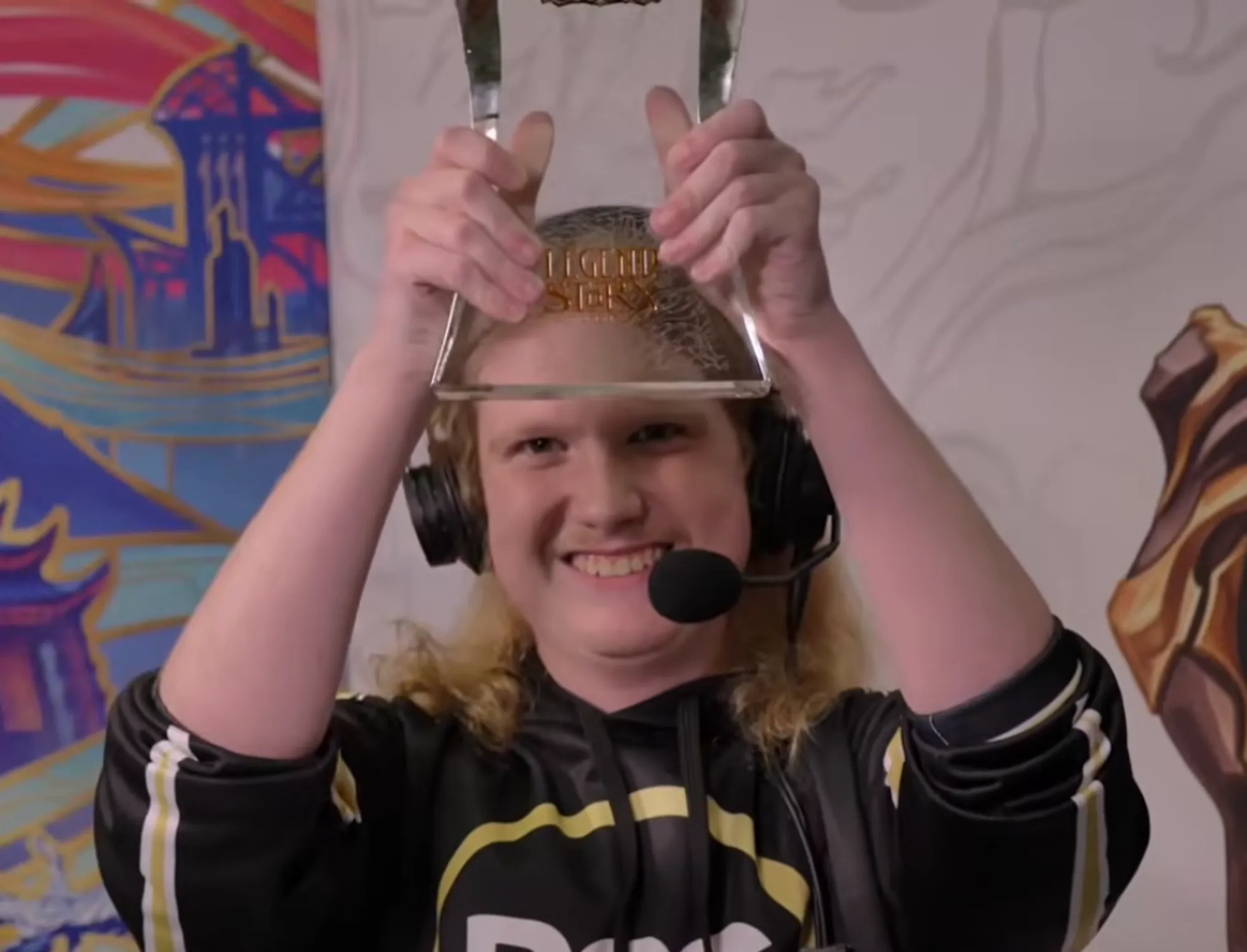
It is only fair to praise the Pro Tour’s champion with the number one spot on this illustrious list. Evan has won a lot of Flesh and Blood in his playing career, previously racking up a Calling win, Nationals win, and Nationals runner-up finish. His first Tier 4 victory will be the crown jewel in his playing resume to this point.
Evan demonstrated his skill on stream basically every chance he got. Despite previously being known for his Gravy Bones play, Evan played 400-500 games on Oscilio to prepare for this tournament. And his experience on the hero shown through multiple times. Against Filipe Lima Cardoso’s Gravy in Round 14, Evan displayed supreme comfort in the matchup, ignoring the allies Filipe was able to develop, and sending all damage straight to the face. Evan played through a Turn 1 Amulet of Echoes not once, but twice in Top 8, fading both Tommaso Viscido and Bartosz Dobrowolski’s hot starts. And, perhaps most famously, Evan showed remarkable expertise on the use of the counterspell: exercising patience and using Temporal Wobble in the most backbreaking fashion against both Bartosz and Yuki Lee Bender.
Number 2: People Fresh Off a Break Up
Look, we’ve all been there. It’s hard and it hurts. Maybe, for example, you made an ill-fated decision to attend Calling: San Diego on Valentine’s Day weekend and find yourself being as Singular as Chanon Puttaree’s Teklovossen. Sometimes you need to lie just to convince yourself that you’re better off outside of the relationship.
But the members of Team PCG and Team Invasion don’t have to lie to themselves—they are thriving in a post-Team PCG Invasion world. Five Team PCG players qualified for Day 2: Matt Rogers, Michael Jaszczur, Hayden Jeanson, Matthew Dilks, and the eventual champion, Evan Herndon. Team Invasion, similarly, boasted an impressive six players in Day 2: Victor Mercado, Peter Buddensiek, Jimmy Nguyen, Lucas Ng, Ian Zhang, and eventual runner-up Yuki Lee Bender. While it will be difficult to reach the highs of the former superteam in Team PCG Invasion, each separate component is off to a great start.
Number 3: Elemental Enjoyers
If this Pro Tour proved anything, it’s that Oscilio is likely the best deck in the current Classic Constructed metagame, at least until next month’s B&R. While the loss of Volzar and Electromagnetic Somersault will likely fundamentally alter the current iteration of Oscilio, the Lighting Wizard is almost certain to get plenty of new tools in Omens of the Third Age. (Fine: the Omens cards won’t technically be Elemental, but you get the point).
But Oscilio was not the only Elemental hero that thrived in Yokohama. Damien Riggins’ Iyslander SAGE deck went an impressive 5-1 in the Pro Tour, losing only to Colin Eriksen’s Arakni, Solitary Confinement. The deck is, in some ways, reflective of a classic “Bullander” list, combining big, efficient two card attacks (like Wounded Bull and Fyendal’s Fighting Spirit) with tall arcane spells (like Ice Bolt and Voltic Bolt). The weakness of this strategy is that they tend to have no way to fully utilize a four or five-card hand. To solve this, Damien registered efficient Go Again attacks like Scar for a Scar and Ravenous Rabble (in a list playing 21 blues, no less). Iyslander has a lot of fans in the FAB community and this list is sure to be a hit at SAGE armories everywhere.
Number 4: Purchasers of the Kayo Silver Age Deck
Going into the Pro Tour, Kayo was the de facto “best deck” of the SAGE format, as the deck has essentially suffered no bans (sorry, Sirens of Safe Harbor, you do not count), while receiving several buffs from Compendium of Rathe (like Predatory Plating and Bear Hug). Silver AGE preconstructed decks, priced at a competitive $19.90, were designed to draw new players into our game, offering a much lower barrier to entry than building a Classic Constructed deck from scratch. Therefore, a competitively-inclined new player may have been tempted to start their FAB journey with the one-handed Brute.
However, with the release of Omens of the Third Age, SAGE will go through its very first community vote. Four heroes (3 voted on by the community, 1 chosen by the developers) will all be “benched” for that competitive season. Going into the Pro Tour, I would have bet precious cardboard that Kayo would be one of those four benched heroes. Now, I am not so sure—Kayo wasn’t even the most represented deck and none of the Top 8 players were on the hero. Therefore, if you invested your hard-earned $20 into Kayo, you may still have a chance to continue playing a bit longer.
Number Five: Pet Decks (and Wearing Sunglasses Indoors)
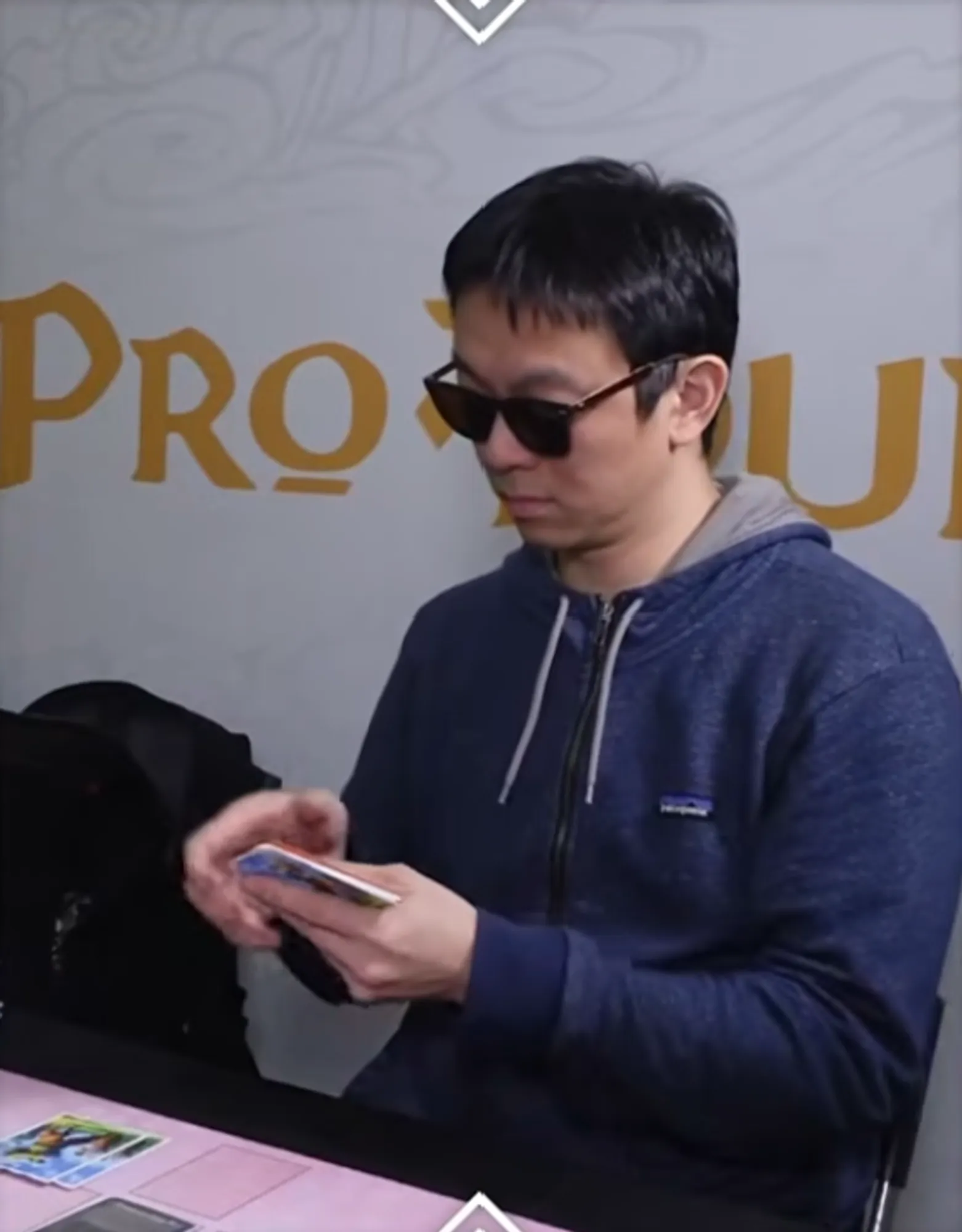
Of course, winning feels great. But winning on your pet deck feels even better. Eugene C is a legend in Flesh and Blood precisely for doing just that, taking Rhinar, Reckless Rampage to heights that no other player can match in recent history. (But special shoutout to Guilherme Coutinho for making the finals of Calling: Yokohama with Rhinar as well). As of this writing, LSS has released a deck tech with Eugene, where he explains some of the card choices in the deck in typically Eugene fashion. Pre-Pro Tour, I had not been keeping up with Rhinar decklists subsequent to the loss of Mandible Claw, but I sort of assumed the fallback would be Ravenous Meataxe. I was wrong. Instead, Eugene opted to play one copy each of Ball Breaker and Savage Claw. As commentator and podcaster Pankaj Bhojwani pointed out on the stream, with two weapons (neither of which natively have Go Again), Eugene’s deck would likely be rich with Go Again enablers. With the benefit of his decklist now available, we know exactly how many: two Aggressive Pounce R, six total Buckwild, three Pulping R, three Wild Ride R, six total Agile Windup, and, most Eugene-y, a single Blue copy of Even Bigger Than That!.
This list would also be incomplete without mention of Chanon Puttaree, the first person to ever top a Tier 4 event with Teklovossen, Esteemed Magnate. Best yet, Chanon did it on a Boost-oriented version of Teklovossen, a deck which, as far as I know, had never before experienced such mainstream success. Now that I have taken it to an armory, I can personally attest that Chanon’s inventive Teklo list is incredibly smooth. Against control or midrange decks, the list relies on the traditional Singularity gameplan to win the endgame. Against aggressive decks, the list foregoes Singularity to play Teklo Foundry Heart. The generalized gameplan is to utilize a 0-cost Boost attack (like Zero to Sixty or Blast Rig), activate Teklo Foundry Heart (pitching a blue), and utilize the 4 floating resources to play a piece of Steel Soul equipment that you hopefully have in banish. The extra push from cards like Evo Face Breaker and Pulsewave Harpoons is sometimes enough to steal otherwise unfavorable matches.
Metagame Reflections Post-Pro Tour
The current Classic Constructed metagame is not long for this world. As of May 28, 2026, several cards that were key to Evan, Yuki, and Michael’s runs on Oscilio will no longer be legal: Channel Lightning Valley, Electromagnetic Somersault, and Volzar, the Lightning Rod. Thus, while I believe Oscilio in his current form is the best deck in the format (way to go out on a limb, Patrick), the Lightning Wizard will certainly be different in a post-Omens of the Third Age world.
At least in this vanishing metagame, Oscilio proved to be a deck that rewarded time investment and did best in the hands of a skilled pilot. While 72 players registered Oscilio in the PT, only 19 made Day 2 (a 26% conversion rate). Of those 19, 3 made the Top 8 (and, of course, 1 won the whole thing). And while you can argue this data is polluted by the SAGE results, Oscilio’s overall win rate was still only 49.1% across the entire tournament—low for the perceived best deck in the room.
Mario and Victor, both popular choices, proved more generally successful. Across the tournament, the decks boasted 52% and 54.4% win rates respectively, despite appearing in large numbers. Given Oscilio’s highest level success and Mario/Victor’s reliability/consistency, it is fair to characterize this tripartite as the leaders of the format. Well, for the next month at least.
I am also curious to see the ripples from the successes of the tournament’s two biggest winners with rogue decks. Eugene C has, by this time, certainly inspired every Brute-curious player to give one of his inventive decklists a try, but this is his biggest finish yet. Chanon Puttaree, meanwhile, has made the first ever significant placement with a Boost-oriented version of Teklovossen. This list, which likely has more game into Mario and Oscilio, may be poised to take over Control Teklo as the presumptive version of the Mechanologist.
Like Classic Constructed, SAGE is also at a crossroads. This is for two significant reasons.
First, we are the precipice of the very first community vote. Two weeks ago, I would’ve placed a healthy wager on Kayo being the first hero to be kicked out of the format, but the baby Brute was barely a factor at the Pro Tour. Indeed, I now wonder if Ira, the most popular deck in the Pro Tour, is essentially guaranteed to be one of the four heroes that get benched, if not for power level, for the monotony caused by a deck that is so steadily present. I, personally, will be using my vote on Oldhim, in a likely ill-fated attempt to scourge the format of the 4-block piles that plague my nightmares. (Come on, you’d still have Terra, fatigue enjoyers.)
Second, as of this writing, there are no other upcoming Tier 4 events featuring SAGE. The next Pro Tour, in Las Vegas, will again focus on Classic Constructed and Draft. And while there will always be Sunday Showdowns with which to engage in the SAGE format, I wonder if the 20-health format will be shelved at the game’s highest level, at least for now. The format has been huge for introducing new players to our game (a fact to which I will personally and strongly attest), but I have heard more than a few murmurs from competitive players that the variance inherent in the format makes it ill-suited for determining a Pro Tour or World Champion. Time will tell.
As mentioned, the next Pro Tour will be in Las Vegas in July. I will be checking in closely with the state of the Classic Constructed and Draft metagames leading into that event, as I am hoping to compete myself. In the meantime, hit me up on Bluesky at @greasyfab.bsky.social if you think I missed anything major.
Topics