One Mind, One Body (Almost)
So you're wondering how this happened:
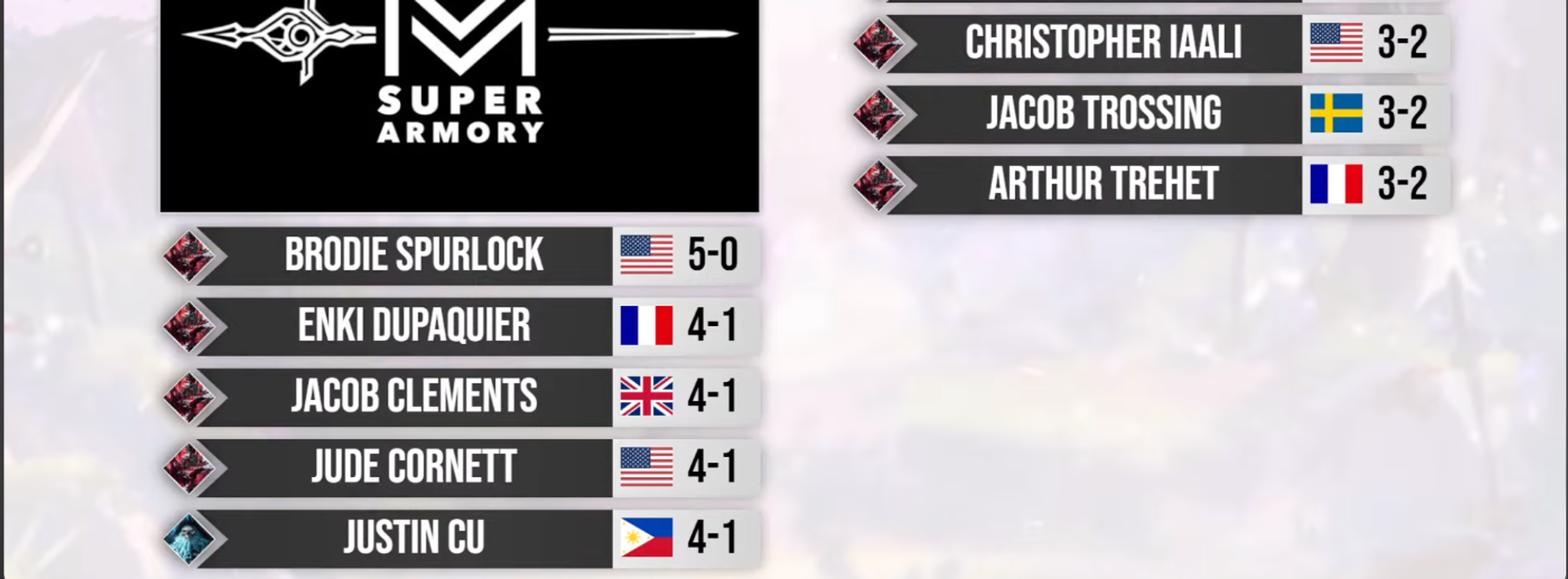
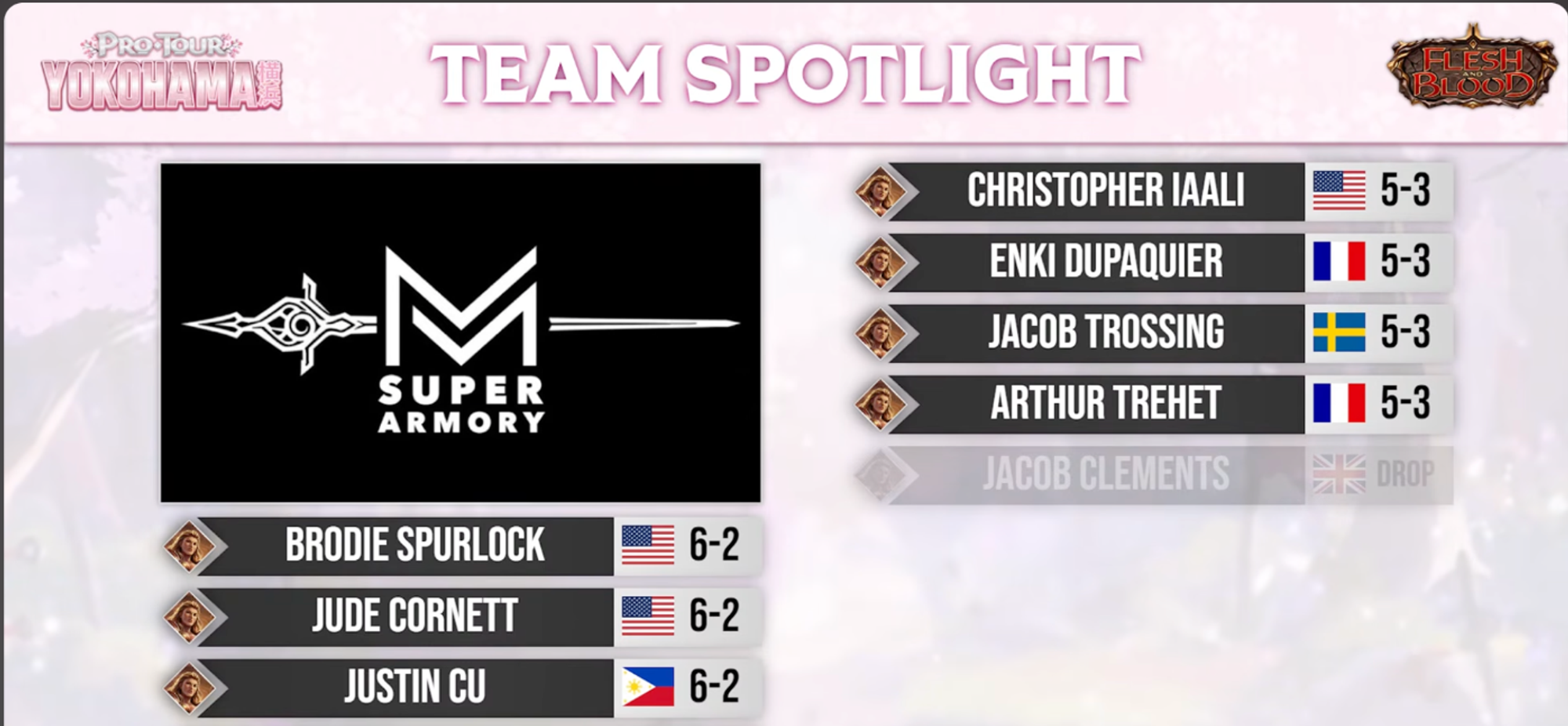
This season, Team Super Armoury achieved a wonderful amount of team cohesion, inspired by our Singapore season where we managed this: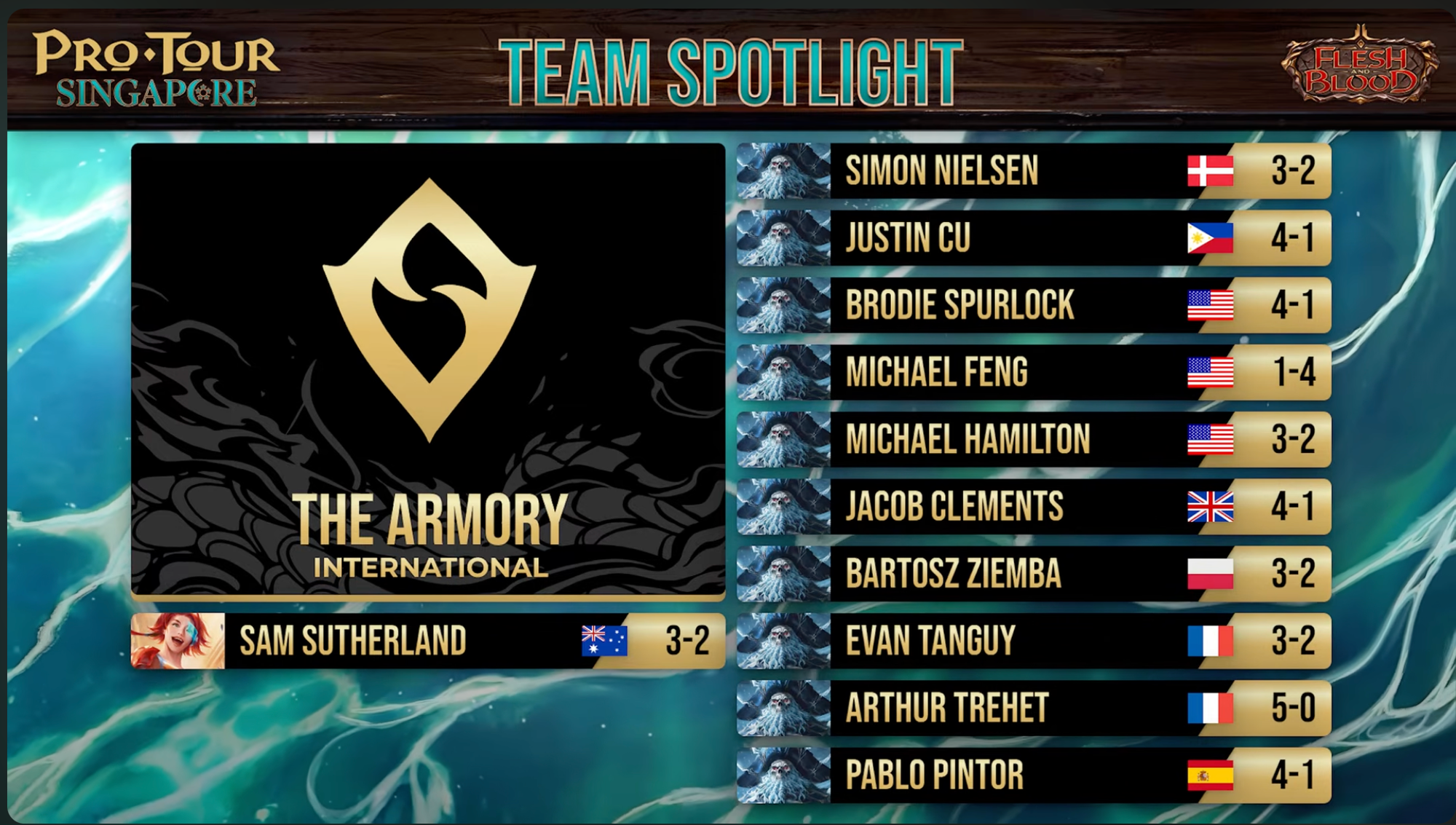
We agreed before PEN even came out to intend to play the same hero in order to coordinate our efforts more efficiently, but when we committed to this we didn’t know what the meta would look like, weirdly enough we actually hoped for a ‘boring’ tier 0 format so the choice would be clear but that wasn't quite what we got. And for Silver Age, we were facing the Wild West, with huge bans shaking up the format and only one major event just one week before the PT. Our work was cut out for us to decide what heroes we would play.
But why were we set on playing the same hero? The way our team works is we have meetings where we discuss our perception of what decks and builds are promising and what remains unknown to us. That way, we can then go play games to try to make improvements to the decks we are interested in and gain understanding of decks or matchups that were previously unexplored. We report the results of these testing games in our Discord server by starting with the matchup and record (3-1, 2-2, etc.) then leave a series of points we learned. This central structure is something I really enjoyed – finding areas of disagreement or blind spots and then playing test games to shed light on those areas. It requires us to be introspective and honest about our confidence levels. Most importantly, it forces us to be open to being wrong when what we thought conflicts with teammates’ views and/or testing information. One of our key principles was to trust the testing of our teammates. We tried to avoid constantly re-litigating the findings of our teammates and believe that their testing was accurate. At the start of the journey we agreed that this process of investigation via team testing would mean it would be far more efficient to work together on the same deck, so that each of us can benefit directly from the testing our teammates do. We hoped this would improve on past tournaments where we played a wide variety of decks meaning, while we could benefit from getting high quality practice on our decks by playing into each other, we were more individually responsible (or in small groups) for doing the work of tuning our decks. This time we would be able to develop really tuned lists by combining all of our efforts on a single hero.
Locking the Decks: <Two Months to PT
So that's the reason for our plan. It started with a team meeting on February 17th where we had a BnR announcement in both formats still to come. Due to the threat of changes in both formats, we were limited in our ability to decide definitively what we would play until later, and in fact agreed to aim to have decks decided by March 28th, (two weeks before the pro tour) so we could have that period to be focused on the deck. In hindsight, I would have liked to have this date a week earlier to give more time for the focused development of the deck but we wanted time to get the deck selection exactly right. At this meeting we discussed the ‘brews’ we wanted to explore and what our perception was of the top decks in each format. We would spend the next two weeks exploring the brews we thought had some promise: I spent some days playing around with Cheating Scoundrel in Pirate Puffin; Jude played a promising Katsu deck, taking advantage of his new Shuriken plan; others explored Fai, Boltyn, and Vynnset. Ultimately we dropped them all with the exception of Vynnset which had some believers. This is a slightly bittersweet part of the process where interesting decks with more potential than the public consensus would have you believe are dropped due to just not quite being there. Sometimes this can be contentious, convincing hero specialists that their brew isn’t quite there, but we had been honest upfront about our plan and even if they felt like, with more time, they could get their deck to where it needed to be, we had also agreed to respect a timeframe.
March 3rd: our frontrunners were Mario, Oscilio and Gravy in cc, Gravy’s place here is a good example to me of how the time spent exploring is not always wasted; while Pirate Puffin wouldn’t pan out, it got us thinking about Cheating Scoundrel, which got us playing it in Gravy. At this point, the Banned and Restricted list had switched our focus to SAGE. Our initial impression (and most peoples’) was that Kayo had been left virtually untouched while every other deck had been hit, so he was an obvious choice. As a team (and I in particular, as I was traveling to Toulouse solely for the Showdown) spent the next week developing Kayo as well as searching for counters. Aside from the obvious choice of Valda we also identified Oldhim, Vynnset, and Nuu as decks that could have positive Kayo matchups, the latter two becoming the focus of a Primed to Fight article I wrote for LSS. Vynnset was nice as the usual inherent weakness of having to hedge for your opponent fatiguing you didn’t apply to Kayo – due to his 10 no blocks – and Nuu was able to perform explosive combo turns with Inner Chi while getting massive value from Outsiders traps. However, both of these interesting brews were again shelved: Vynnset was too behind vs the other decks in the format capable of blocking out, and Nuu was not positive enough into Kayo once the Kayo started adapting to her plan and shoving armour at her Stealth attacks (though personally I do regret shelving Nuu, she was soo cool and would have caught people off guard).
March 10th: In just one week we were confident in our assessment of SAGE which highlights how the shorter and simpler games lend themselves to faster iteration. We were waiting to see where the meta settled, so we switched our focus back to CC. I was focused on Mario while other teammates felt Victor and Vynnset were promising.
March 24th: It is Decided
Final meeting before we locked our heroes; it emerged there was a big difference in our perceptions of Mario’s Victor matchup – some teammates wanted us to explore Victor thinking they had a good Mario matchup. After playing it internally and determining it to be Mario favoured, and a late surge in Vynnset support being toppled by some very negative results into Oscilio, our choice was down to Mario and Oscilio. Gravy also saw some advocacy but we were worried about his matchup into Ninjas and Warriors on top of his Oscilio matchup. Between Mario and Oscilio, we were at something of a deadlock, ultimately being pushed to Mario due to our worry that DIO may see a surge in play due to her ability to target Oscilio. On the other hand, we felt confident in our ability to flex between fatigue and racing DIO as Mario.
Meanwhile, in SAGE, every Showdown was dominated by Kayo. We decided we would play a Kayo counter if it had reasonable equity into the room. And our Valda deck was showing promise in testing vs Oldhim and Florian, making us confident in picking it as our PT SAGE deck. Finding ways to gain value without attacking was proving to be the key to winning SAGE games, as if you don’t attack you force your opponent to find a way to convert their hand for value without blocking which a lot of decks seriously struggle with.
Optimization to the End: <Two Weeks to PT
March 27th: With both decks locked, our efforts turned to tuning the decks. In the case of Valda this involved a lot of interesting questions around the optimal build. We came to like playing all of the 10 power Crushes to win the Guardian mirrors and because a plan of ‘3 tapping’ Iras – forcing them to convert their whole hand without the option to block by developing auras then sending big Dominate damage to close the game – was proving effective, meaning the large vanilla crushes were more desirable than smaller, disruptive attacks. Florian was another very interesting matchup. We experimented with Craterhoof as a tool to force through Smack of Reality but when it was the focus of our plan we were often too telegraphed and we would let the Florian crack the chants before we destroyed them. Instead we started playing Imperial Seal to blank their d-reacts and red Edge of their Seats to enable situations where we can spend two turns stacking aura damage before finally attacking.
In CC I personally felt quite confident with our team deck, having spent the last several months playing it, so I spent much of the CC time helping teammates pick up the deck and making final refinements to the list. In particular, the fatigue matchups needed a bit of work. Using Remembrance to recur our Up Sticks to get access to more guaranteed damage and sources of Mark by flicking our Klaives was a good tool, as not only did it guarantee 1 damage from flick, but it also meant that we could often transform to a demi-hero that gives us access to an attack reaction which would be especially effective as our opponent runs out of d-reacts. We also spent time exploring mirror plans. We ultimately liked running a high number of defence reactions to mitigate our opponents on-hits and potentially brick them if we deny their access to Go Again by denying mark and/or Stealth attacks hitting. We also started running a Codex of Inertia to punish them for drawing hands that don’t convert after we block out and pass if they have d-reacts and/or multiple finishers. We explored other cards like Command and Conquer as well as a way to punish the d-reacts but it played quite badly with our usual cost curve of either using Tunic to swing Graphene or pitching a blue for both daggers.
Takeaways?
Above all, I want to emphasize that I loved working with my teammates this season and every one that’s come before. However, it is important to reflect on the good and the bad. When I had pitched the idea for this article to Bryce I had hoped I would be writing it at the end of another successful season for team Super Armoury, and unfortunately I feel Yokohama may be our worst tier 4 in terms of results. Personally, it was a poor showing with me failing to make day two, and as a team – compared to our previous three seasons which regularly saw members make top 8,16 and 32 – no one who brought our team deck lineup of Mario and Valda was even in the top 64.
It is difficult to confront a situation where you feel like you failed, and doubly so to share that failure with others. But it is my hope that by confronting it head on and taking an honest look I will have the best chance to improve going forward. The key to the process is the balance between having time to find the right deck and time to refine it. When I look back at Singapore, we had the advantage of initiating the work on Gravy as the team deck more than a month out, which gave us time to really benefit from everyone developing the deck.
Of course, it is also important to acknowledge that variance plays a role, perhaps if we had been a bit luckier on the day and had some more solid results I would feel differently. Sitting where I am now, even if we had won PT Yokohama, I still think we began communal optimization too close to the event. The important thing, when one makes a mistake, is not to repeat it:
“Ever tried. Ever failed. No matter. Try again. Fail again. Fail better” - Samuel Becket.
Or put more crassly by one reddit user:
“Don’t fuck the same cactus twice”
So I’ll be trying to pick my hero further in advance in my future events, though I do love a last minute pivot, so if you see me tweet asking for some random cards the day before the next pro tour, you can reply with a picture of a particularly lovely looking cactus.
A Note from the Editor:

<3 You Jacob,
-Bryce