

Hello everyone, Ashlyn here! Coming at you with another Fai-related… Article!? Today, I will discuss all things Fai when it comes to Nationals Season. We’re gonna get you up to speed on decklists, matchups, and how the meta might shake up for our favorite, fiery boy. But first, I think an introduction is in order :)
Wait, Content Creators can Play!?
If Nationals weekend was your first exposure to my lovely self, hello! But if not, then you probably know me from my YouTube channel (AshlynV3). My Flesh and Blood journey began around the time Part the Mistveil released, but I got my first real start on Fai after purchasing some marvel Phoenix Flames at the Rosetta World Premiere. After the 2025 Road to Nationals Season, I ended up with a Fai build that I was really proud of. I turned on the camera, yapped about it, and the rest is history. Although my upload schedule could use some work… all of my competitive energy as of late has been solely focused on Fai, regardless of meta viability. So my reason for picking Fai for US Nats was laughably simple: He’s my favorite! That doesn’t mean I didn’t have any inkling of the raw power of this hero. Every game I played and every iteration of the decklist I constructed kept pointing to the conclusion that Fai was a serious meta contender. Apparently, a Minnesota local felt the same way. Matthew Gump and I both successfully sent Fai all the way to the final day of competition, which was on nobody's bingo card heading into the event. So, how did we get here? Let's catch ourselves up on how an old powerhouse of the meta game rose from the ashes to conquer some of the United States’ greatest competitors.
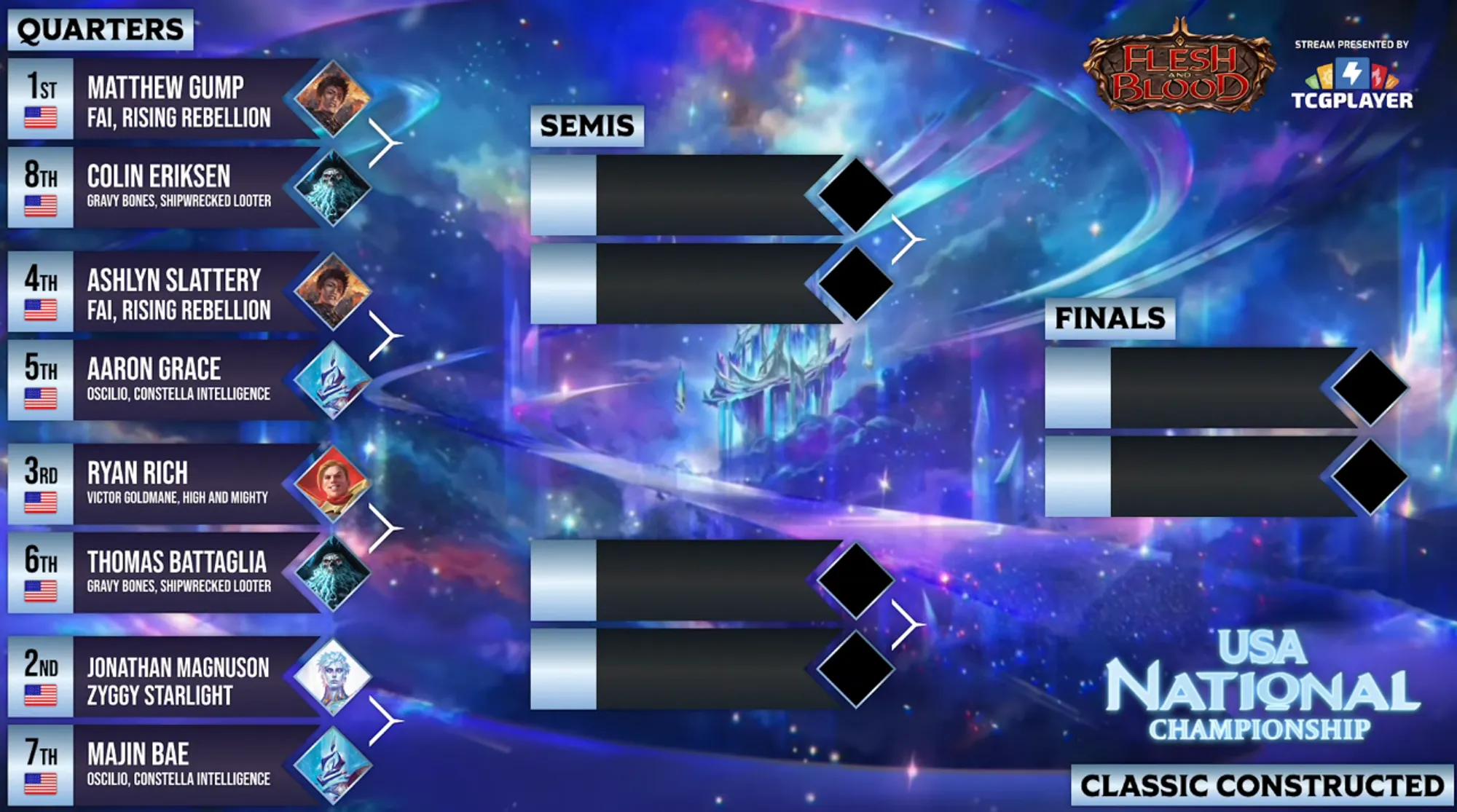
Where Has Fai Been?
Post Uprising:
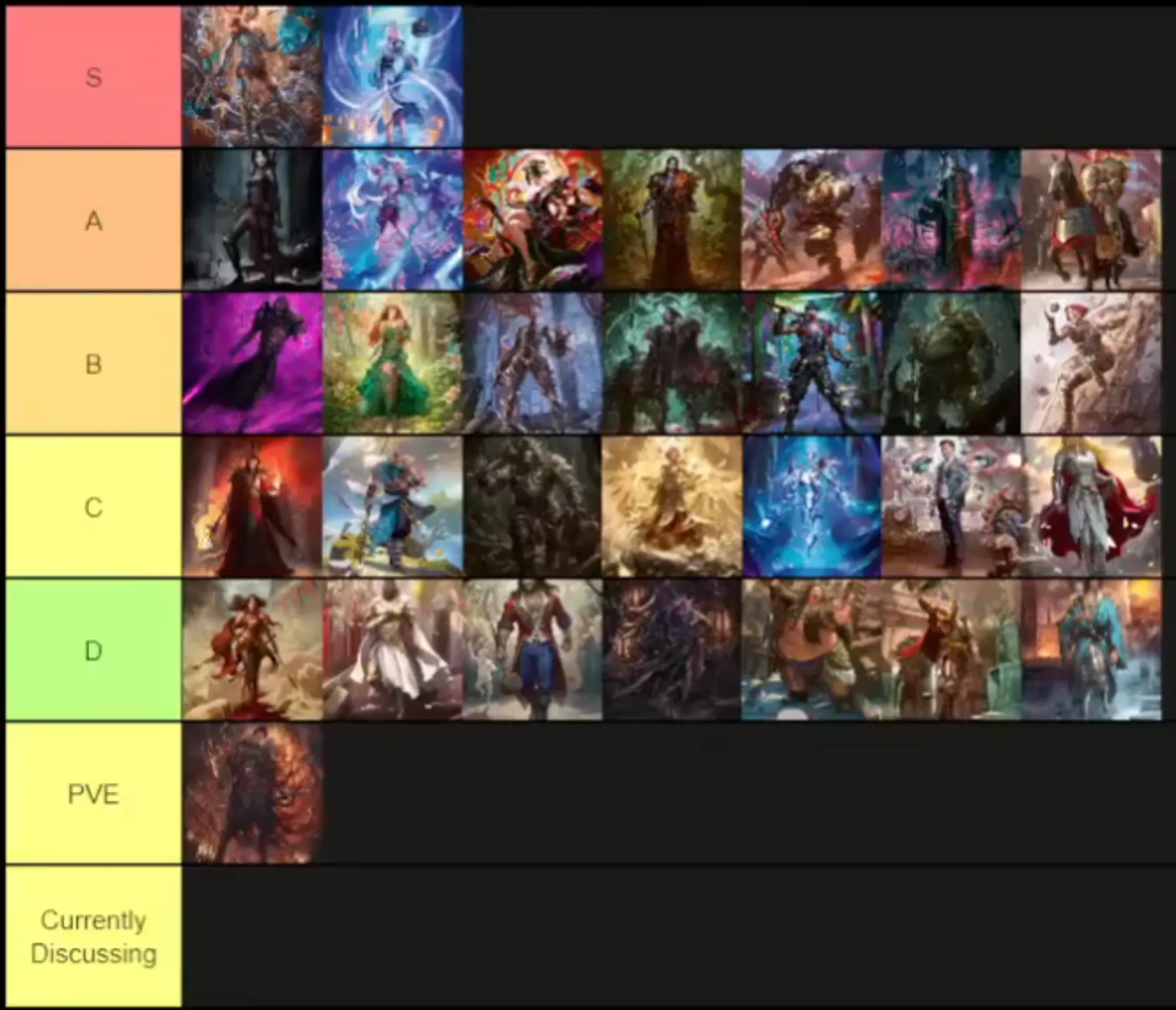
As you can probably tell from when I started playing the game. I never had a chance to juggle Phoenix Flames in Fai’s heyday. A lot of this history is well documented by content creators, articles, and old coverage alike. Thus, I’m not going to get into the weeds with this section of our story. All you need to know is that Fai was a powerful deck that leveraged – frankly – broken cards to incinerate his opponents at a blazing speed. Pretty much all of these cards were banned over the course of Fai’s tenure. The most notable ones are Stubby Hammerers, then Belittle, then finally Art of War. The last of those was the nail in the coffin to send him down to the depths of tier lists. And it wasn’t even his fault (Zen was the real Art of War abuser)! I remember watching The Card Guyz’ very own Nathan Crawford relegate him all the way to “PVE” tier. Rosetta was certainly a meta of all time for Fai, Rising Rebellion. Calling it a fall from grace would require a level of niceness that I don’t even know exists.
Still, some avid enthusiasts saw flickers of flame still left in the ashes. The equipment suite, for one, was still extremely powerful. With some well-aligned Spreading Flames, high damage turns were still very possible. Mercy Bickell did the best with what was left and constructed a Rosetta Fai decklist. Which, I cannot emphasize enough, is the entire reason I’m here writing this article today. This was the first full Fai deck I put together in paper. When people describe Fai nostalgia, my fondest memories go to lists like these. I miss Enlightened Strike every day.
Rosetta Fai (Kanos not allowed) (Copy)
Luckily for the Draconic Ninja fans out there, it didn’t take too long to get our fix in. The release of The Hunted led to new cards being printed for the class, alongside a new hero, Cindra! This knife-flicking, royal counterpart built up such incredible hype for her release. As I kept playing games and constructing decks for her, though, I came to one resounding conclusion…
Post Hunted:
I hate her. I hate everything about her. I hate her design. I hate her flick-knife-based playstyle. I hate that her best card is so broken that it was printed as a legendary. I hate how every turn is the same. I hate how she cannot block to save her emperor. I hate how she only plays reds, the pitch mechanic isn’t real, and it can't hurt her privileged royal butt. I hate how her cost curve is fixed completely by her chest piece. I hate how any player with twenty+ reps into her can shut down her entire gameplan. For the players who love Cindra to death and have stuck with her through highs and lows: I love that for you. I’m glad that there are people who say unseasoned, raw chicken breasts are their favorite meal. Variety is the spice of life as they say. As a Fai diehard, Cindra just lacked what I wanted from a Draconic Ninja. But if the new girl in town isn’t what's for me, I might as well stick with what I like.
With a fresh new injection of cards into his pool, there was a lot of room for experimentation in Fai deckbuilding. People debated in purple chat about Snapdragon Scalers vs Dragonscaler Flight Path, Is Rake over the Coals good or not, Fire Tenet: Strike First, Yay or Nay? To shortcut the conclusions, Fai got a lot of additional power in the Draconic talent. Cards like Ignite and Oath of Loyalty contributed to an abundance of starters. Fealty generators such as Display Loyalty, coupled with Brand with Cinderclaws, allowed Fais to run powerful non-Draconic cards like blue Dragon Power and Fire Tenet: Strike First. Lastly, but certainly not least, Rake Over the Coals provided an additional anthem effect to a deck desperate for power cards. Overall, The Hunted gave Fai considerable buffs both in his consistency and ceiling. Unfortunately, with all the hype going into the other Draconic Ninja hitting the scene, Fai was in an uphill battle to prove himself as top dog.
For the last year and a half, the community has perpetuated a narrative that Fai is just a worse Cindra. Admittedly, my contrary opinions came after inhaling unhealthy amounts of copium. Yes, there were a few metas where Fai was a strong pick. Elly Bird shocked players and casters alike with her impressive 60th finish at Worlds last year on a “worse Cindra”. When the expected metagame involved Verdance, Gravy Bones, and Cindra, Fai had a comfortable matchup against all three heroes. Notably, with the help of Blazen Yoroi, Fai surprisingly felt favored in a clash of the Draconic Ninjas. However, with eighty-six Cindras and one Fai in the room, it was still a hard sell to any competitive player that Fai was the correct choice.
fai worlds 25
Unfortunately, the narrative held strong as the eventual winner, Michael Jazczur, took home the trophy with Cindra in tow. Speaking of Jazczur, I wonder what his Compendium of Rathe Spoiler card was…
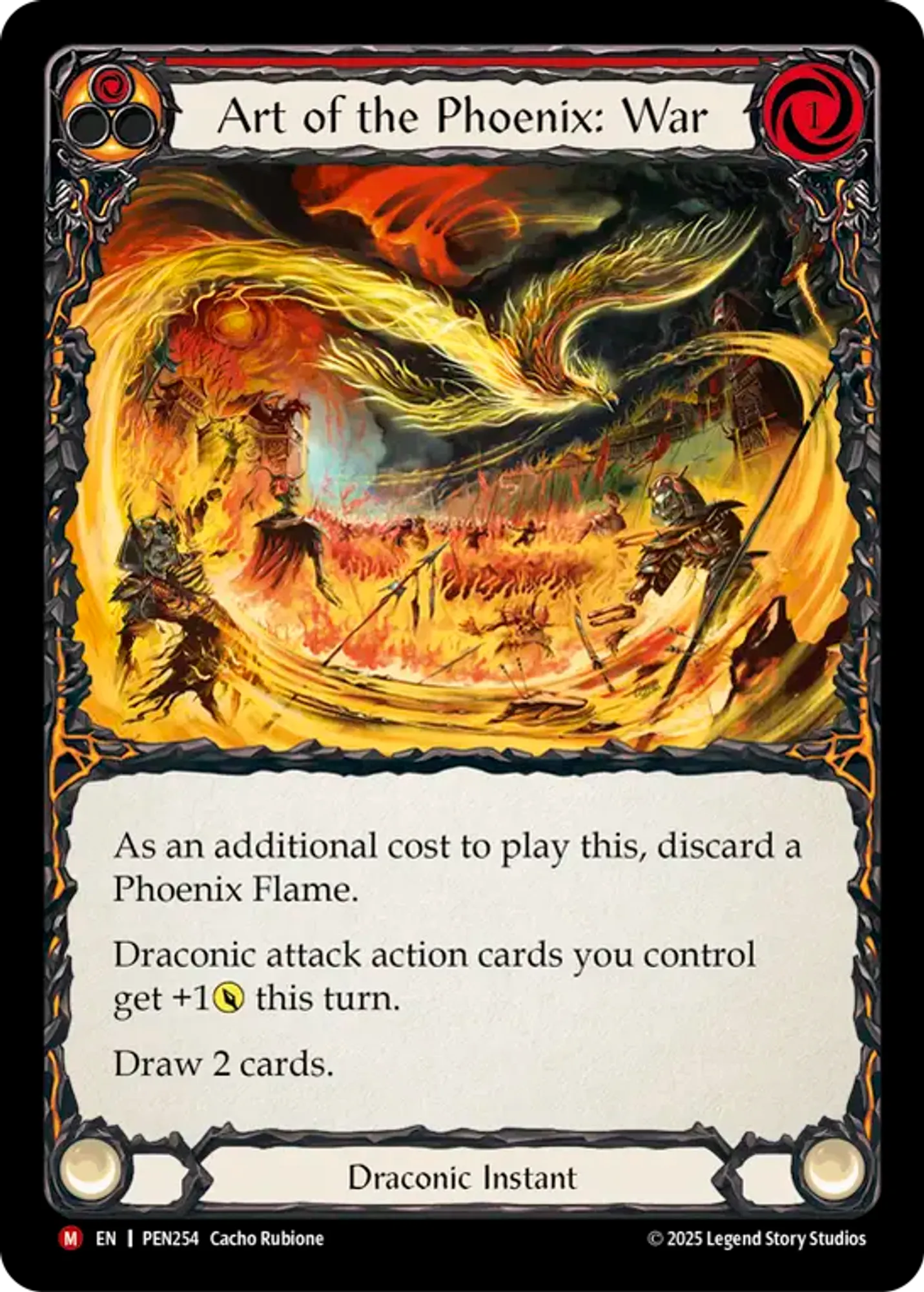
That seems… busted…
Post Compendium:
James White has answered our prayers!! I mean it literally has Art of War in the name. This hero is going to the moon! But as the dust settled, and the cards were tested, all that you could hear were crickets from Joe Shmoes and top players alike. The upgrades made the deck better for sure, but it wasn’t Bonds of Ancestry Zen level as some of the early bandwagoners were hoping. In order to make the build consistent and cohesive, you had to include subpar cards like Inflame and take out old powerhouses like Oath of Loyalty. Despite Fai lying dormant in the meta at large, I still want to go through how the upgrades in Compendium fundamentally changed the deck, as it paints the picture on how Fai was able to make it to the top tables.
Phoenix Flames Matter!
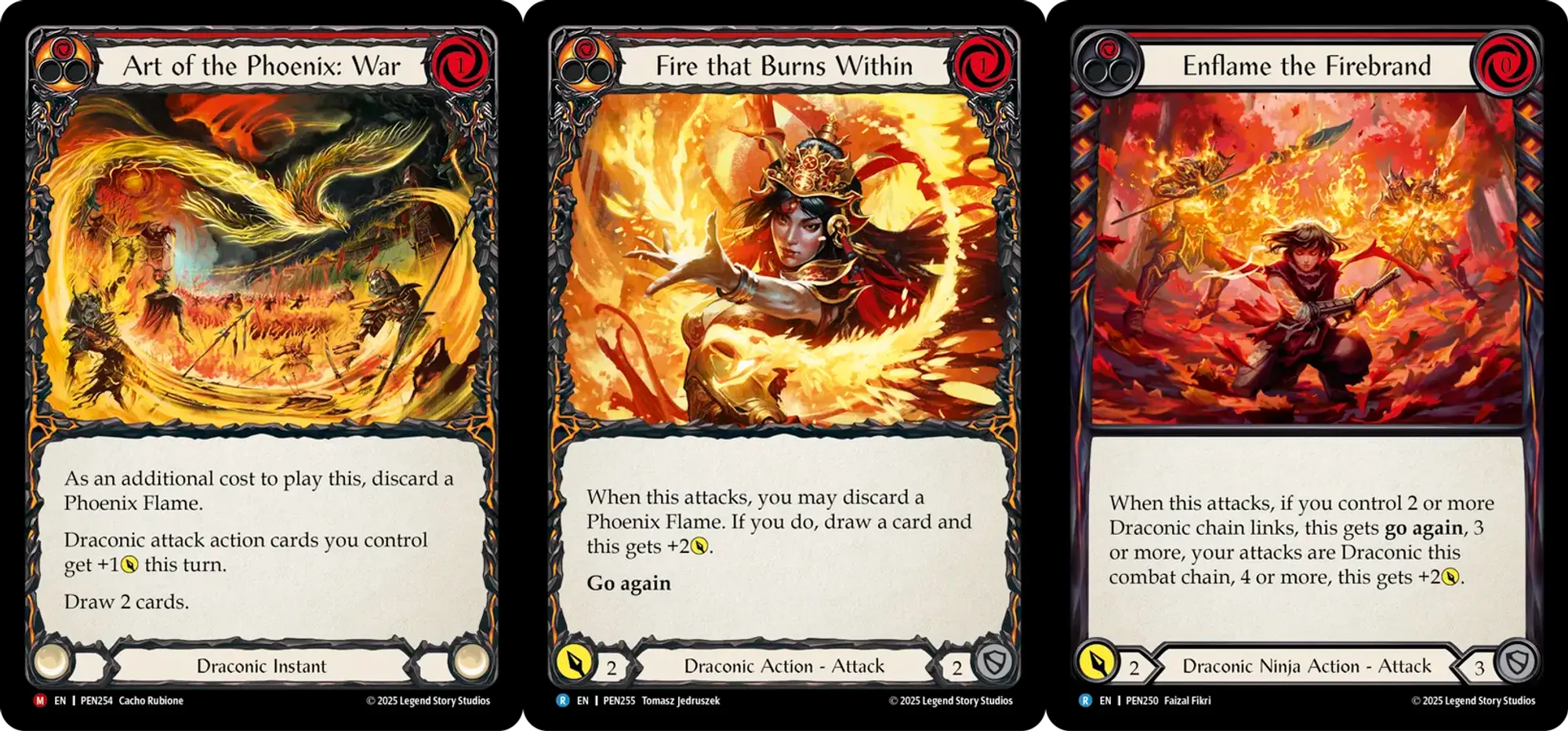
Phoenix Flame payoff cards before Compendium required copies of them to be in the graveyard, in your deck, or sometimes on the combat chain. Now, cards like Fire that Burns Within and Art of the Phoenix: War created a payoff for having a Phoenix Flame in hand. They require you to discard a Phoenix Flame from your hand in exchange for some truly insane effects. Cards that grabbed Phoenix Flames from graveyard or your deck – like Rise from the Ashes and Flamecall Awakening – paired very nicely with this new card type. The more Phoenix Flame getters you have, the more consistently you can cash in the powerful discard effects. Towards the later parts of testing, most players found that 2 extra Phoenix Flames in deck was worth it to keep a higher consistency when it came to these effects. Additionally, drawing a Phoenix Flame in hand was a lot less of a cost than in past versions of Fai, due to your hand now being the most desirable location for them. The more cards that had Phoenix Flame printed somewhere on them, the easier it was to enable these fresh new power cards.
Happy Feet, Wombo Combo, That ain’t Cindra.
Art of the Phoenix: War was a return to (phoenix) form for the Draconic Ninja. Blocking out and attempting to run Fai out of threats was no longer a viable strategy. If you gave him an inch and an arsenal, he could now fire back with a 35 damage combo turn. Sure, Victor was still difficult, but the new cards gave you a light at the end of the tunnel. Some players leaned into this combo aspect heavily, including tech of old like Energy Potions to bank resources for future turns, and Rake Over the Coals for some extra anthem effects to really reach the deck's newly heightened ceiling. One Energy Potion and two Prowess of Agilitys on board produced this ludicrous turn from Matthew Gump in his round 3 game against Nigel Loutzenhiser. Folks, this is what dreams are made of.
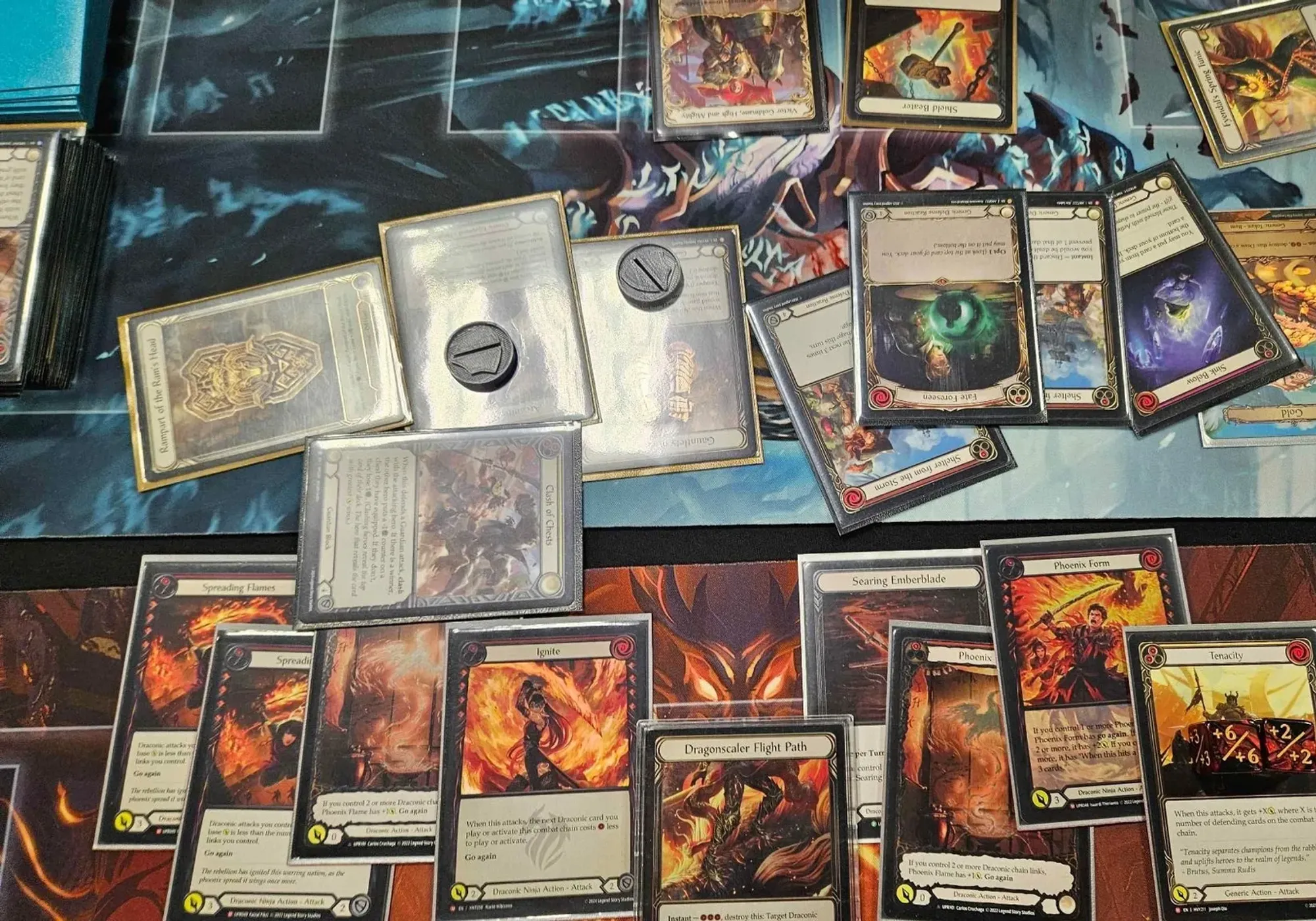
New Cards, Same Turn
Fai’s attacking turns before Compendium usually didn’t dynamically change throughout the turn, save for a choice between Salt the Wound or Tenacity off of a Mask of the Pouncing Lynx activation. With an influx of new cards to sequence at the start, middle, and end of combat chains, every card had to have a certain question asked of it: “Am I ok with drawing this in the middle of my turn?” One of the most hotly debated cards on this subject is Oath of Loyalty. Because it can only legally be played as your first action of the turn, if it comes at the wrong time, you have to hold back a card on the “play every card you have” turn. This also asks you a very important question about your blue base. Matthew Gump and I actually have closer lists than most believed, but in this aspect we are polar opposites. Matthew’s blue base is filled with combo enablers with absurd turn 0 equity like Prowess of Agility, Truce, and Energy Potion, as well as tech pieces like Warmongers Diplomacy, Overcrowded, and Ripple Away to deal with certain pesky matchups. In certain matchups and gamestates these are all extremely powerful cards, but drawing them off of Art of the Phoenix: War can be game losing as you don’t have a way to convert them into reasonable offense. My approach is to forgo the silver bullets and maintain consistency even when my deck wants to give me trouble. Cinderskin Devotion, Lava Vein Loyalty, and Dragon Power ensure I can present solid damage in these blue-flooded turn cycles. Both philosophies are valid, and I recommend picking whichever one makes you smile when you wake up each morning.
Solitaire Mirrors
One of Fai’s weaknesses before Compendium was that if a deck could kill him faster than he could kill them, he had almost no shot at taking them down. Into aggressive matchups, Phoenix War and Fire that Burns Within makes your damage output much higher. I found Kassai to be a struggle in previous versions of the list due to her raw numbers being too hard to compete with. Now, with the insane turns we can set up and the lack of disruption on her side, that matchup has completely flipped on its head.
An Achilles Heel Just Got a Little Bigger
Despite the many great benefits these new cards provided, they also further amplified Fai’s weakness to disruptive decks. Before Phoenix War became your primary win con, losing a card was an acceptable setback for Fai. Now, you are asked to give all gas and no brakes, which some decks are particularly adept at trouncing. Arakni, Marionette and Marlynn make it nearly impossible to play out your most powerful turns without extreme misfortune befalling their draw sequence. When the most powerful card ends up hurting you against certain decks, an astute player will ask themselves if they should take this card out against disruptive matchups. Matthew Gump and I both agree that the answer is a resounding yes.
To Switchboard or to Not Switchboard…
Many Fai players remember the Kodachi and Emberblade switchboards of old. Instead of switching between weapons in this modern take, you swap between a combo game plan and a midrange one. Fai has multiple ways you can build him both with their own set of advantages and disadvantages. Most players can wrap their heads around Combo being a powerful archetype, especially into a field of low-disruption opponents. Notably however, Fai can also be built as a very solid midrange deck that can slow the game down or hit the gas depending on how your hands line up. Maybe one day I’ll bust out my Draco Fire midrange Fai brew, but for now I’ll keep my suboptimal builds to myself. The main problem with a pure combo Fai who runs Phoenix War in every matchup is that your sideboard slots are really hard to fill. Adding in non-combo-centric cards like defense reactions can cause massive bricks when you are trying to go wide on your most explosive turns. At one point, I saw players adding in 6 poppers just to find some use for that 12-15 card dead zone. I came to the conclusion that adding a midrange switchboard was the most effective way to add matchup equity in your sideboard. With decks like Cindra, Marionette, and Vynnset being ever so popular, a completely glass cannon strategy is a recipe for bad GEM luck. A midrange switchboard usually involves subbing in 6 defense reactions to take out 3 Phoenix Wars, 1 extra Phoenix Flame, and 2 Phoenix Flame tutors. If you want to take up extra sideboard spaces to make each configuration stronger, you can. For example, add in a playset of Oaths of Loyalty for your midrange portion and a playset of Inflames for your combo game plan. There’s a lot of flexibility and variety in those specific packages, so customize to your heart's content to feel out something that works for you. Based on current results over Nationals weekend, it seems like having a switchboard is the best thing you can be doing on Fai in this meta. Going with what has proved to be successful seems like the sound choice. However, if I always made sound choices, I wouldn’t be playing Fai in the first place, so get out there and prove me wrong!
My 80!
I hope you had as much fun learning about the evolution of Fai builds as I had writing about it. But now we're here, in the modern day, and I have so much I want to talk about! When excluding our wildly different blue bases, Matthew Gump and I only differ on 9 slots in our lists. Furthermore, three of those slots are a difference between two playsets of defense reactions. I bring this up only to emphasize that there is a group of powerful Fai cards shared throughout most builds. Therefore, I want to mainly focus on a few key cards and decisions I made during the deck construction process.
United States National Championship 2026 3rd 🇺🇸
If Lava Burst is so good, why don’t you run more Lava Bursts? And to that I say… Yes!
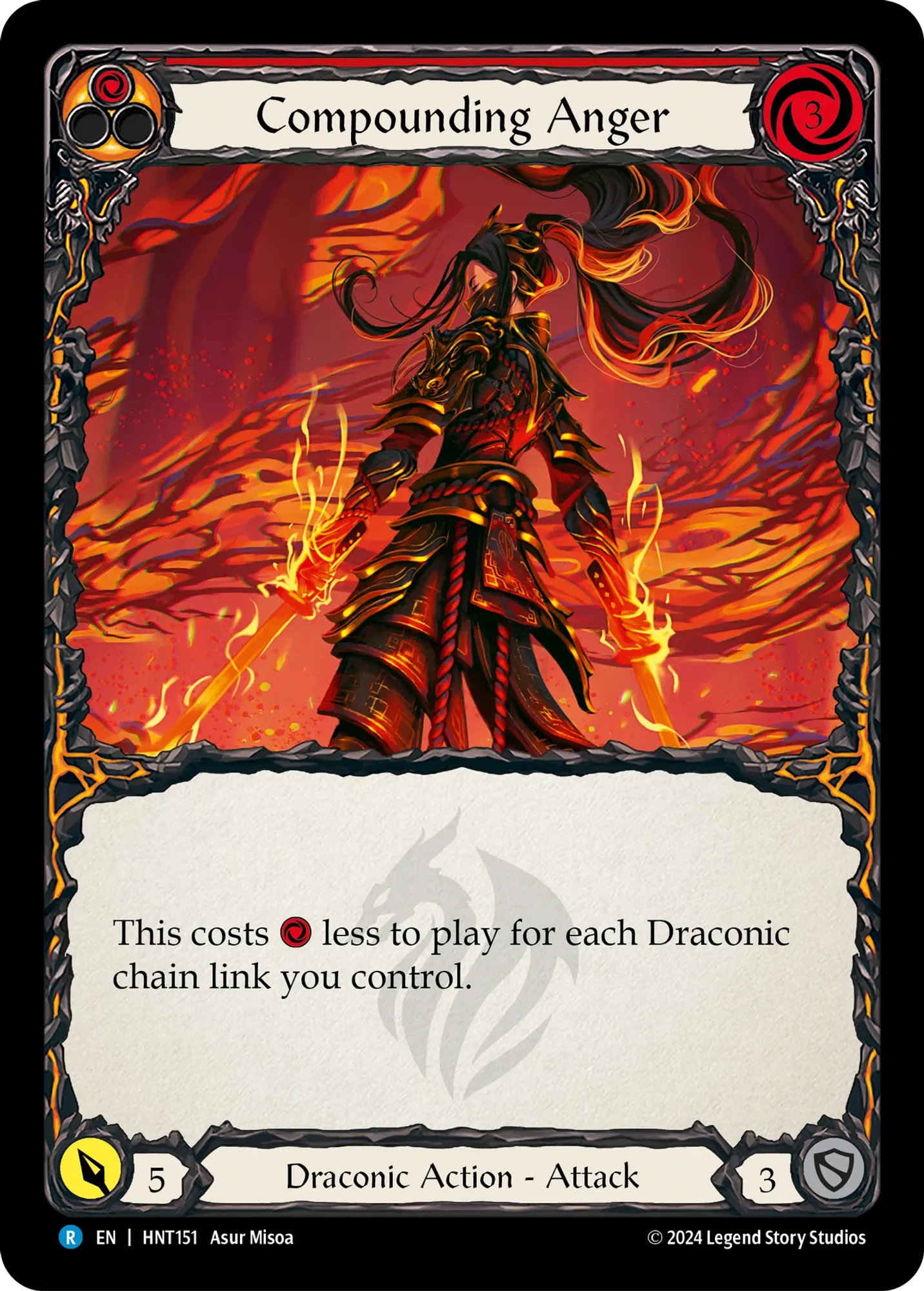
Compounding Anger is Lava Burst copies 4-5. In older Fai builds, its inability to trigger Tiger Stripe Shuko was an issue for sure. But now, with the onslaught of new 2-power attacks, this drawback has become much less of a concern. I found that this card was powerful in both combo and midrange configurations. The floor being so high kept drawing me back to this card despite other cards begging to fill its slot. Its biggest issue is its lack of Go Again. Which does mean that we are putting a higher strain on our Dragonscaler Flight Path to bail us out when drawing too many finishers. Our boots play double duty with converting blue-flooded hands and double finisher hands. However, I’ve built my blue base to play effectively off of multiple blue hands, giving me room to put weight on the other side of Flight Path’s scale.
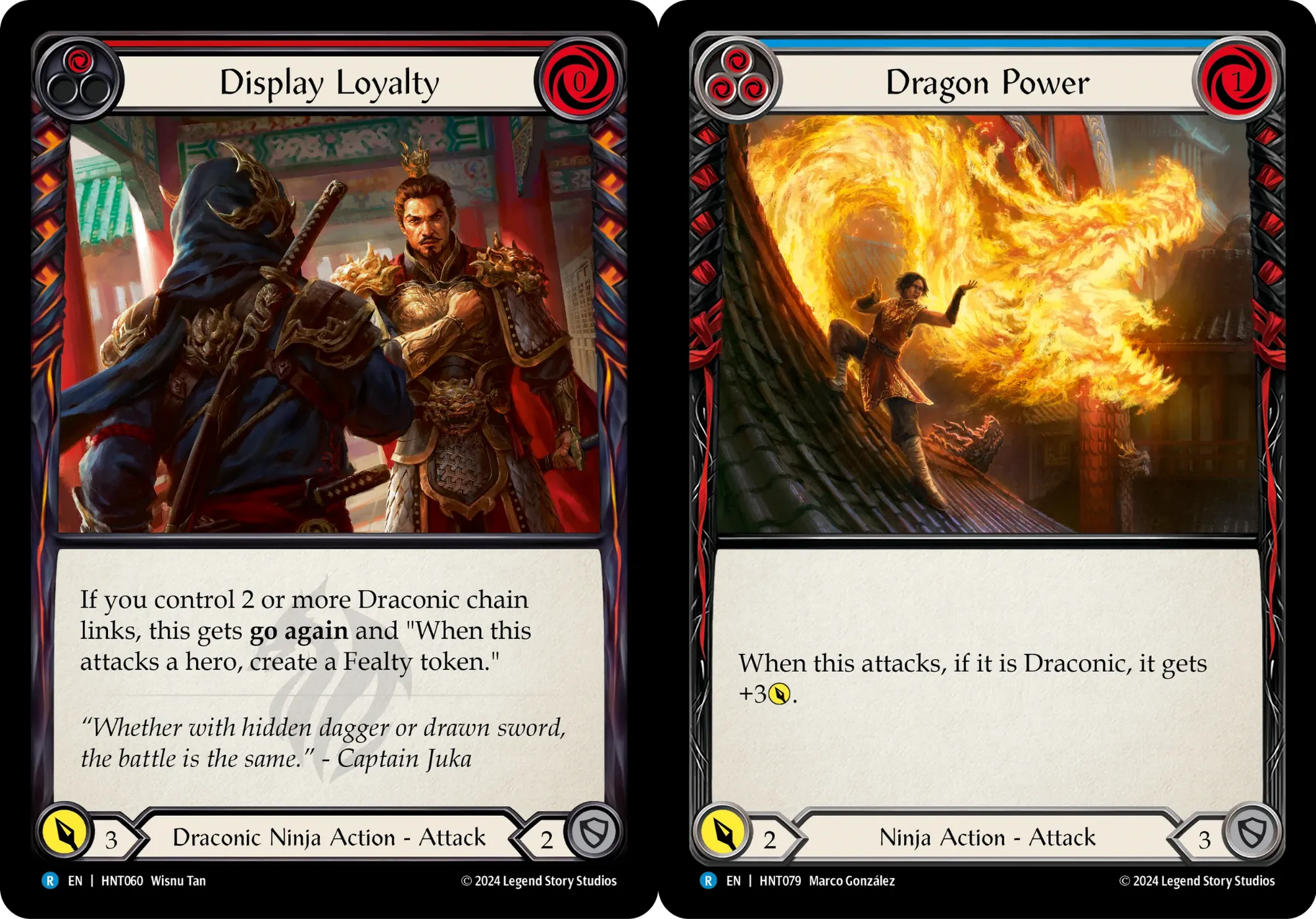
Blue Dragon Power adds a lot of, ummmm, power to your existing blue base. Having a 1 cost version of Lava Burst when drawing multiple blue hands has won me more games than I can fathom counting. Its condition is now easier to trigger than ever with the addition of Enflame the Firebrand’s effect, making the whole combat chain Draconic. It’s a card that is very powerful when you make room in the red base to compensate for it. The card keeping it cohesive is Display Loyalty. Having a flexible token that can make anything Draconic when you need it to be has numerous use cases:
1. Making Dragon Power’s effect consistent when you draw it
2. Turning Overcrowded into a 3 blocking card, allowing it to become a 4-block with even one more token aura entering the mix
3. Allowing your Salt the Wounds and Tenacitys to obtain anthem effects from your Spreading Flames and Art of the Phoenix: Wars
4. Avoiding bricking with your few non-Draconic cards on Oath of Loyalty turns
Truthfully, I think it's a hard call. On average, the Fealty that Display Loyalty creates translates to 1 value. However, there is an opportunity cost to building your deck to take advantage of this card. You are running an extender that isn’t stellar unless you get a chance to utilize the token it generates. Personally, I think the juice is worth the squeeze with this package of cards.
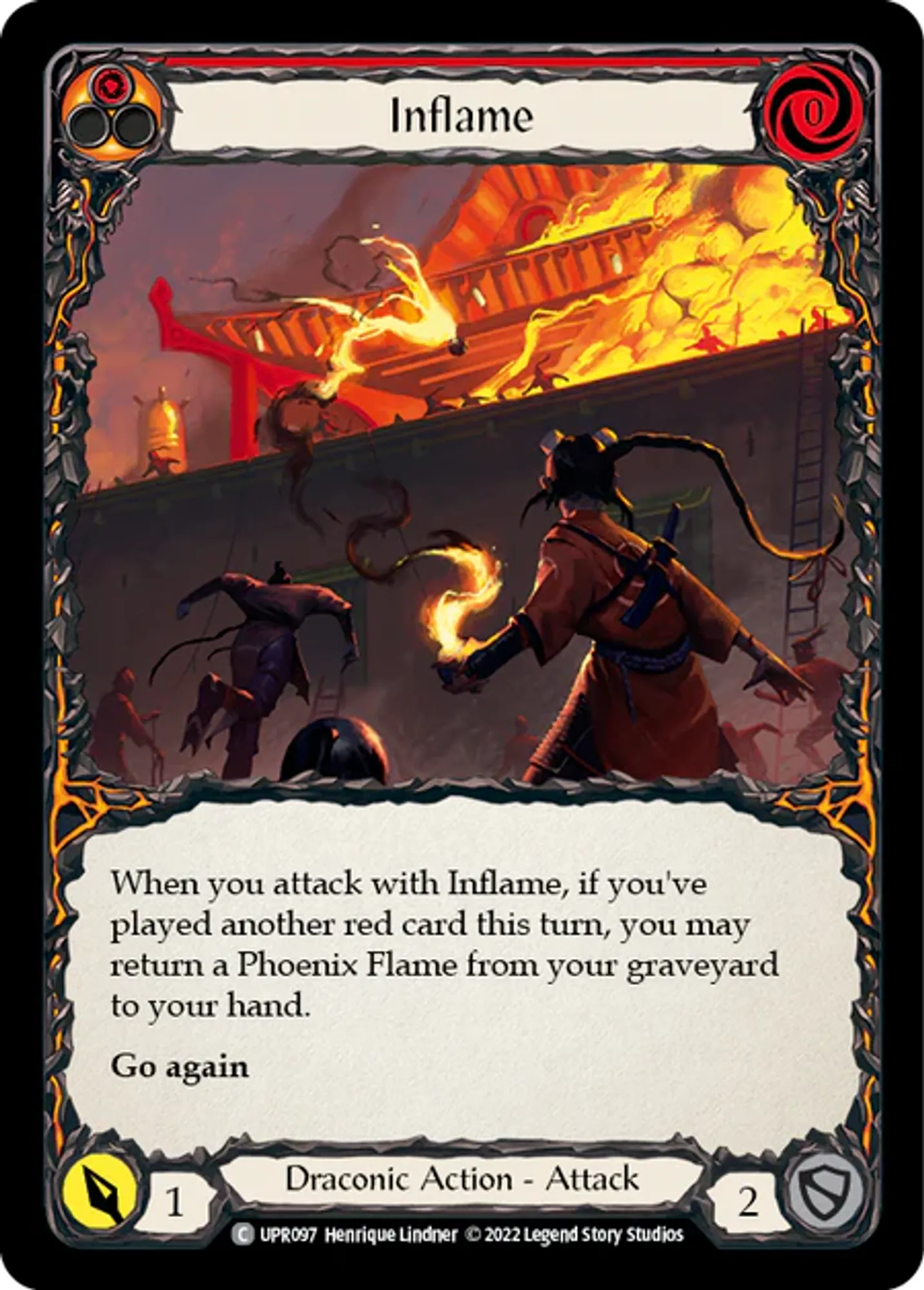
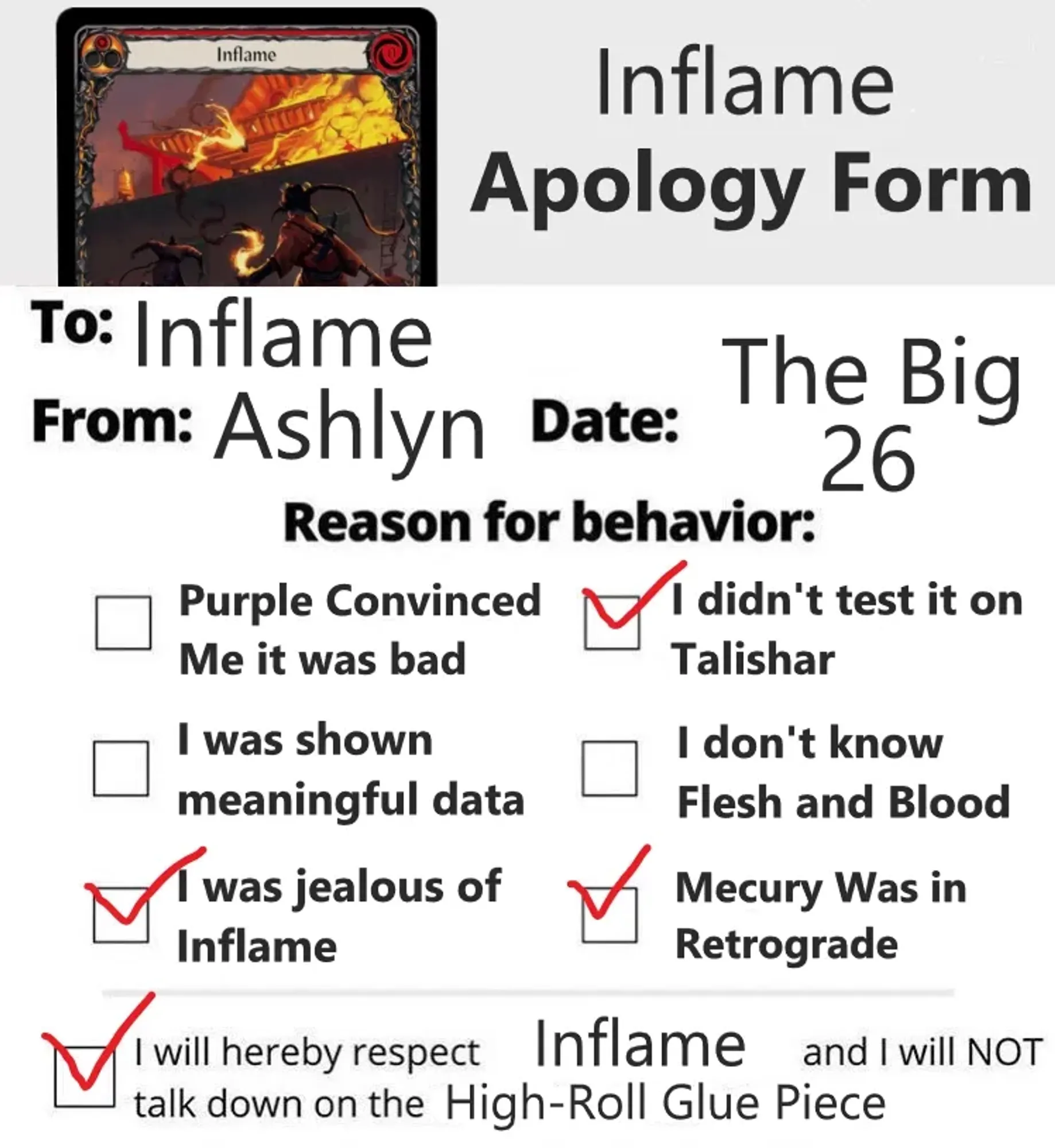
I used to think Inflame was really, really bad, and turns out, if you print enough support, even the most memable cards can rise to stardom. It’s good if you draw it in conjunction with either Phoenix War, Spreading Flames, or Fire that Burns Within. On every other turn, it is laughably bad. However, being a consistent glue piece and a tutorable Lynx target for an on-demand flame has considerable benefits. I have it as a one-of in my list because I found that I needed just one more card that picked up a Phoenix Flame to truly reach a level of consistency I was comfortable with. Needless to say, it won me a game and bailed me out of a horrible situation in another. After all it’s done for me and all the disrespect I’ve put on it, it deserves an apology from yours truly.
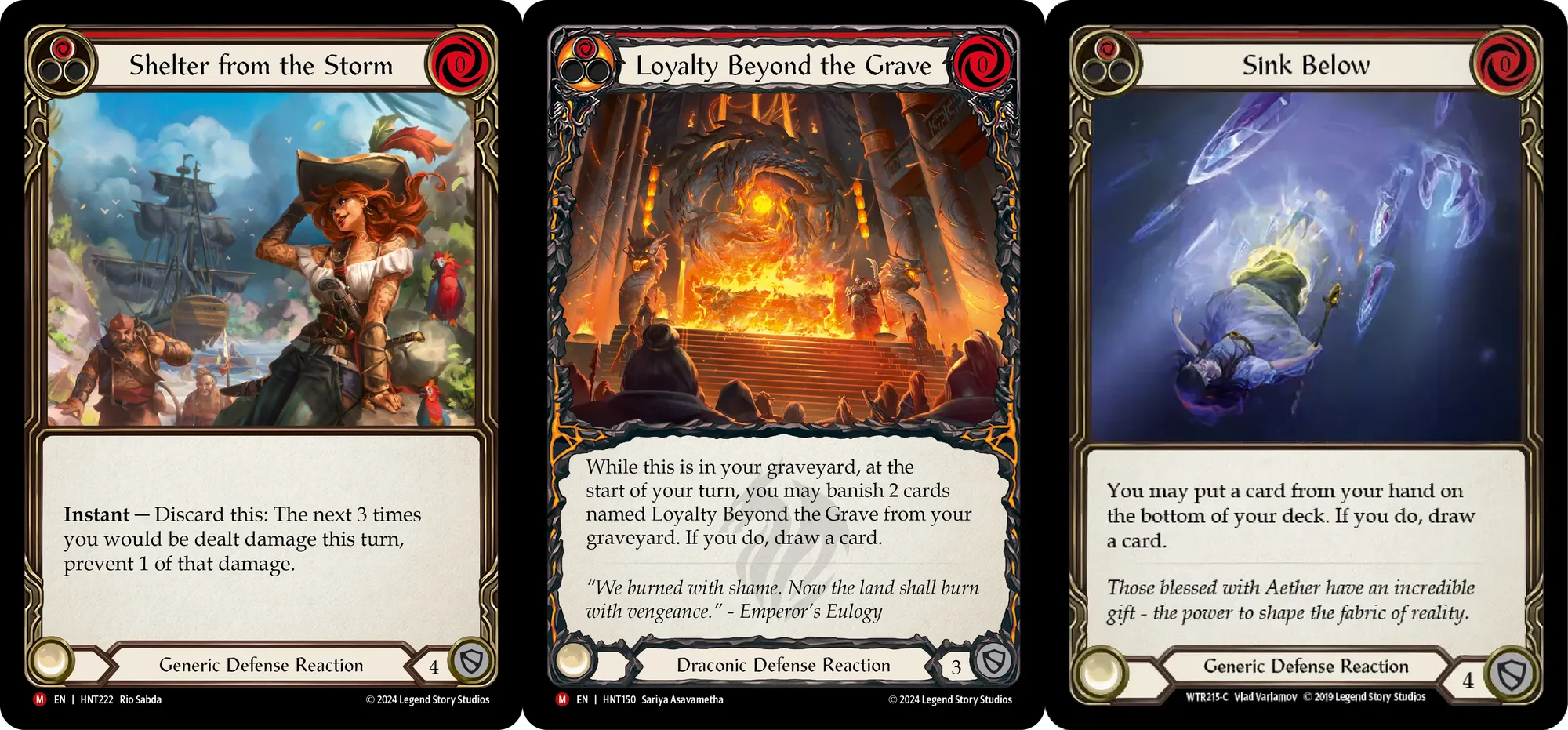
When deciding on the six defense reactions to create the base of your midrange switchboard, you really only have three playsets to choose from. When there is an abundance of Marionettes and Cindras floating around, Shelter from the Storm is a no-brainer for the first playset. The choice of the other three cards is a little bit of a trickier decision. Sink Below is as powerful as it is classy. 4 defense is hard to beat in conjunction with its hand filtering properties. When you’re an aggro deck, any opportunity you get to sculpt your hand is a godsend. Even with all that in mind, I chose Loyalty Beyond the Grave to occupy my second defense reaction slot. What it lacks in raw numbers and filtering properties, it more than crushes in offensive overlap potential. In matchups you expect to go long and need a powerful combo, Victor being a primary example, you can hold on to the free draw until just the right turn to explode. Against Marionette, I found that the extra 1-block from the sink below often didn’t matter when responding to attack reactions. And into Vynnset, her 6-power attacks often meant that a Loyalty Beyond the Grave and a 3-block from hand were enough to cover them up. I would say that Cindra and Prism are the two primary matchups where that extra point of defense matters. Seeing as how Cindra already lost points to us due to the presence of Boots of Omnis Ward and Prism has fallen out of favor with all the Victors running around, I found that I consistently got rewarded for this greedy sideboard choice. On-demand draws were crucial in two of my swiss wins at US Nats.
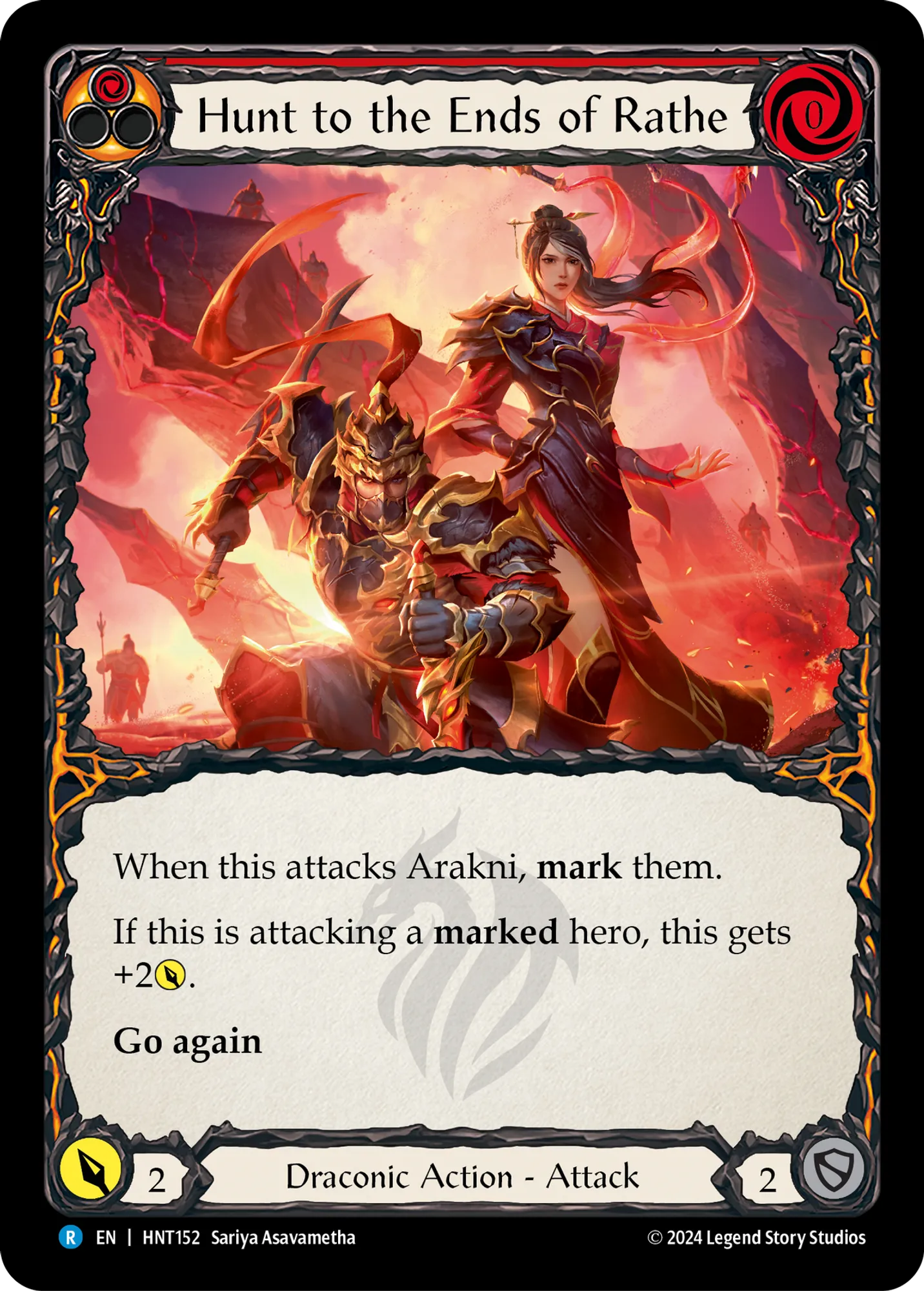
Arakni, Marionette was one of the more challenging decks to problem solve for. Despite the midrange plan working better, I still found it hard to wrestle the win rate in our favor. So, I opted to include a playset Hunt to the Ends of Rathe in my sideboard. Turns out a 0 for 5 starter (+1 from triggering Shuko) wins games of Flesh and Blood. This also created an additional benefit of being a great card to have in all my midrange matchups. Being able to take out the last portion of my extra Phoenix Flame package added a level of consistency I was very happy with. A Draconic starter is powerful, even if its base power is only 2.
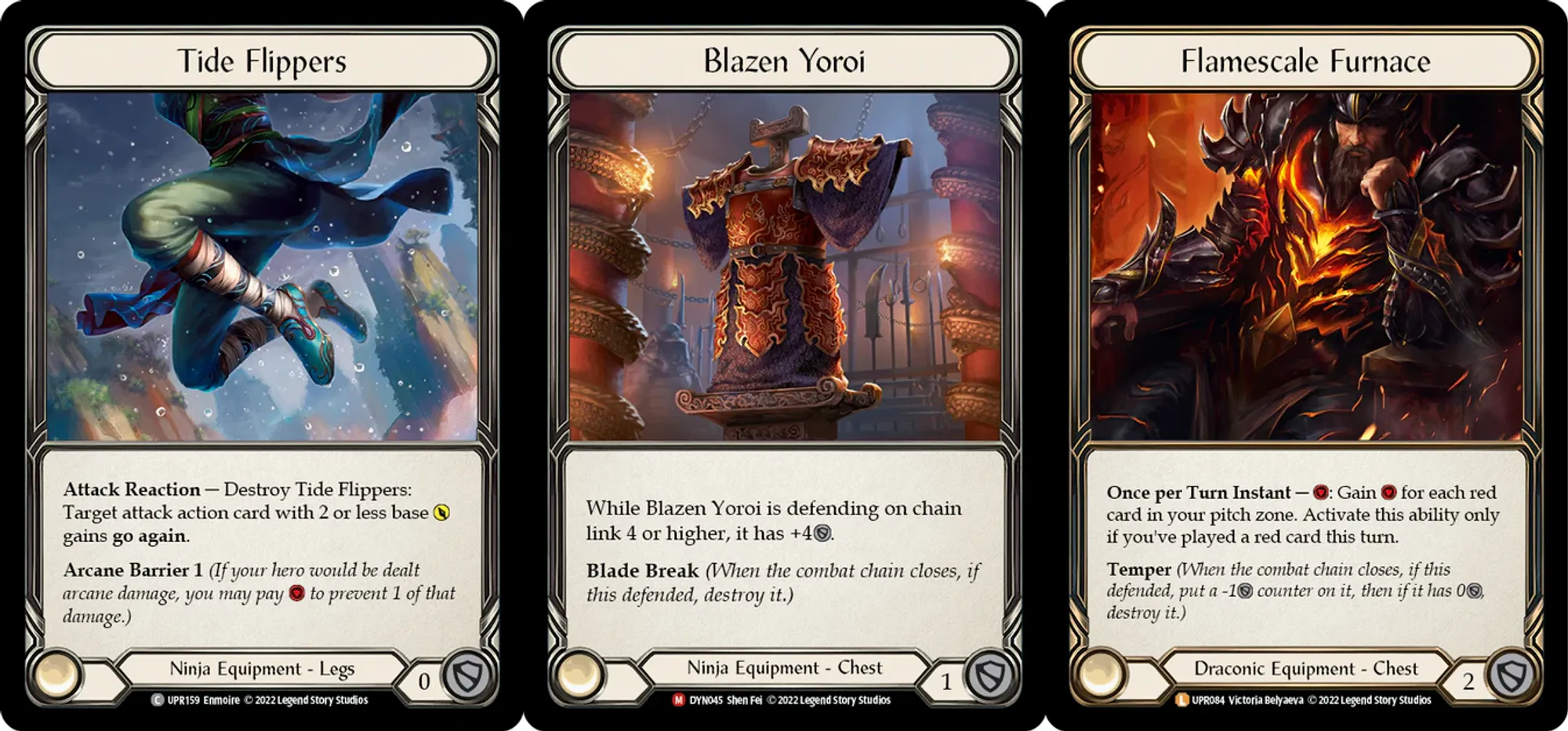
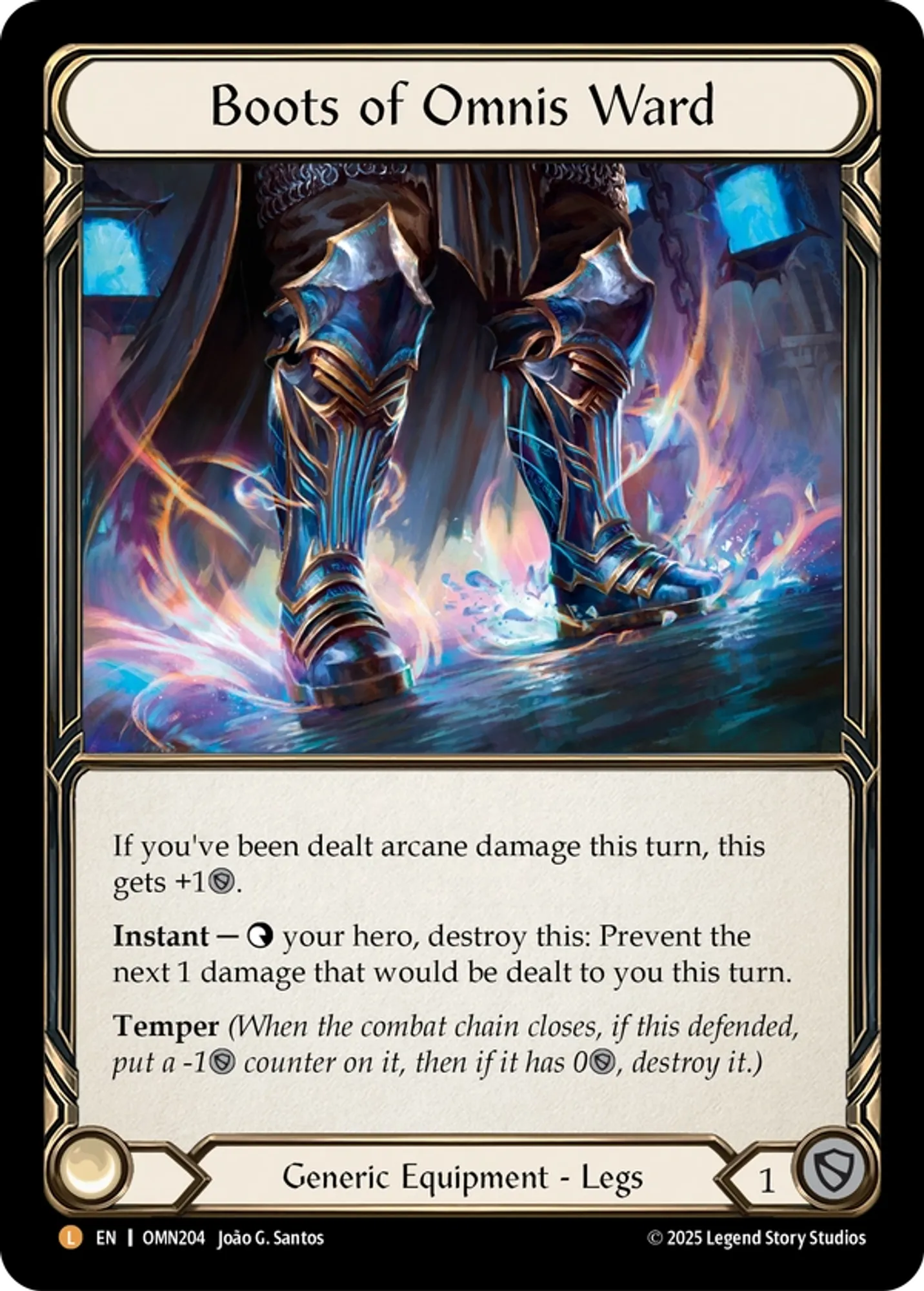
Lastly, I want to get into some equipment inclusions to target specific matchups I was expecting to face. Tide Flippers is there for Vynnset and pretty much Vynnset only. Midranging her is the best way to succeed, and you can't really do that if you let every Runechant deal 1 arcane. Flamescale Furnace is a general catch-all for your midrange matchups. When you substitute out half of the one costs in your combo configuration, the Fyendal’s Spring Tunic resource is significantly less useful. Don’t be afraid to throw this in front of a Hunter’s Klaive if you have reason to believe there are no reactions behind it. Blazen Yoroi is for all of the Ninjas (no, not you Ira!). Turns out anti-Ninja Carrion Husk is pretty dang good against Ninjas. And finally, the card that I am told I am responsible for spiking the price on, Boots of Omnis Ward. This card is here specifically for the Marionette and Cindra matchups as a one-time flick prevention. Denying their first opportunity for a mark or negating Mask of Momentum draw is quite potent against these two. It also has potential equity into the Gone in a Flash Oscilio lists and any Auroras that may be floating around.
The Field
We’ve now got a decklist designed to take on the biggest baddies in the world of Rathe. So let’s go through the top five most represented decks at US Nationals, and see how Fai matches up against these titans of the metagame.
Arakni, Marionette
Neutral Matchup
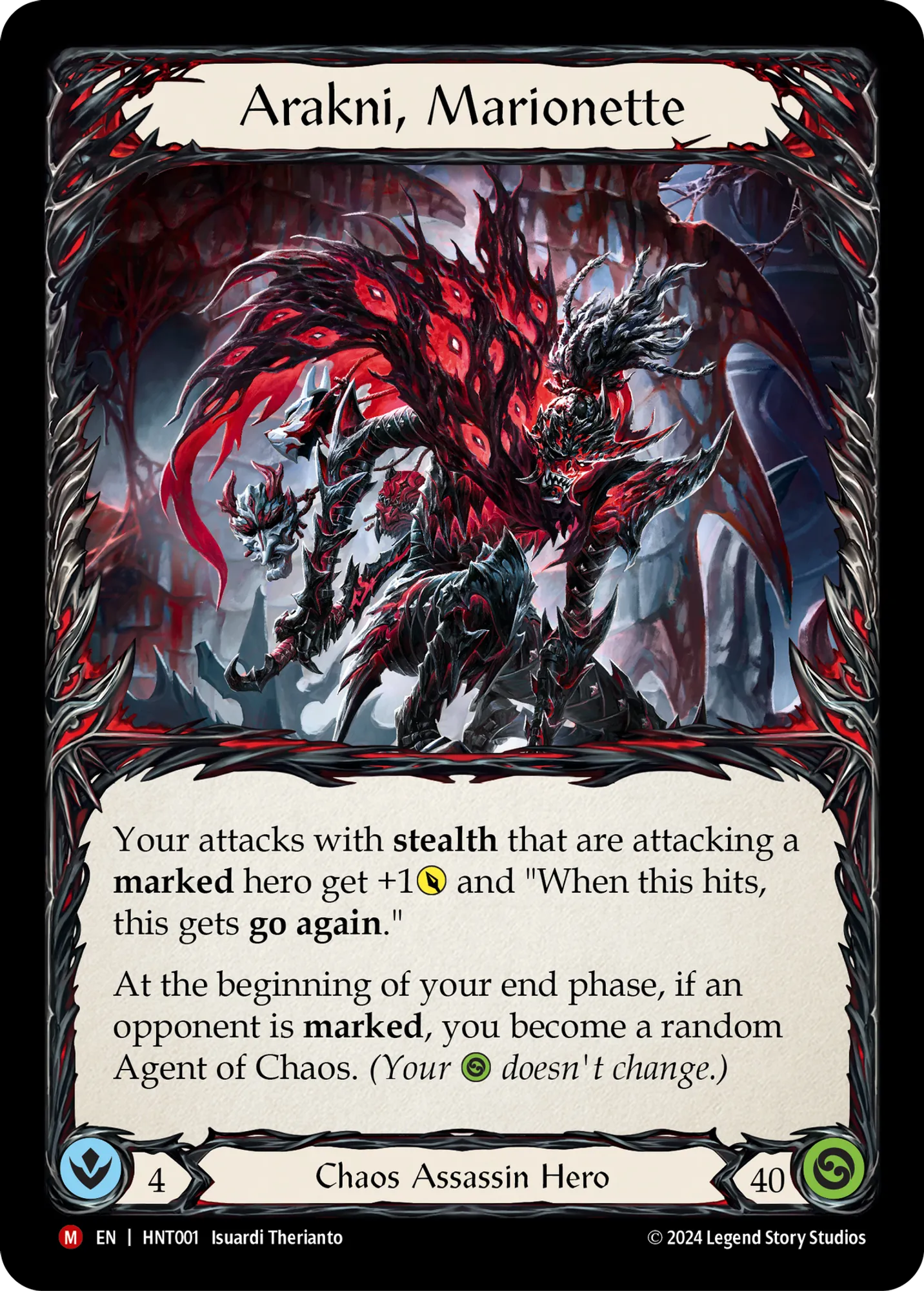
This matchup used to be one of the biggest reasons not to play Fai. Consistent disruption and high damage can be quite hard to take down when your opponent can get online quickly. But what if we can stall them from getting online for at least one turn? That’s where Boots of Omnis Ward comes in. Most Arakni’s have built their deck around being able to get a mark on their first turn of the game, block with Mask of Deceit, and transform into Arakni, Orb-Weaver. Stalling this opener for one turn can be game-winning in and of itself. And, without a free Klaive to flick away and with some smart blocking decisions on your part, you can really stall this out for two, sometimes even three more turns. When going second, my recommendation would be to block for 4+ defense on the first and second Klaive they swing. They have around a 13% chance, in an average Marionette deck, to have two dagger-based attack reactions. The chance of becoming marked is a little higher because of the presence of blue Reaper’s Call, but in the majority of your games, this strategy should insulate you from getting marked turn 0 after you activate Boots of Omnis Ward in response to Flick Knives. And it is usually smooth sailing from there. When going first, leak damage if you can, but if not, avoid swinging out to prevent mark-applying traps from blowing you out. I would recommend bringing in a midrange configuration for this one, as your most fiery turns are fanned out in the face of an onslaught of disruptive attacks. Additionally, defense reactions allow you to more safely block out disruptive on- hits like Mark of the Black Widow or Infiltrate when you’re worried about an attack reaction following closely behind. This deck has been completely absent from any Nationals top 8s so far, but you still should expect it to be quite the popular pick.
Victor
Unfavored/Favored Matchup
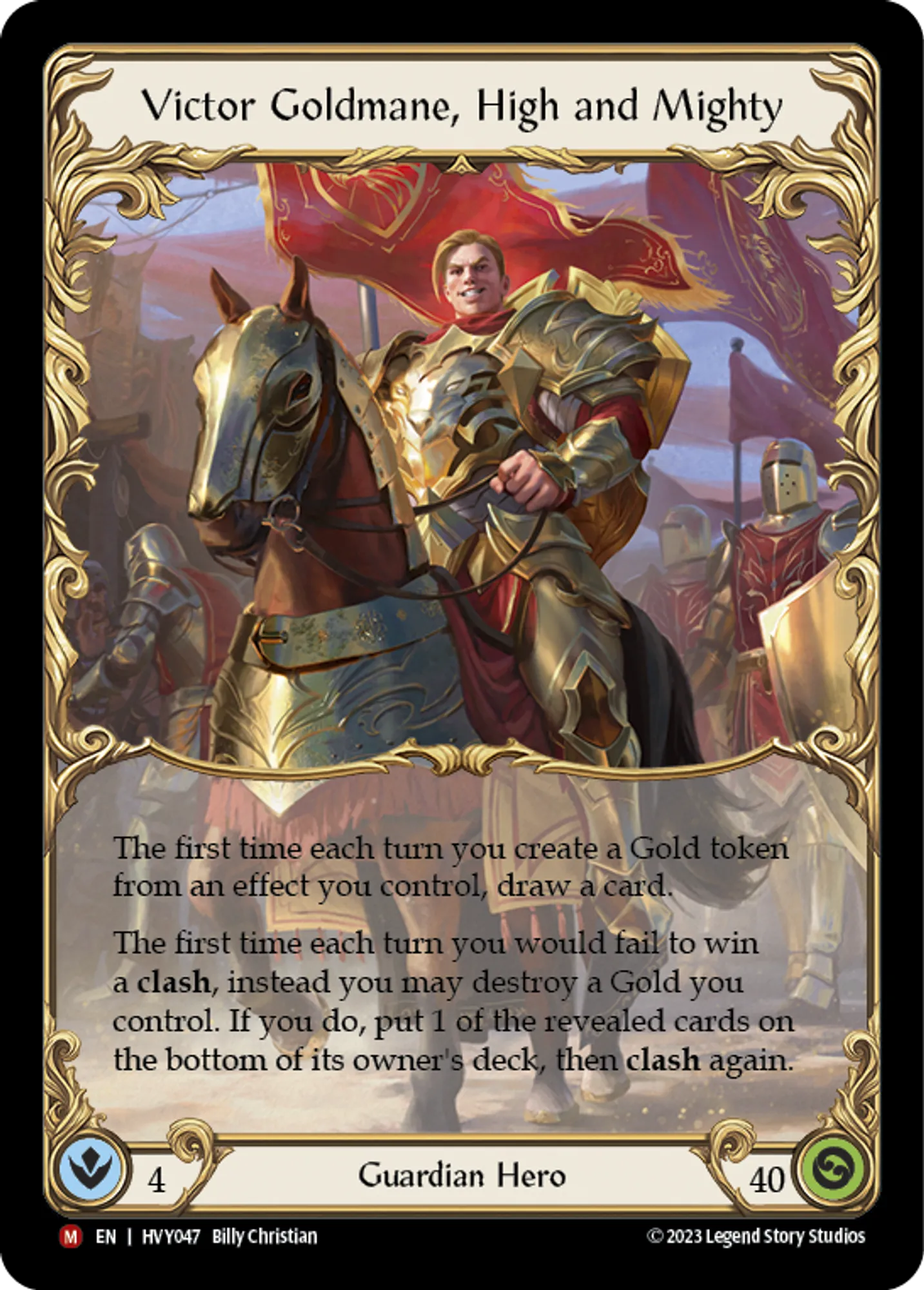
When Fai players discuss the matchup you would least like to see, the consistent frontrunner has been Victor. Large disruptive attacks that can skip your turn, Clash cards that are all but guaranteed to go in his favor, and a large fridge of armor make Fai’s usually strong offense look like a pathetic flailing of the arms. However, I believe this is a common misconception that has naturally perpetuated through reinforcement. If you forgo your turn cycle math and instead decide to turtle up and focus on setup, Victor can get stuck with large hands he struggles to convert. You can’t Clash if I’m not letting you block! With good play and a couple of things falling in your favor, Victor is certainly beatable. With Phoenix War getting into the mix, Fai now has more tools than ever to enable his combo game plan. Against tempo Victors, the matchup went from beatable to simply unfavored. However, tempo Victor wasn’t the only type of deck being registered at Nationals. Slot Victor is a version of the deck with less Clash equity and an increased focus on the fatigue side of things. This was mostly a by-product of Gravy Bones reentering the classic constructed metagame and Victor needing an alternative strategy against the shipwrecked looter. Even against popular aggro decks like Cindra and Dash I/O, Victor had a very potent win con of running these two decks out of threats. What slot Victor players didn’t account for was an aggressive deck that was nearly impossible to fatigue. Fai was a perfect foil to this type of Victor strategy, and this is a key part of how Fai performed super well. One of the matchups we were the most scared of suddenly became winning! I put this at an unfavored/favored matchup because it is largely dependent on what build they are running. Be sure to pay attention and try to catch on to which version you’re facing, then adjust your game plan accordingly.
Gravy Bones
Favored Matchup
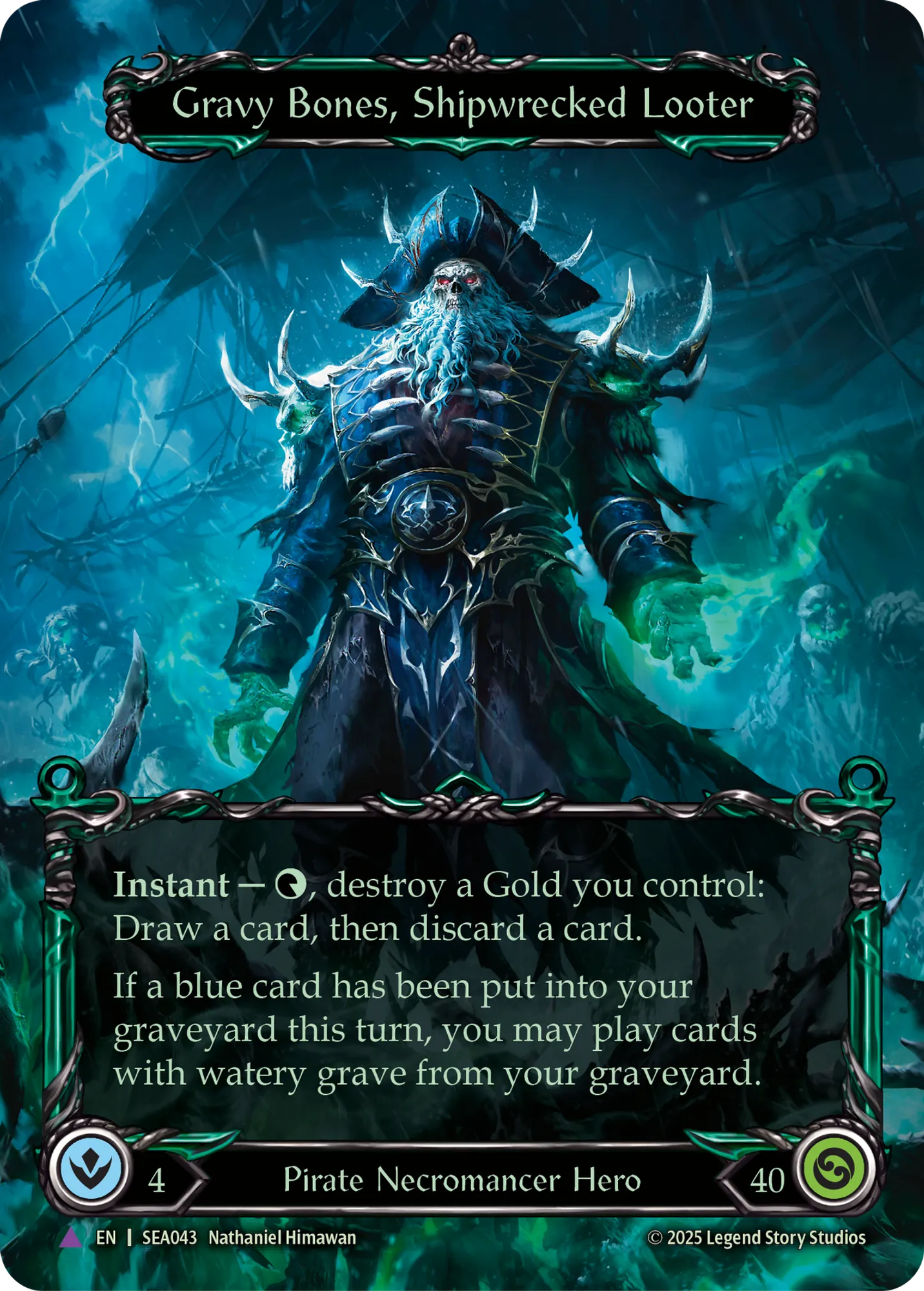
Aggressive Ninjas like Cindra and Fai make it really difficult for Gravy to set up strong allies and get value from them. When Victor and Marionette were looking to be the top decks, the presence of Gravy Bones was all but guaranteed. These Illusionist/Necromancer types are what long combat chain decks thrive into. Just because it's favored doesn’t mean the matchup is a done deal. Conqueror of the High Seas can certainly blow you out of the water when you want to use your arsenal to play out your most powerful turns. Sea Floor Salvage and Sunken Treasure threaten to put your Phoenix Flames in precarious situations. The latter of the two is especially potent when you’re caught in a blue-dry hand. Always try to have a plan if your opponent gets the privilege to block with a Sunken Treasure. Warmonger's Diplomacy is very potent at stopping what Gravy Bones wants to do. However, Warmonger’s also shuts down your most powerful playline, Rise from the Ashes -> Art of the Phoenix: War. Sure, the matchup is favored, but the skills to navigate tough game states are a crucial part of closing it out. Variance and wrestling with it are baked into Gravy Bones’ core. When they draw their last Tip the Barkeep off of a Gold to win the game, be sure to laugh it off and remember that Gravy Bones just be like that sometimes.
Cindra
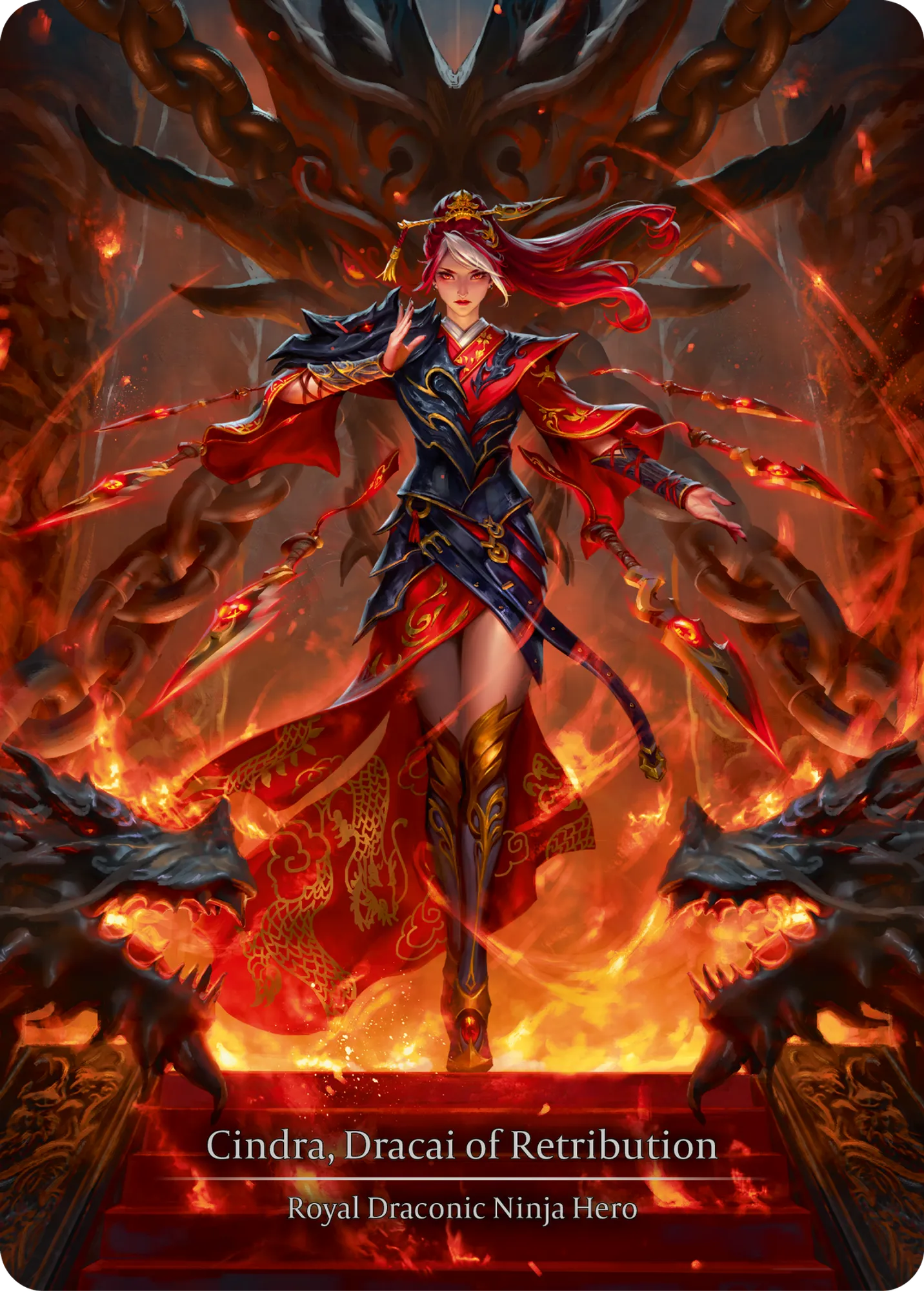
Extremely Favored Matchup
Now we get to her… my arch nemesis. Luckily, we completely trounce this deck in around 80% of our games. Despite what the Talishar win rates might show, this matchup is very difficult for Cindra to win, and she needs some very specific things to go right to even have a slight chance of victory. The combination of Yoroi plus Boots of Omnis Ward allows you to prevent two mask draws by only committing two total cards from hand. After preventing one Momentum trigger from connecting and sometimes after preventing two, you can now play an aggro mirror where you start with a 20+ life lead. I find it hard to explain to people who have struggled in this matchup why it's so favored. Luckily for me, Matthew Gump completely annihilated Charles Dunn on coverage. Trust me, this is what an average Fai vs Cindra game looks like at a high level. The one way you can lose this matchup is if you get caught out and let a Mask of Momentum draw happen on turn 0, or a well-timed Ancestral Empowerment punishes you for even thinking of blocking. Reps into Cindra are important so you know when and where you should commit your equipment. Be aware of the hiccups you might face, and it should be smooth sailing.
Oscilio, Constella Intelligence
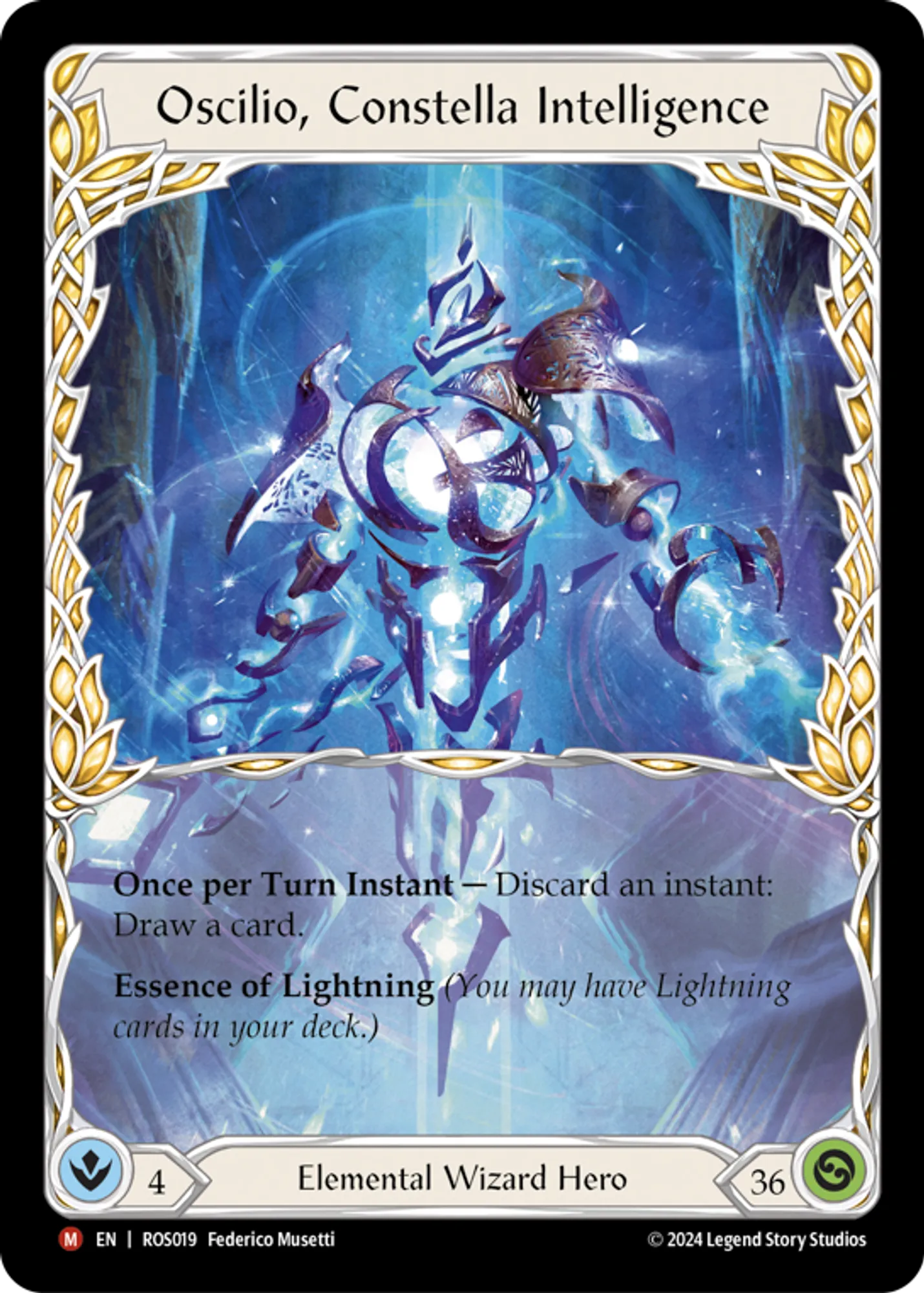
Favored Matchup
Oscilio, for all intents and purposes, was the breakout deck of US Nationals 2026. With two different versions, Spellscilio and Greavescilio, making it into the top 8. Let’s break them down individually, as they ask very different questions of you as a Fai player.
Spellscilio is a mono-arcane deck designed around leveraging powerful Amp effects onto an Aether Flare to deal massive arcane damage to unsuspecting opponents. Without a real dedicated Wizard being the talk of the town going into the event, players skimped out on Arcane Barrier equipment. A mistake that spells doom for most, but if you’re an aggressive deck that doesn’t want to prevent damage anyway, you feel like you’re in a pretty great position. There is not much in the way of strategy when facing off against types of decks like these. Focus on getting maximum value out of every hand and hope that it’s enough to kill them before they kill you. If you know your opponent is running this version of the list, bringing AB1 and even AB2 can be a massive help for expanding the kill range these decks are so desperate to get you to. I would recommend going first against this type of deck in order to prevent leaking a lot of arcane damage turn 0, and also for setting up for a chance to leak damage in case they fortunately draw a plethora of instants.
Greavescilio (I don’t think it has a formal name, so this is what we will stick with for now) is essentially a 0 for 4, Go Again slop deck that goes over rate with one Gone in a Flash + Lightning Greaves turn. Although arcane damage is present, physical damage is what you really have to deal with here. You feel pretty comfortable against this type of deck as, ironically, you’re the one with a lightning-fast offense that wins out. You actually want to go second into this type of strategy, as tempo is everything in these kinds of matchups. This presents a really tough challenge of guessing which version of Oscilio your opponent is on. They both require different turn orders and different sets of equipment. One of the solutions proposed recently was running Double Cross Strap and Boots of Omnis Ward. If you don’t need the arcane barrier, you can cash Double Cross Strap in for a resource, acting as a pseudo Tunic. Boots of Omnis Ward can also get you 3+ blocking value, as there are numerous 1 arcane pings in Greavescilio’s instant pool. Against Spellscilio, the AB1 and the one-time prevention can act as a way to deal with a powerful Aether Flare turn. This equipment combination does need more testing and is just an idea for now, but it may prove very useful if it’s shown to be potent in my practice games.
This, hopefully, will help you wrap your head around why Fai was such a strong pick for the Nationals' season. He had quite the powerful matchup spread against the most popular decks. The viability of Fai in this current meta also doesn’t seem like a flash in the pan. The Japan and New Zealand National Championships both managed to get one copy each into their respective top 8’s. Fai is here, he’s real, and people are going to start having to consider his presence when making crucial deckbuilding decisions.
How the Meta Might Adjust
As much as I hate to admit it, Fai has his weaknesses just like every other deck in the game. Although most competitors at US Nationals avoided adding Fai specific tech pieces, I expect the hate cards to come flowing downstream to your own National Championships. Let’s briefly go over some of the hate cards you may have to face down!
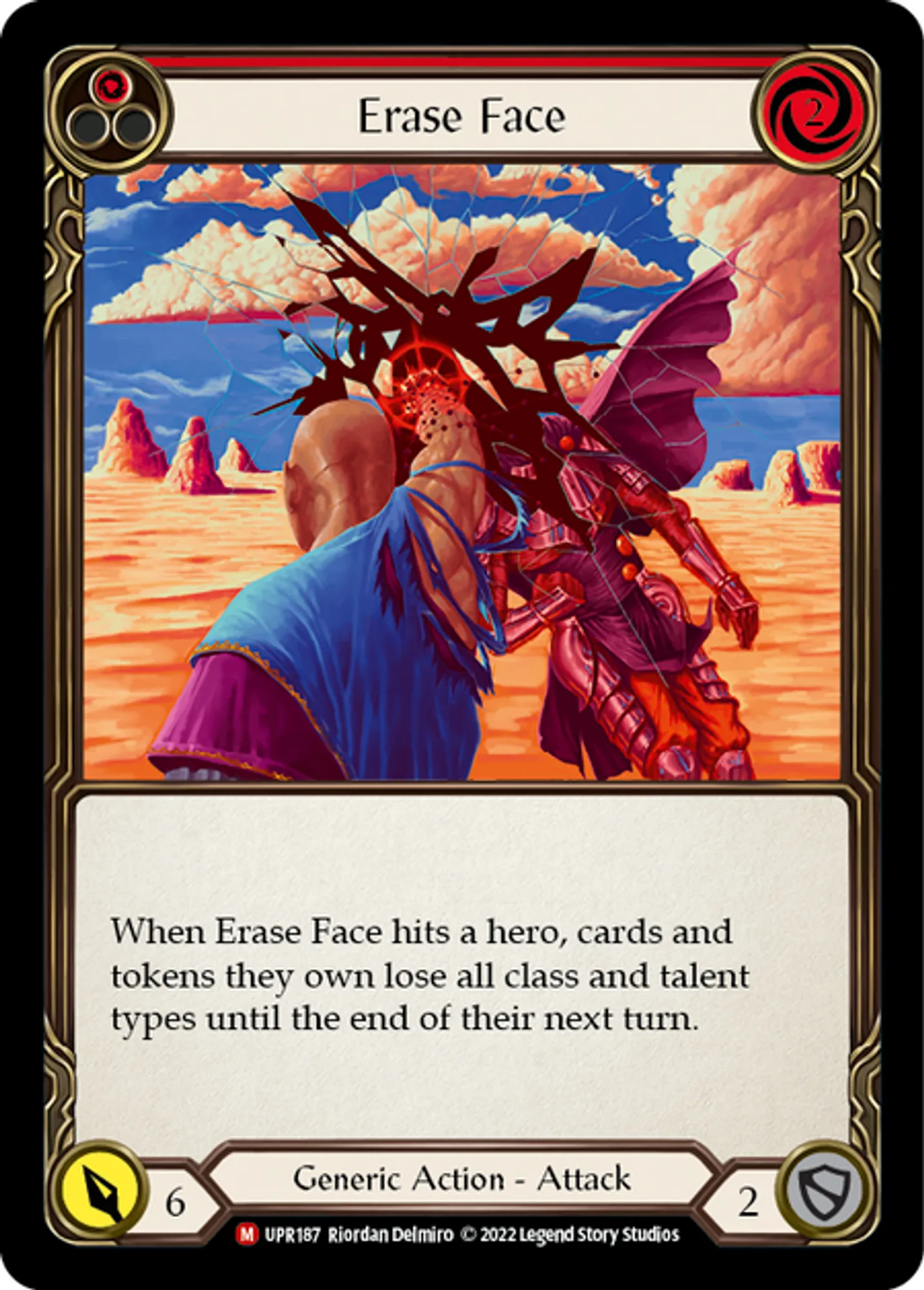
Erase Face is such a nightmare to deal with, as your entire deck is built around playing Draconic cards. Most of the time, you just have to block this one out, but if your hand contains a lot of cards with unconditional Go Again, you can still cash them in for a reasonable offensive turn. Erase Face importantly doesn’t stop you from turning cards Draconic with Fealty tokens. This card also has equity into Dash I/O and Cindra, so I expect this card to pop up as an all in one counter to the prevalent aggro decks of the meta.
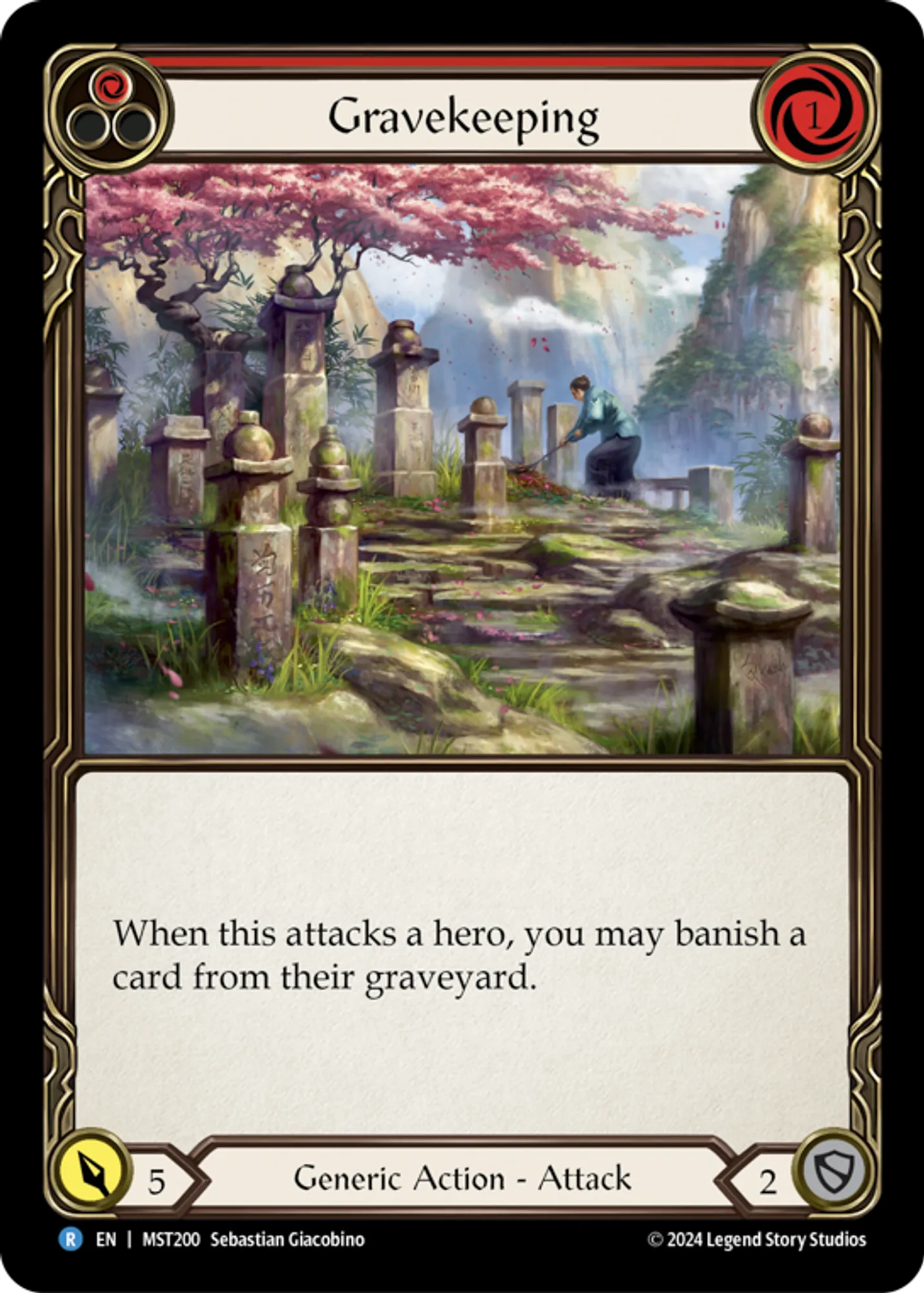
Graveyard hate sucks, it really does. But the generic graveyard hate kinda sucks too. Gravekeeping is probably the best option for most decks looking to target both Fai and Gravy Bones. However, its 1-cost nature and its 2-block downside make it really awkward to actually play. It's a large opportunity cost for something that a Fai activation completely negates. It can be a blowout if you’re not prepared and are lacking in ways to save your only Phoenix Flame in the graveyard, but most of the time it's not. I wouldn’t worry so much about this one relative to some other hate you might come across.
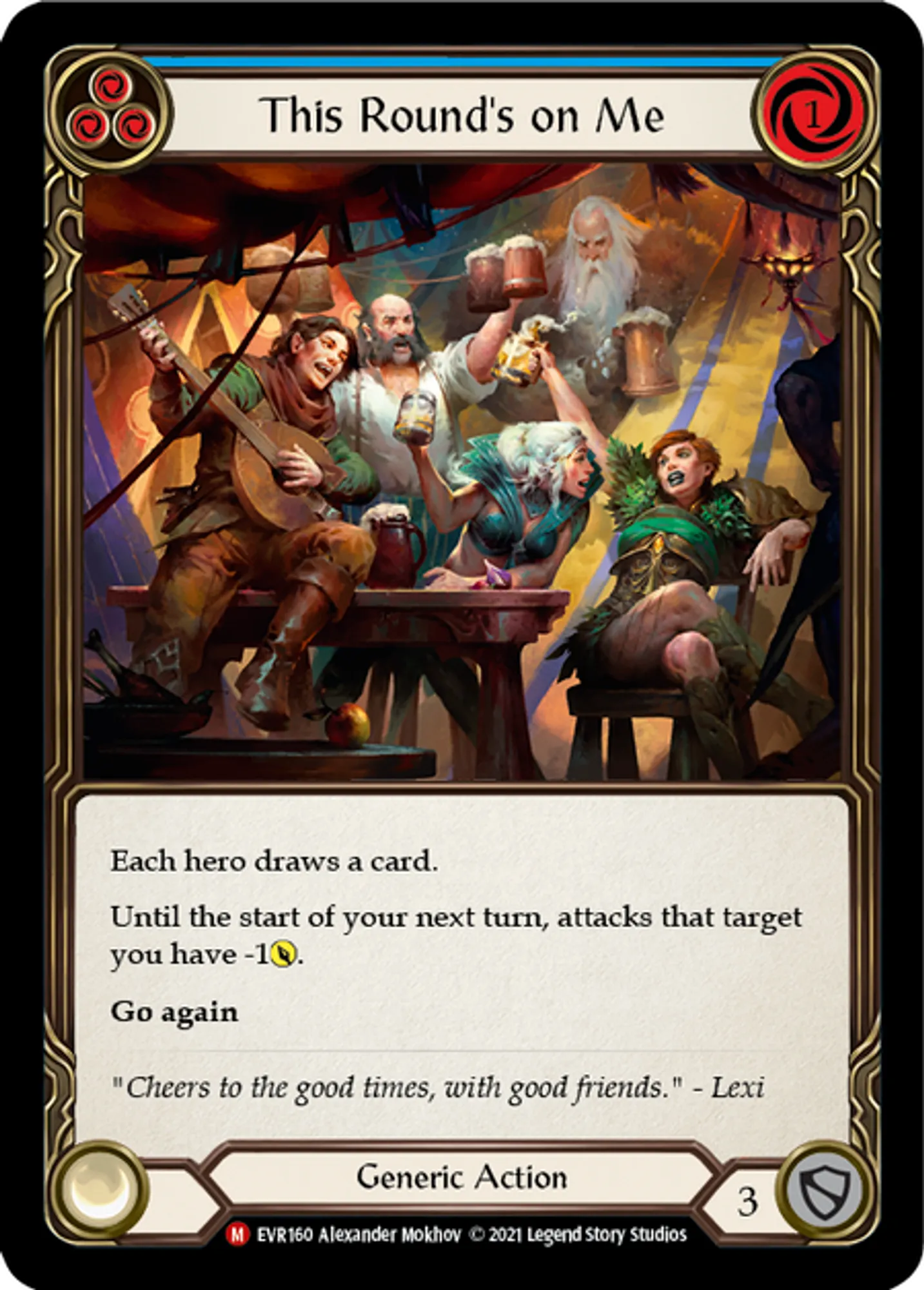
This Round’s on Me gives you a card in exchange for your entire turn having an inverse anthem. This can be a great way to lower your damage on some of your most powerful pop-off turns. I mostly see this card popping up as a tech piece in the Fai mirror to add more matchup equity on turn 0. If you’re facing down this card, avoid using all the cards in your hand and try to play out towards a setup turn if you are given the luxury.
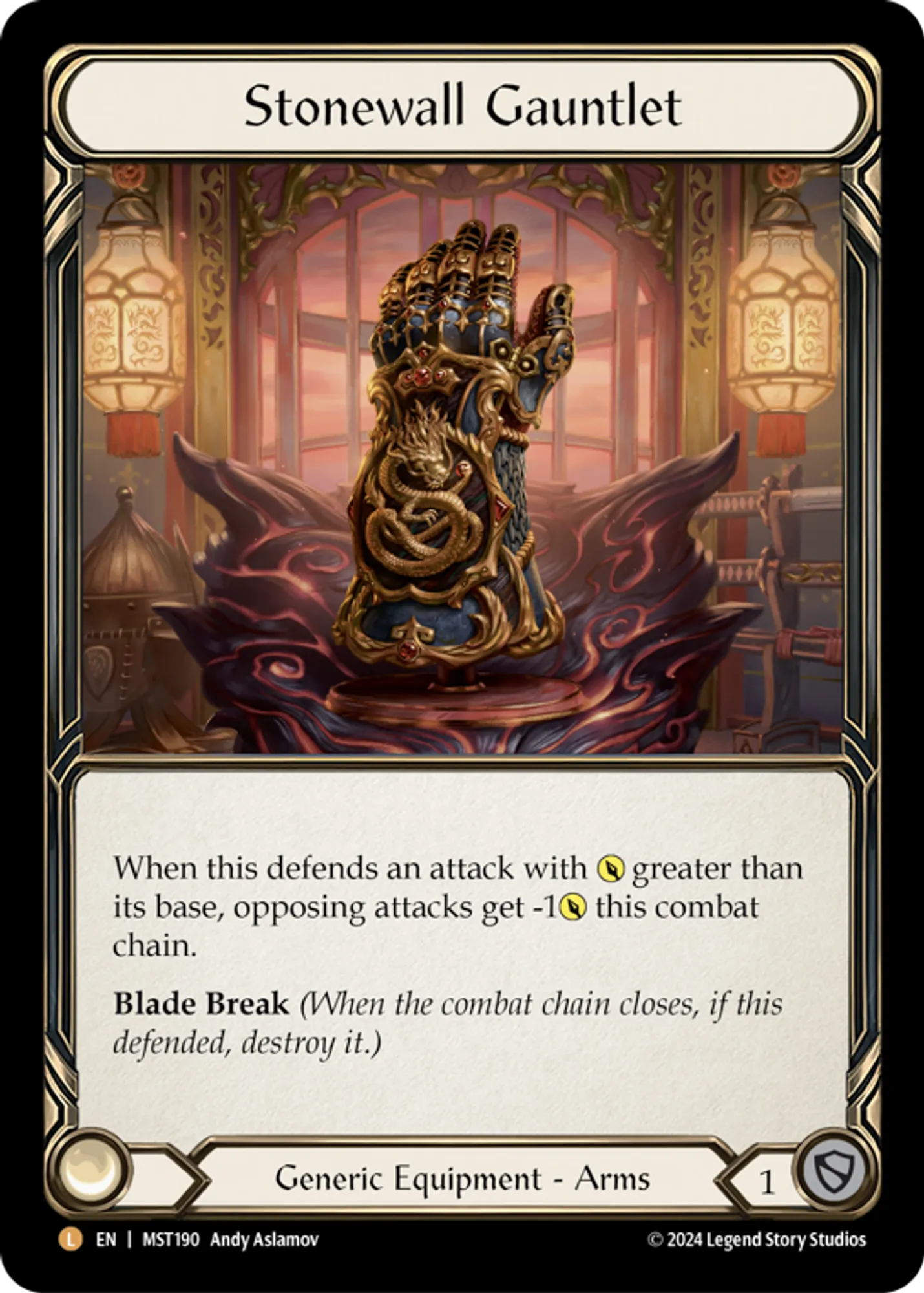
Start in play, stay in play disruption adds an element to FaB that I really enjoy, and Stonewall Gauntlet is no exception to that. Acting as a “This Round’s on Me" style effect on an equipment without the primary downside is quite good. Most opponents will save this for your Art of the Phoenix: War turns to cash it in for massive value over a long combat chain. Although it goes against everything you learn as a fledgling Ninja player, sometimes closing the chain is the best choice. Phoenix War affects all cards for the entire turn, so its anthem effect is still well and alive even when your original combat chain isn’t. If you have two starters in hand, you can catch hasty opponents snap blocking with Stonewall and only let them get 2 value by closing the chain. It’s a game of chicken against high-level players, and is a fun mind game once you realize how much agency you have in it. Take your time, think through the possible realities, and you should be able to minimize this equipment's effectiveness.
Personally, I don’t think Fai’s presence really shakes up this current meta too heavily in terms of hero choices. Fai and Cindra share a few weaknesses, and the meta already was expecting a Draconic Ninja to be one of the top dogs. The decks that I’m most scared to see pop up are Prism and Marlynn, which are the top two worst matchups you can ever hope to run into. If we are considering potential heroes LLing, that very much so changes my tune. The most likely hero to LL currently is Victor Goldmane. And although I am glad to see him finally sunset, your significantly better matchup into Victor relative to Cindra is one of the biggest boons of playing Fai currently. Gravy also could fade back into the watery depths if both Victor and Marionette effectively leave the top of the meta. It’s a very tough call to make on how the meta will shake up, but be on the lookout for how the tides change leading up to Pro Tour: Las Vegas.
Thank You So Much!
I’d like to thank you all so much for taking the time to read through this article. Hopefully, I’ve given you enough tools to get a Fai-re started at your respective National Championships. Fai is getting up there in terms of points, so get your games in while you can! If you have any questions about parts of the article or need a deeper dive into a specific concept, please feel free to reach out to me on Discord (slatty_v3). There is nothing I love more than discussing specifics about our rebellious little fellow. I’m very docile, and I don’t bite, trust me >:). Good luck Faimilia, and send Fai off in a blaze of glory!
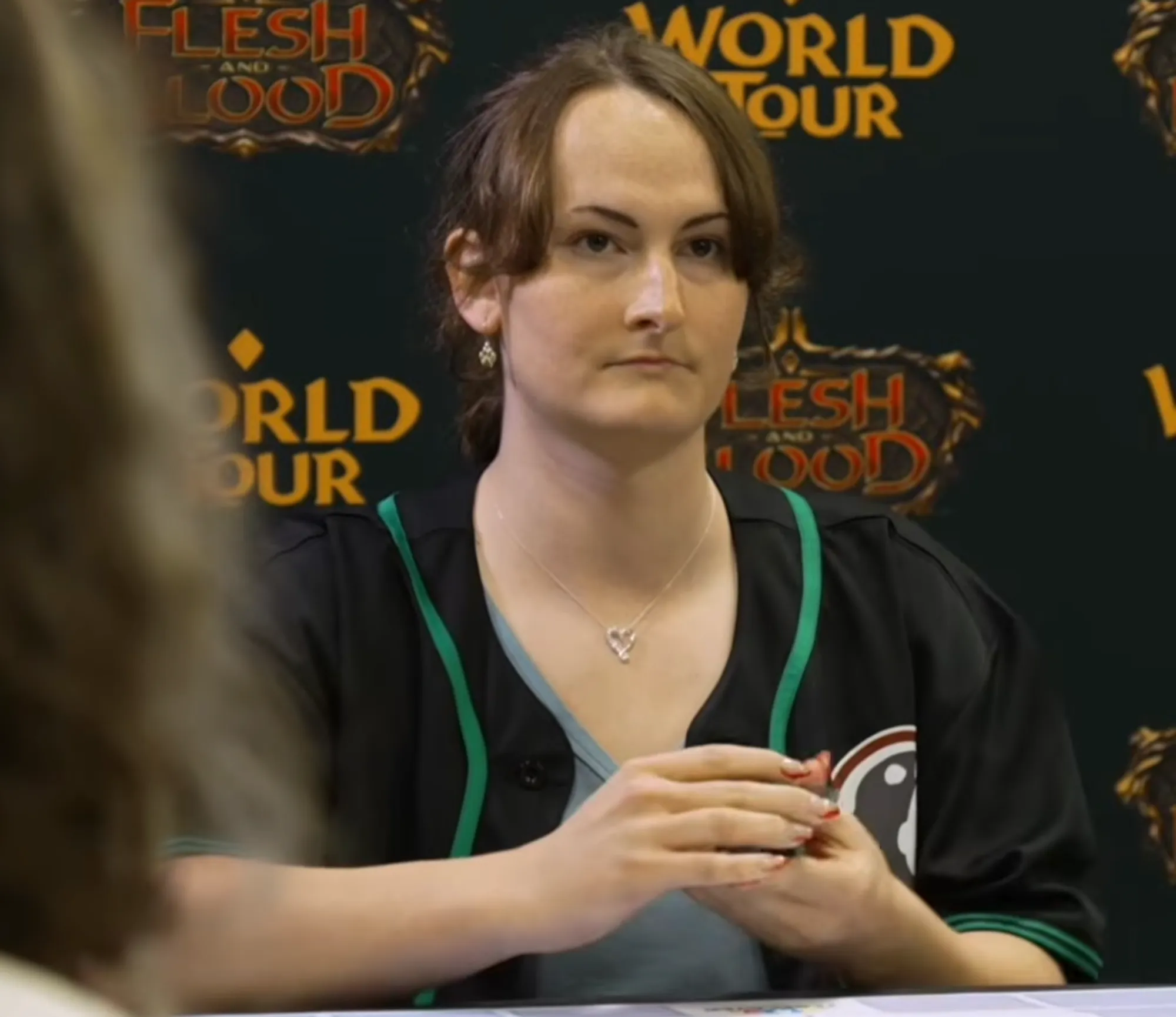
Ashlyn Slattery
I'm Ashlyn Slattery! Or as some of you may know me from my YouTube page: AshlynV3. I got a lot of fiery passion for our rebellious little Ninja, Fai. I've made guides, gameplay videos, and meta updates ever since the release of The Hunted. Making educational content is my biggest passion in the Flesh and Blood space. So, hopefully you can learn a trick or two from yours truly <3