

I'm New Here!
Welcome! I recently won the August AGE STL Open on Aphrodias Zyggy, an unconventional pick in the current meta, and I want to talk about why it might not be such an unconventional pick after all.
But first, who am I? You might not have heard of me before, but others have taken my decks to greater success than me. I first put Verdance on the map at Calling Memphis, taking her to 9th at the Calling and 5th at the Battle Hardened the next day at the start of the Hunted meta. A week later, soon-to-be US National Champion Majin Bae took the same exact list to win a Battle Hardened, just a week after picking up the deck.
Likewise, at the start of the AGE STL Open series, I took Oscilio to the finals, losing magnificently on stream to Lucas Oswald. Peter Buddensiek then took the exact same list to win the January AGE LA Open the next weekend. So, if we follow the pattern correctly, one of them will definitely win the next Calling on Aphrodias Zyggy.
Why Zyggy?
What if I told you there was a deck that played like pre-ban Oscilio, but with more consistency, disruption, and Storm Striders, at the cost of a slightly lower combo ceiling? Enter Zyggy Starlight and his signature weapon, Aphrodias. They have access to overrate Illusionist attacks, the explosive Gone in a Flash and Lightning Greaves combo, and a pseudo Storm Striders in Starfield Touch. Most players are on Refractor or Iris for Zyggy, but some ‘crazy’ few have been working on a few versions of Aphrodias Zyggy.
Starplate Zyggy
This version leans heavily into Plutonic Starplate, which grants you a resource the first time you play a Lightning card on your opponent's turn. This curves nicely with 1-cost auras like Corrosive Space Dust, making it a 2-card 8 on your opponent's turn:

Cards like Blur Reality also make an appearance, since you can use it to flicker an aura, gain a resource from Starplate and ping your opponent with Aphrodias. To deal with Guardians and fatigue, this list switchboards into Reality Refractor to swing auras for 5. That’s right, Aphrodias is the headliner, not the understudy.
While fun, this version lowers the Gone in a Flash combo ceiling since you always have to pitch to activate Lightning Greaves, and a lot of your instants cost 1. In my testing, it also struggles against Flick Knives decks, since without a cheap Ward up, they eat your 4-Ward Corrosive Space Dust with a flick. Iris has an easier time into fatigue than Refractor too, which leads me to the next version.
Tunic Zyggy
This version runs Tunic and more of the blue 0-cost auras. 1-cost auras come at a premium, so only the red Corrosive Space Dusts and Circular Flowtides are run. But since it's on Tunic, this list can abuse overrate Illusionist attacks like Miraging Metamorph and Spears of Surreality.
Additionally, since it's on 0-cost auras, this deck can easily switchboard into Iris, making the fatigue matchups easier. It also has an easier time into Flick Knives decks, since you'll usually leave behind a blue 1-Ward aura, perfect for preventing the flick from those pesky aggro decks. This is the version I ended up on for the August AGE STL Open and for the upcoming meta.
Decklist
Aphro Iris Switchboard Aug AGE STL
Sigil of Conductivity
The thesis of the deck lies in one card: Sigil of Conductivity. The hidden ace in pre-ban Oscilio, this aura is even stronger in Zyggy, thanks to the new flicker mechanic. Zyggy's hero power lets you destroy your own Lightning Flow and flicker Sigil of Conductivity, generate an Embodiment of Lightning, and give your Gone in a Flash Go Again. Then, with the remaining resource, you can either send Aphrodias, Miraging Metamorph, or – if you have a Tunic counter – Command and Conquer.
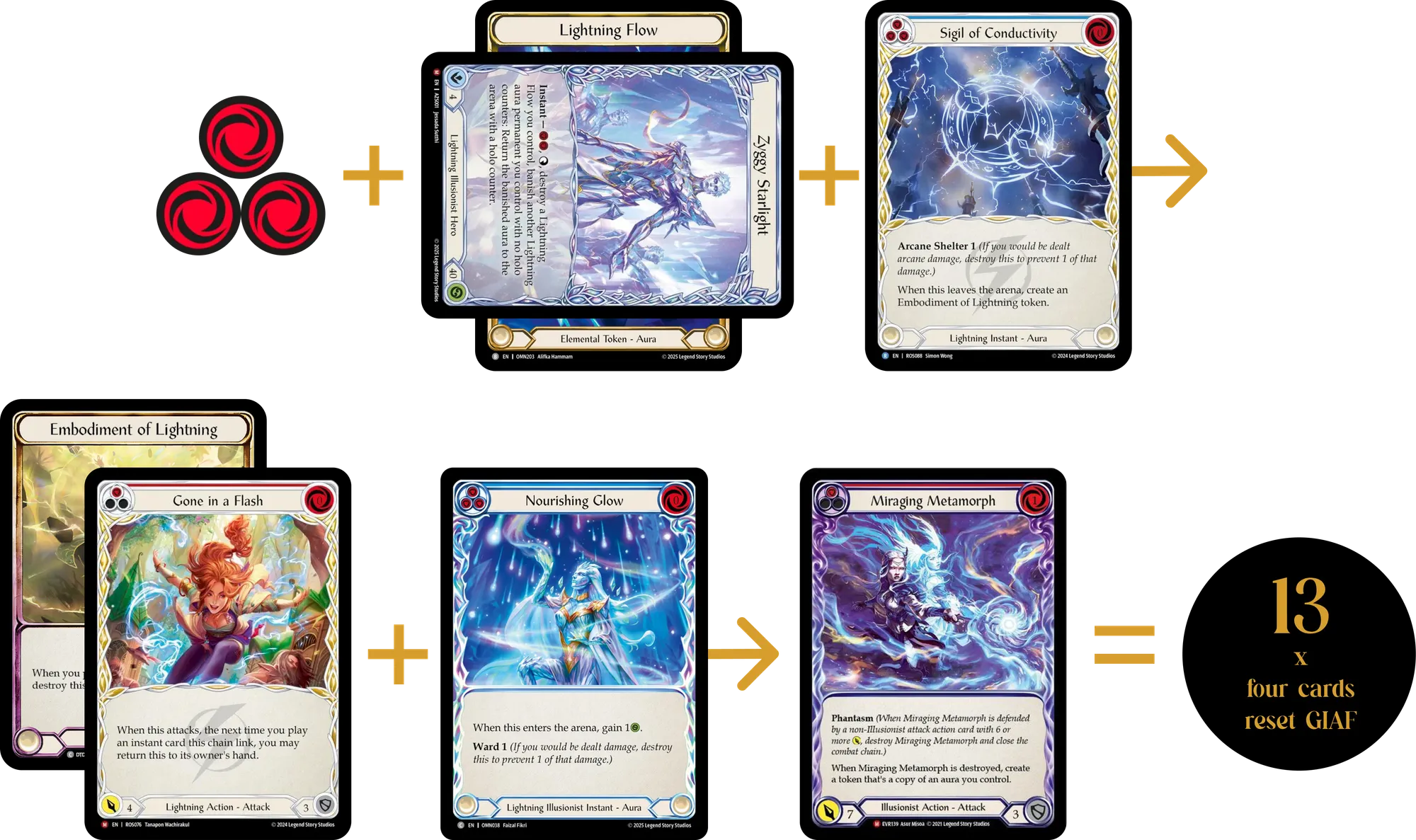
Compare this to pre-ban Oscilio, who required an Embodiment of Lightning to be on the field or a setup turn with Blast to Oblivion to make a similar line possible. This consistency means, if given the space, you can always convert your hand once Conductivity is in play. And since most heroes don't do arcane, it tends to stick around once played.
And now for the spice: pairing Sigil of Conductivity with Flash of Brilliance also allows you 3 uses of a single copy in a game: first you flicker it, then you use Flash of Brilliance to return it to your hand, and then you get to flicker it again.
Tunic Targets
The deck is heavily reliant on your tunic counter.
First the auras. With a Tunic activation, we get to do the Starplate thing and play Corrosive Space Dust, flicker it, and send Aphrodias in one turn for a 2 card 8. Circular Flowtide can also be flickered and backed up by Aphrodias in one turn for a Lightning Flow neutral Aphrodias ping. However, thanks to Stardust Spike, we can also do this at any time Stardust Spike leaves the arena, since that generates us a resource and amps 1. This ends up being the way you play these auras a lot of the time, since the next cards rely on Tunic even more.
Miraging Metamorph and Spears of Surreality. With a Tunic activation, Miraging Metamorph becomes a 1 card 7. There’s no better rate in Flesh and Blood. Spears of Surreality, when paired with Gone in a Flash and an instant, also becomes a 2 card 10-12, depending on what the instant is. These are the plays you usually save your online Tunic for.
Gone Package
Our Gone in a Flash package includes a lot of 0-cost auras, most of which have Ward 1 and an extra benefit on the side. Where pre-ban Oscilio got at base 1-2 value off each bounce of Gone from Volzar, we get 1-2 Ward to help insulate our next turns. Of note, Starlight Road is also an MVP here, as it allows you to continue your (non-combo) Gone in a Flash turn via an Embodiment of Lightning. I almost got to pull this off in the finals against Mario (if not for a Leave No Witnesses forcing me to play out an aura from arsenal to not lose it).
Gone in a Flash with Go Again → play Starlight Road creating an Embodiment of Lightning to bounce Gone in a Flash → play Gone in a Flash → bounce it with a 0-cost aura from arsenal → end the turn with Phantasmclasm.
Disruption
Command and Conquer and Phantasmaclasm are the best disruption pieces we can run, and helps slow down the game until we can set up a big Gone in a Flash combo. I also play 1 Crackle from Afar, so sometimes this lines up with Command and Conquer to steal the opponent’s arsenal. The hand knowledge you get from Phantasmaclasm is also massive, and helps you play around their next turn better. Just be sure to remember what cards you saw when they were revealed, unlike me in Top 8.
Fragment?!
This is the most controversial piece of the deck for sure. Many have said that the Fragment mechanic is bad, and they’re not wrong. However, into aggro, I think it does wonders. If your opponent blocks, you’re happy, since their cards normally convert for more than 3 value on offense. If your opponent doesn’t block, you’re also happy, since you just pulled off a 1-card 5. I picked the two most beneficial Fragment effects for the deck – Shattering Flowtide for Lightning Flow generation, and Unwinding Finality for recursion and, sometimes, card draw. Since we play so many instants, even if you don’t have Go Again, you can usually play the card you draw from Finality, and we also have Crackle from Afar and Fleeing Starbreeze to pump it by 1 or give it Go Again.
Iris Package
These are your standard cards you would include in an Iris list. Haze Bending for the extra turn it buys you when a Guardian wastes their turn clearing it, and Astral Etchings to make a super powered Spectral Shield that you try to protect for the rest of the game.
Gameplan
First or Second?
Generally, I like to go first, since there are a lot of no-block instants in the deck. You can usually set up a few auras on turn 0, or even discard Cosmic Duality to generate a Lightning Flow early (ping yourself and Arcane Barrier it, unless they have no Arcane Barrier, to prevent your opponent from filtering). I will also send a Shattering Flowtide turn 0, trading a Flow for letting the opponent filter one card. The first Flow is really important, since a lot of auras are dependent on being flickered.
Aggro
For aggro matchups, I bring in Cap of Quick Thinking to filter aggressively for Gone in a Flash and to insulate myself against instant-heavy hands.
Early game (before you draw Gone in a Flash) block and conserve your life total. Play disruption like Command and Conquer and Phantasmclasm, or look for high-value plays like Tunic Miraging Metamorph. Use Cap of Quick Thinking if you need to filter for a card.
Walk your life total down with the opponent, but make sure you save yourself a life buffer, so you can take a pivot turn once you draw Gone in a Flash. Your goal is to get them down low enough where they have to start blocking just to stay alive.
Post combo, they should be in the single digits, or you should have full tempo to go on the offensive. Flicker cards like Conductivity to go wide with your Gone in a Flash, or flicker Corrosive Space Dust to defend and chip them down. Look for opportunities to finish them off with arcane.
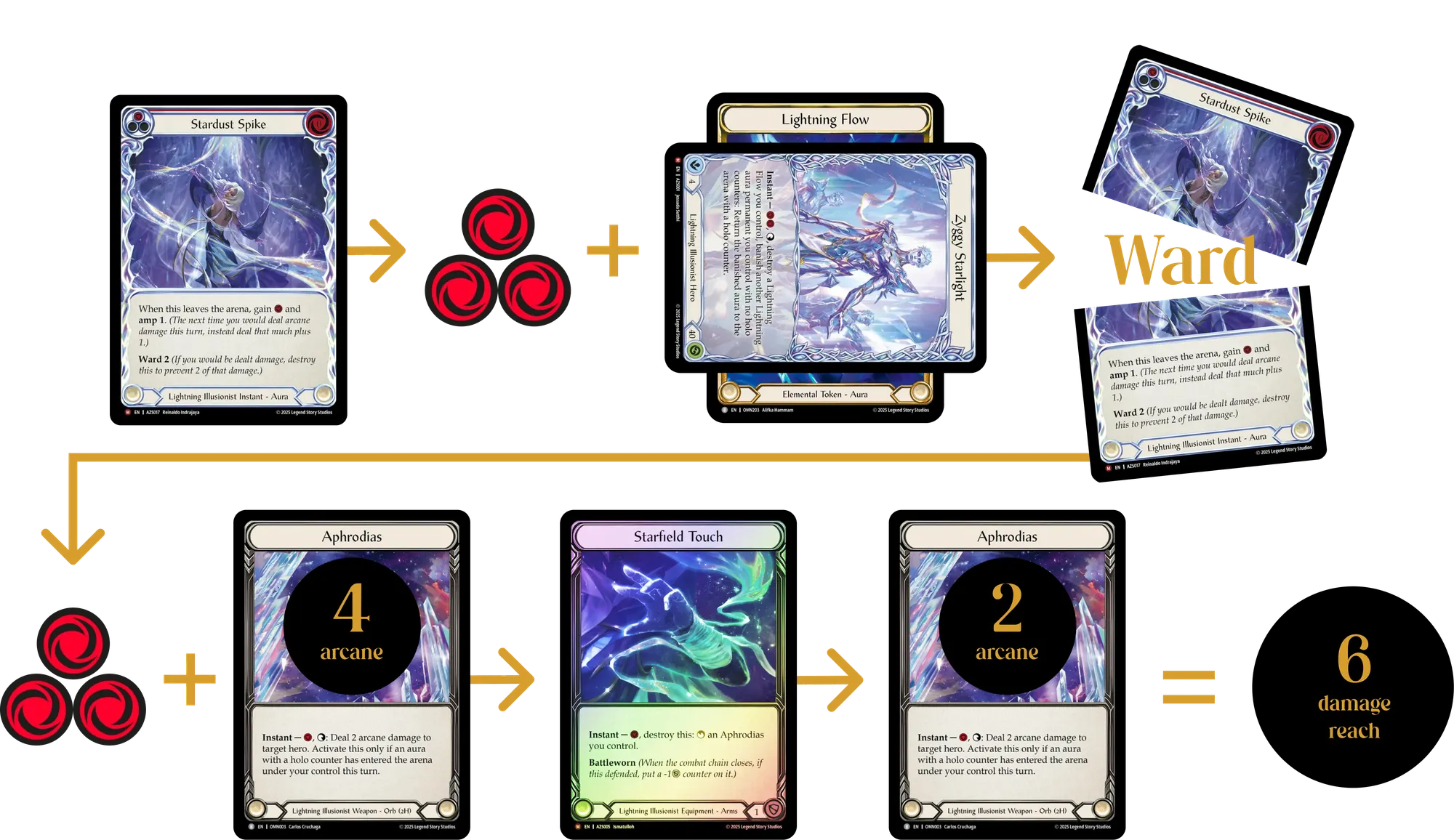
Aphrodias combo: Play Stardust Spike → flicker it → lose it → send Aphrodias for 4 → activate Starfield Touch → send Aphrodias for 2.
Make sure you watch your Lightning Flow count. In aggro matchups you don't have too much space to generate Flow.
Midrange
In midrange matchups, I bring in Flash of Brilliance to get as much value out of Sigil of Conductivity as possible. Lightning Flow generation is key here, and you want to ping your opponent with Aphrodias as much as possible.
A common way to go positive in Lightning Flow is to play out Flicker Reality and arsenal Circular Flowtide. On the next turn, when they pop Flicker Reality, respond to it leaving the arena with Circular Flowtide, flicker the Circular Flowtide for free, and ping with Aphrodias.
Another powerful play is to let a Flicker Reality die, flicker a Sigil of Conductivity that's in play, then Tunic Aphrodias. Flicker Reality targeting Stardust Spike is also very strong since Stardust Spike generates the resource for you to activate Aphrodias.
When going for the Gone in a Flash combo, make sure you'll have an Embodiment of Lightning on the next turn, since your opponent will likely block with their whole hand. Common ways to do this are to have Conductivity and Lightning Flow on the field, or to play Starlight Road or Sigil of Lightning as part of your combo.
Fatigue
In fatigue matchups, bring in Iris, Calming Gesture, and Crown of Providence. Board in the good Iris cards like Haze Bending and Astral Etchings.
Try to overwhelm your opponent with auras, so that eventually you can start sending multiple auras per turn. Set up for a solid Gone in a Flash combo, ideally by using Tunic to pay for Lightning Greaves and playing out a ton of 0-cost auras.
Your opponent will most likely block with their full hand, and the next turn you can pitch a whole hand of blues to swing the board of auras you just developed. Stack some wide Gone in a Flash turns for late game, such as a blue, Starlight Road, and two instants. Try to set up Spectra as much as possible.
Aug 1st, 2026 - “Sink or Swim”
I went into this tournament after taking a seven-month break from Flesh and Blood, looking to secure a spot at the Player’s Championship. I'd only played one other AGE Open, where I finished 2nd, so I had to win (yes, you heard me right) this one to qualify.
Round 1 - Hala
I assumed my opponent would be on fatigue, so I boarded in Iris and my aura package. The game was going well, and I was ahead, until she blocked with a card called Blunten, which sniped my Gone in a Flash in hand. Ok, no problem, now that I know it’s a card I can play around it. Fast forward a couple turns later, and I instinctively arsenal a defense reaction instead of my Gone in a Flash, only to swing with an aura again next turn and get my Gone in a Flash sniped by another Blunten. Third time’s the charm right? Near the end of the game, I got to play a cool line where I went Gone in a Flash → bounce with an aura → swing the aura → play Gone and bounce it again. I got the choice to bounce the Gone in a Flash with an aura from my arsenal, or one from hand, and – not thinking – I chose the one from hand. Blunten snipes the last Gone in a Flash from my hand, and we go to time and I concede. Not a good start!
0-1 but learned that Blunten is a war crime
Round 2 - Aurora
My opponent started out hot and I had to decide whether to give up two Gone in a Flashes to block her Burn Up // Shock for a turn. I did, and immediately started drawing all-instant hands afterwards. Punished. Pain. Suffering.
I started aggressively filtering for Gone in a Flash, throwing disruption when I could, and eventually walked our life totals down together. I played a Phantasmclasm and saw them on an all-red hand. My opponent took the 9 damage and started playing out his hand. I drew a Stardust Spike, flickered it, and my opponent recognized they were in lethal range and passed.
I sent the Aphrodias combo anyway, forcing my opponent to pitch away the rest of his hand. With full tempo now, I forced blocks out of my opponent and eventually won with another Aphrodias combo on their turn.
1-1 down but not out
Round 3 - Riptide
This was another matchup I knew nothing about other than "traps are bad, try not to trigger them." So I boarded in Aphrodias, since Iris would give all my auras Go Again, which I knew would trigger a ton of Riptide traps.
I chipped him down with physical and arcane and ended up not triggering a single trap. I was spooked, especially since this Riptide got 2nd at the last AGE Open, but we got there in the end.
2-1 surely this day becomes more normal now
Rounds 4 + 5 - Guardians
I boarded in Iris for both matches. I developed auras and chipped them down until I could finish them off with arcane pings.
4-1 finally all was right with the world and I was locked
Quarterfinals - Kassai
I've heard Kassai is commonly referred to as a bad matchup for Zyggy, and that you should bring in Iris to clear allies. But I've had pretty good success with Aphrodias in this matchup, so I brought in my midrange package.
My opponent assumed I'd be on Iris and boarded in weapon hate and no Arcane Barrier, so I capitalized on that and sent arcane every turn. Having auras on the field also helped me block out their attacks, so she only ended up creating one ally the whole game, and that was right before my Gone in a Flash combo turn where I didn't block.
She did get a 6-Copper Blood on Her Hands turn early in the game, but I saw her pitch one early and I bottomed one off Phantasmclasm, so after that I let her gain as much Copper as she wanted. I finished the game off with a Flash of Brilliance bounce Stardust Spike, play and flicker Stardust Spike for 7 arcane damage.
Gotcha! One down, two to go
Semifinals - Cindra
Cindra can definitely be a scary matchup, but I started off the game strong – drawing disruption turn after turn. There was a turn where I blocked with Fate Foreseen, saw a Command and Conquer on top of the deck, with a Command and Conquer in my hand and a defense reaction in arsenal. My opponent sent a Snatch as their last attack, which I could cover with my defense reaction, but I decided not to, since I was likely sniping that arsenal with my Command and Conquer on my turn anyways, and the defense reaction would protect my next Command and Conquer on the following turn.
Shimmering Mirage was the MVP here, blocking for 8 in one turn, after which I used Tunic for Miraging Metamorph. I stayed ahead in life this way until I drew a Gone in a Flash combo turn, after which I took a turn of damage to bring them down to low life totals, and finished off the game with arcane.
Is this really happening? One more for the Player’s Championship
The Finals - Arakni Marionette
He's seen me play the deck throughout Top 8 now, so he boards in Arcane Barrier 2, Spellvoid 1 against me. I fail to prevent getting marked early, and he gets his Graphene Chelicera set up. He plays a Codex of Inertia to get rid of my Gone in a Flash, forcing me to aggressively filter for another one.
We walk each other's life totals down until he's at 5 life. I play out Corrosive Space Dust on his turn, dealing 2 more arcane damage, but unfortunately don't have a Tunic counter to send Aphrodias afterwards.
He goes down to 0 pitch. I have Gone in a Flash and Sigil of Solace in hand. The maximum-value line is to go to my turn, play Gone in a Flash, and bounce it with Sigil of Solace, which is what I do.
But I miss lethal. By pitching Sigil of Solace instead of playing it, I could have brought him down to 1 life, still sent Gone in a Flash the next turn, drawn a blue the turn after and flickered, sent Aphrodias + Starfield Touch + Aphrodias again for deterministic lethal (since I had to play around his Arcane Barrier 1 / Spellvoid 1).
Thankfully, the next turn I’m still able to send Aphrodias twice, which forces him to break his Spellvoid equipment to avoid death. And the turn after that, I send Aphrodias for the win.
Thank You
Thank you for reading about my Aphrodias Zyggy deck! This has been a fun experience and deck, and I’m excited to keep working on it and hopefully get more results on it. I hope my article has convinced you to at least try out Aphrodias Zyggy, and I can’t wait to see the innovations everyone comes up with! Together, we can realize the developers’ vision and stop playing the boring variant.

Jonathan Fouk
Hi! I’m Jonathan Fouk, a Flesh and Blood player dedicated to playing interesting decks. I started the game with Kano, and moved on to Verdance after the book burning of ‘24. Once they banned my Plume of Evergrowth, I quickly moved onto Oscilio, and now that Volzar is banned, I’m playing the new Arcane Illusionist Zyggy. I tend to really dive into a hero, so I hope I’ll be able to share helpful insights through articles here at AGE. In my spare time, I create card games and mobile games for fun.