
I Thought I had it Right
I strut up to my local Pro Quest, ready to steamroll the competition with Gravy Bones, Shipwrecked Looter, the strongest deck in the format. He tops every metagame chart, he’s got a great matchup spread, I am so locked in for this tournament. Round one: I explode on turn three to an Oscilio. Round two: Dash I/O runs me over in short order. Round three: Kassai goes on premium ally-clearing duty while chipping me down with Cintari Sellswords. What the hell? I thought Gravy Bones was the best deck in the format! I thought if I wanted to win a tournament, I was supposed to play the best deck! And yet here I am, 0-3 on the day with what feels like the biggest target on my back. How could this happen to me?!
Metagame data is a powerful tool, but it must be used responsibly. This is even more true at the local level, your Pro Quest and Road to Nationals seasons, where things can really start to deviate from the norm. The metagame in your city, state, or even specific LGS can (and often will) look vastly different from what you might expect to see in a Calling Day 2 conversion table, or even a Fablazing winrate matrix. This can be due to a variety of factors; some folks don’t spend as much money or time on FaB, some prefer to specialize on their “pet” deck (yes, I mean you, Rod, with your Rainbow Pummel Jarl), and others may not necessarily have their finger on the pulse of the week-to-week metagame shifts at the highest level. None of this is meant to denigrate anybody. There are very skilled Flesh and Blood players who choose not to engage with Organized Play at the most competitive, spikeopathic level, but still manage to excel in their local scene. This could mean they don’t have any interest in playing Necromancer or Assassin, but have no problem taking you on a deliberately-paced trip to pound town with Decimator Great Axe Fang. It could be that your area just really likes Lightning for some reason (it’s me, I’m your area), and you can reliably count on three to four Oscilios at your local events, besides a few more players already hyping up the inevitable return of Aurora. Whatever the circumstances may be, there can be localized metagames that look pretty hostile towards the “best” decks in the format. If you can reliably expect, out of a 32-person Pro Quest, a handful of Runeblades and Cindras (plus a cheeky Huntsman), that tournament suddenly looks very difficult for an Arakni, Marionette to win. If your local metagame has a lot of aggro decks such as Dash and Oscilio or Warriors like Fang and Kassai, you’d have to make a substantial prayer to the GEM Gods in order to make it through those swiss rounds as a Gravy Bones player.
Your Meta is Different
In this article, we’re going to go over how to identify your local metagame, what angles you might be able to attack from, and what factors could be beneficial or hostile towards your preferred hero. I’ll present these ideas with a few metagame charts from actual local RTNs and explain what to look out for, what to prepare for, and ideally how to break it wide open. I’ll highlight the classes and strategies that I think would thrive in these environments, which ones I would try to avoid registering, and some tech cards that can give you a much-needed edge in some otherwise tough matchups.
To be clear, I don’t recommend going down the rabbit hole of tuning for everything. We’ve only got 80 cards to work with, after all. If your local meta is super wide open, you’ll do yourself a disservice by trying to jam tech cards for every matchup and burning through your precious sideboard slots, or even worse, compromising your core gameplan. Into very open fields I like choosing a deck with a linear gameplan, typically on the aggressive side. Just pick a hero you feel comfortable piloting, and ideally one without any really bad matchups. Don’t be too cute with your configuration, and you should be in a good spot.
Information moves fast, heroes come and go, and metagames evolve. In fact, Florian has just hit Living Legend in the middle of this 2026 Road to Nationals Season! So while these examples will technically be based around metagames of the past, the fundamental ideas should carry over well into the future. There’s bound to be another good boardstate deck and LSS still hasn’t banned Storm Striders. I’ll be sure to summarize the key features of each metagame so that you can apply these heuristics as formats continue to develop in 2026 and beyond. Let’s take a look at this first “local” metagame, break it down, and break it open:
Metagame #1: Gravy Bones Isn't Real and He Can't Hurt Me
Key Metagame Features
- Low representation of boardstate decks
- High representation of bursty aggressive decks
- Low representation of arcane damage
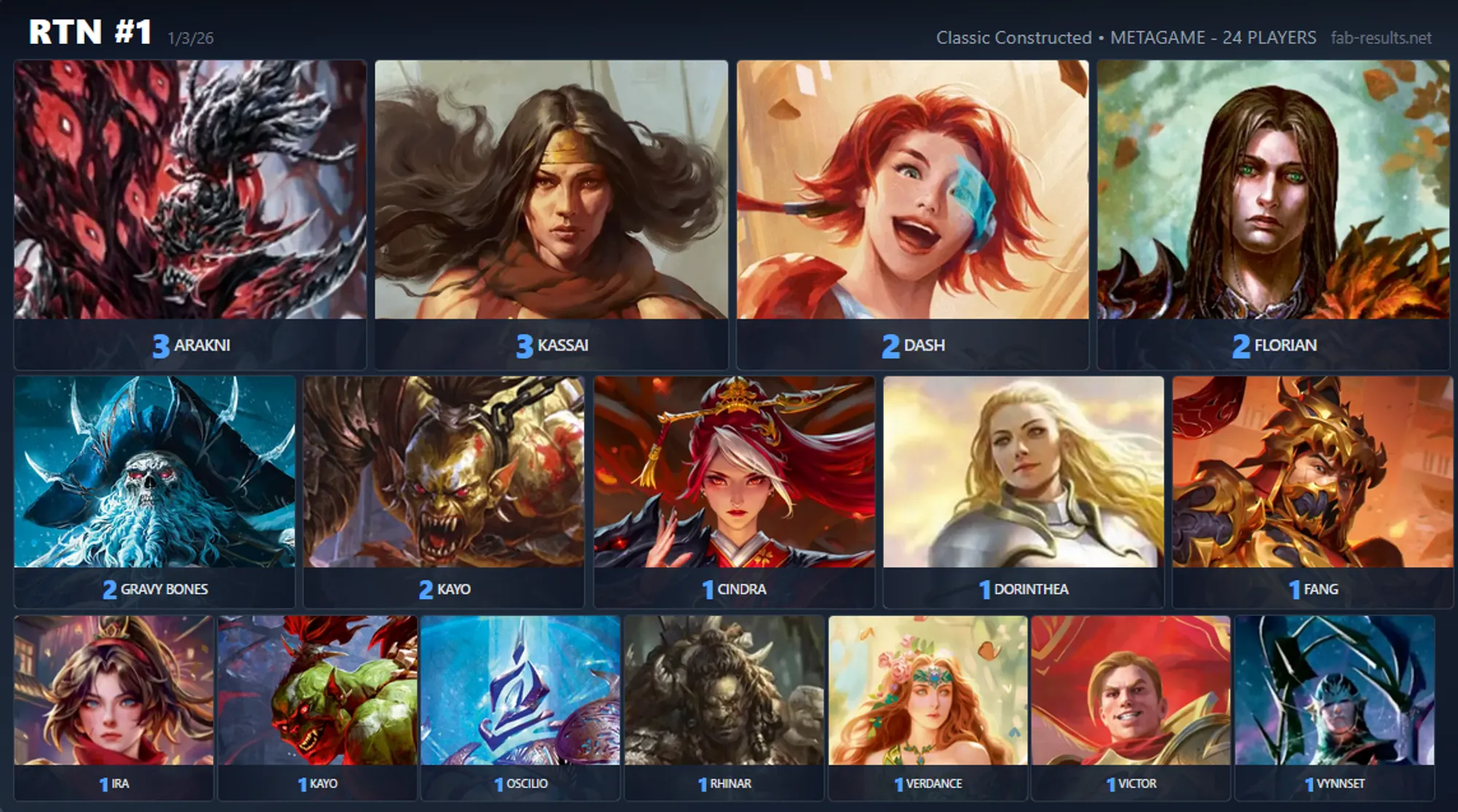
First, we’re going to look at the hero breakdown from my week one RTN. At this moment in time, public perception was perhaps at an all-time high for Arakni Marionette and an all-time low for Gravy Bones. Warriors were (apparently) everywhere, Oscilio was (apparently) one of the best decks in the format, and Marionette had (apparently) cracked the Gravy matchup. This was reflected in our week one Sunday RTN where the entire room had only two Gravy Bones out of twenty four players. The tournament was instead heavily represented by Marionette and a general aggro population with Kassai, Dash, and Kayo A/D. This was an excellent field for everyone's favorite emo boy, Florian, Rotwood Harbinger, and I had registered his slower, more defensive version with precisely this in mind.
1/2026 RTN
All I wanted to do week one was beat up on Arakni Marionette–Gravy matchup be damned. And the plan worked! I made top 4 and naturally lost to the Gravy Bones in the Semifinals. But if that top 8 bracket had broken any other way, I could’ve had multiple favorable paths to first place. Florian is well-suited to deal with Arakni, Marionette (Earth Runeblade armor is basically Guardian cosplay) and Haunting Rendition is a huge tech card, especially in an opening hand going second. Channel the Millennium Tree is an excellent way to shore up the grindy warrior matchups and create some inevitability in the endgame. There was a single copy each of Verdance and Oscilio in the tournament, but I think Florian was still an excellent call.
Victor would also be a reasonable choice into this field, with solid game into the various aggro decks. In metagames such as this one there’s so much value in defensive disruption during the block phase, especially before reactions. If you can stick a well-timed Test of Iron Grip against Arakni, Kayo, or Kassai, it can be a massive tempo swing. If your area doesn’t have a strong affinity for the Shipwrecked Looter, (better yet) if they play a lot of Assassin and Warrior, I would heavily recommend these more defensive and disruptive midrange decks for your upcoming Pro Quest.
As for decks to avoid, I think the hyper aggressive heroes such as Cindra and Dash I/O would really struggle in this field. Arakni, Marionette is able to race with the added benefit of disruption, and Warriors and Runeblades typically have the defensive tools to grind out and take over in the mid-to-late game. Oscilio would be a bit of a gambit here, balancing a great Warrior matchup with a tough time into the faster aggro decks. And with an excellent Gravy Bones matchup being one of the premier reasons to play Oscilio, I would lean towards shelving the lightning wizard in this field.
For individual cards that have a ton of value in this field, disruption is the name of the game. Decks are going fast and slowing them down is crucial. I’ll start with Warmonger’s Diplomacy, everyone’s favorite low-opportunity-cost blue 3 block. Arakni, Marionette is currently being built with a front pump, dagger-centric plan. They’ve obviously still got a powerful reaction suite, but a well-timed Warmonger’s can turn a massive turn into pitching reds for dagger swings. Kassai is also very Non-Attack Action heavy, Dash I/O has all of her items as well as Spark of Genius, and Warmonger’s also has narrow (but effective) use cases into Gravy Bones, Oscilio, and the Brutes. I think disruption during the opponent’s turn is even more valuable here. Test of Iron Grip, Face Purgatory, Scowling Flesh Bag, and a well-timed Cull all have the potential to swing games into a lot of heroes here.
To boil this down to meta-agnostic terms, the “fair” midrange deck (Florian/Victor) can bully the aggro decks (Marionette/Dash/Warriors) while hoping to dodge the bigger-but-more-fragile boardstate deck (Gravy). Fair Midrange would usually fall to the bigger boardstate-centric midrange decks like Gravy, but if you can reliably dodge that, your tournament is looking very promising.
Metagame #2: The January LA AGE Open
Key Metagame Features
- High representation of tanky aggressive decks
- High representation of arcane damage
- Low representation of boardstate decks
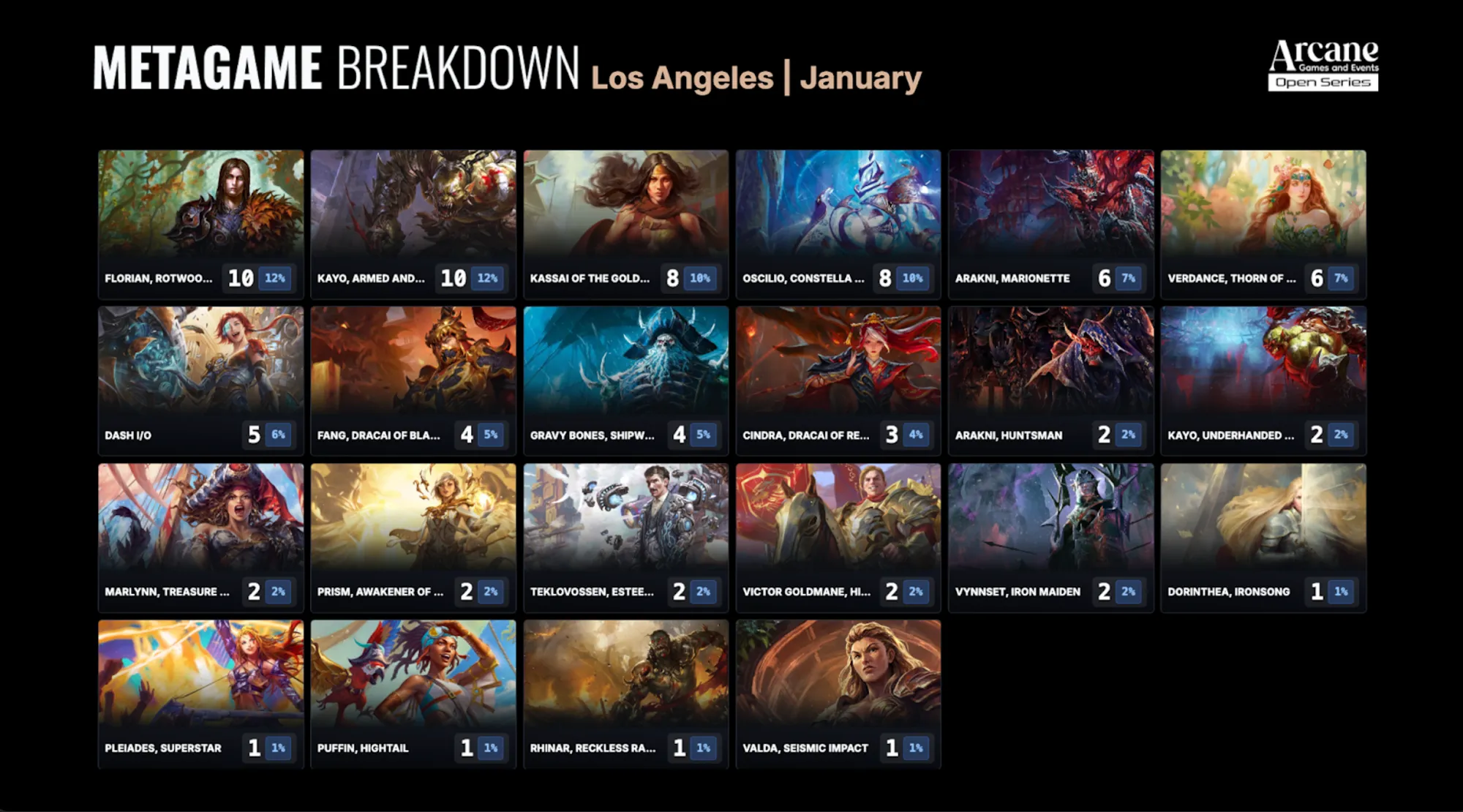
Here’s a metagame that realizes some of the things we talked about in our last example, but with a few key differences that change the angles of attack. We’re looking at the hero breakdown from the January AGE LA open and, once again, we have a metagame with a pretty low representation of the Pirate Necromancer and a strong presence from Kassai, but that’s where the similarities end. Florian and Kayo A/D are tied for the most represented hero, with Kassai and Oscilio having equal representation just underneath. Arakni, Marionette is also less represented here, tied for third with Verdance. This metagame looks a bit more open than the last one we looked at, but there are still notable components to it that we can use to make an informed hero choice.
Kassai, Kayo A/D, and Florian (if we assume a CMH-centric build) are all decks that hit hard and block nearly as well, and they make up a huge chunk of this metagame. We also see a big presence of Wizards to really solidify Arcane damage as another pillar of this metagame. As mentioned, Gravy Bones only makes up 5% of this hero spread, so decks that usually fall to the big boardstate deck have some insulation here. With that in mind, we’d want to find a deck that can punch through solid defenses without getting totally blown out by arcane damage.
My first instinct here would be to side with the Wizards and try to use arcane damage to undermine the solid armor block that many of these top heroes possess. Oscilio is certainly capable of more explosive average draws than Verdance, but this comes at the expense of lackluster defense, meaning he’s vulnerable to more aggressive opponents. Verdance leans in the other direction, offering a more consistent mid-to-late game while lacking the early pressure to close out games quickly. There’s no perfect answer in a field this open, but I like starting from a place of trying to sidestep the most powerful aspects of the decks you’re targeting. In this case, Wizards have the ability to sidestep the powerful armor block of Brutes, Warriors and Runeblades.
We’ve talked about the big baddie a lot already, but I think Gravy Bones or a boardstate deck with a similar gameplan also has a lot of stock in this field. A lot of those top decks (including the two highest represented in Florian and Kayo A/D) are not heroes that I would consider very action-efficient. Where ninjas, assassins and warriors can be more deliberate and modular with how they sequence their damage, other heroes are often more rigid in their options. Earth heroes will often block two cards and send a Decompose attack. Brutes’ ideal average turns have two attacks for anywhere from five to nine damage, maybe with a claw swing for three in between. These decks are much less efficient at removing things like allies or spectra auras, meaning they often either fall behind trying to clear the board, or get run over trying to race. A deck that can take advantage of these more deliberately-paced heroes would find a lot of good matchups here.
To look at specific tech cards that have a lot of equity in this field, we’re going to try to find cards that can find equity in very different matchups, considering the broad hero spread. Arsenal disruption looks excellent here, with many of the top decks having power cards that can lead to explosive five-card hands. An earth hero may tuck a Felling of the Crown in arsenal, waiting to cash it in until they’ve already banished an earth card so their first Felling has the full eight power. Oscilio loves to set up Gone in a Flash, and Kassai has more busted specs than I care to remember. We mentioned that many of these top classes have excellent armor. In addition to playing classes that try to sidestep armor, you can also try and blow it up! Mangle and Batter to a Pulp for the Guardians, Palantir Aeronaut for the Puffin sickos, and Art of the Dragon: Scale for Draconic Ninjas are all serviceable cards that gain huge equity if they can manage to snipe a Grasp of the Arknight, Storm Striders, or Valiant Dynamo.
To summarize: If there is a high representation of powerful armor and single-action heroes, I would look to either circumvent the value of their armor (via arcane damage, Piercing weapons, or armor destruction) or take advantage of their generally slower action economy (most commonly with permanent value pieces). Many of these archetypes will try to set up a powerful arsenal, making arsenal disruption an excellent form of interaction. I would avoid aggressive decks that are vulnerable to fatigue, as these play directly into the superior armor value of the top decks. The split-damage aggression of a hero like Oscilio (or Aurora please come back) would be much more well-suited here.
Metagame #3 The F-Word (Fatigue) and Macro Plans
Key Metagame Features
- Decks that utilize fatigue as their primary strategy
- Decks at the extreme ends of offense and defense squeeze out the middle
- Macro gameplans are crucial
Fatigue as a core gameplan is seeing a bit of a renaissance in early 2026, due in no small part to a breakout performance at the Columbus Calling by Pleiades, Superstar. This totally rogue hero employed a full-fatigue strategy to put two copies of the deck in Top 8 (shoutout to pilots Damien Riggins and Thomas Johnson-Averette). Pleiades has some extra shenanigans going on (this is not a guide on suspense auras) but the basics of fatigue are still on full display here. All the best defensive tools in the game pair with Guardian’s best disruptive attacks with the sole purpose of running you out of cards. Miller’s Grindstone burns even more of your deck with an obnoxious breakpoint, letting them keep up the pressure with just one card. When it’s got the necessary tools to compete with the other decks of the format, Fatigue can be one of the most consistent, often deterministic, and certainly frustrating archetypes in the game. If you’re not ready to attack these strategies with a solid understanding of the macro-game, you’ll find yourself on the losing end of a forty-five minute slugfest.
First, a quick breakdown on “micro” and “macro” in Flesh and Blood: Micro refers to the turn-by-turn decisions throughout a game which are primarily concerned with the current state of the game and the arena. Things I would consider part of the micro game include: consciously deciding to go off of arsenal in order to maximize damage on the current turn, throwing armor in front of a Snatch to prevent the on-hit, or using a Sink Below that you may otherwise save in order to filter a redundant blue out of your hand. Many games of Flesh and Blood are decided by trading value hands in this way, and it may be the case that the micro strategy is all you have to worry about in some games. Macro strategy, on the other end of the spectrum, is what you must consider when trading value hands isn’t the best course of action. A macro gameplan can manifest itself in many ways depending on your hero choice, so I’ll provide some examples here that cover a few heroes you might even encounter at an upcoming local event.
Against Kayo, Underhanded Cheat (RKO) it’s very important to try and keep your life total higher than his as a means to stifle the effectiveness of his Reviled cards (like Mocking Blow). For this reason, it’s often considered a good strategy against RKO to block physical damage with your armor as soon as possible, even if it’s not preventing an on-hit effect. This makes him have to work so much harder to get his Reviled cards online, and their average turn value suffers as a result. It can feel very unintuitive to prioritize blocking “vanilla” damage with armor at the earliest opportunity, but it creates a cumulative denial of value that creates a ton of equity in the matchup.
When facing Earth heroes, Plow Under is a card that must be respected. Thanks for reading! Jokes aside, this Command and Conquer without agency is a card whose power level relies heavily on you having an arsenal to disrupt. I remember my first games against Florian, a decidedly defensive hero, in which I would arsenal my Arc Lightning or Lightning Surge knowing they would convert into a banger five card hand on my next turn. Then Plow Under would happen and I’d realize I’ve just spewed 4-to-6 value because of my damned hubris. So we have another counterintuitive strategy here, where we often become incentivized to convert four card hands as opposed to setting up an arsenal. You can obviously pick moments based on how many Earth cards the opponent has in their graveyard, or simply make them have it if your five card hand is lights out for them, but the safer and more consistent macro plan of playing as aggressive as possible leads to less blowouts, at the very least. Some classes utilize instants that maintain their full value even on the opponent’s turn, so you can respond to the Decompose trigger with something like a Sigil of Solace or, y'know, Sigil of anything from our boy Oscilio.
On the other end of the arsenal debate we have Assassins and Rangers with their pesky Codices! Codex of Frailty into Leave no Witnesses is one of the most brutal one card plays that we have in the game of Flesh and Blood. The recent printing of Overcrowded has given us a tailor made answer to the card, but it’s not our only option! Oftentimes, the strongest plan against this is to simply stick a card in your arsenal, and save it for a rainy day. You’ll still get a frailty token, but a Sink Below in arsenal is a great thing to sit on when the Leave No Witnesses comes knocking. But that’s not all! You’ve also got to be aware of the dreaded Inertia token. A well-timed Inertia Trap can rob you of an entire card’s worth of value if you’re not careful. Though they have been picking up in popularity as of the early 2026 seasons, I would say Codex of Inertia and Inertia Trap are still not quite as popular as the everpresent Codex of Frailty. For that reason, I’m much more keen on setting up an arsenal and insulating myself from getting my hand shredded by a Codex.
Then we have the big, bad, Miller’s Grindstone-wielding, game-clock-chugging menaces known as Fatigue decks. These decks don’t “win” so much as they demand you to say “I lose” as you pick up your 74-card graveyard and ask yourself where it all went wrong, wishing you could take a walk and analyze your life choices but realizing they’ve already paired round five and you really have to pee. So let’s try and avoid that fate! This introduces concepts which intimidated me as I first started getting into competitive Flesh and Blood: the second cycle and, even spookier, the pitch stack. A fatigue deck is going to do its best to block or prevent as much damage as possible on most turns. The only real limiting factor on these defensive capabilities is the heroes’ intellect. Typically, the average ceiling of these defenses would be somewhere in the realm of 20, ignoring armor and assuming all 4-blocks and a defensive reaction in the arsenal. Punching through that is no small feat, and many decks would run themselves out of cards trying to convert an entire hand just to chip one or two damage. This is where many decks have to calculate the most damage they could deal in a single turn, and can they actually make it happen. I was standing behind Michael Jasczcur in the top eight of Calling Columbus, watching him pilot Florian against fatigue Pleiades. At first, I thought Michael was about to lose the game, as a Germinate had just been Rippled Away, and the decks were very thin. But then I noticed the Runechant token on the table with something like 39 as the represented value. Michael sent a Felling of the Crown backed by enough arcane damage to end the game.
Calling: Columbus 1st 🇨🇦
We saw Majin Bae dispatch the other Pleiades on stream in the same tournament by setting up a massive Glyph Overlay, creating a single instance of arcane damage that the fatigue player was unable to survive. I often hear this style of gameplay referred to as a hero's “set-up” plan, playing a slow and seemingly lower-value early game in order to assemble a singular damage spike that tips the math in their favor. Verdance has Healing Potions and Rampant Growth, Fang has Fire and Brimstone with Rake over the Coals and Dragonscaler flight Path, and if LSS doesn’t ban Flicker Wisp before the return of Aurora you can bet I’ll be pitching that sucker with an Arc Lightning for as long as they allow me to. Not all decks and configurations are as effective, if even capable, of setting up these Spirit Bomb turns. Some decks may have to try and pressure the opponent enough to just get over their defenses turn by turn, while slower decks might have to utilize some counter-fatigue measures. The existence of cards like Remembrance can totally flip the fatigue matchup on its head, so if you really want to mean it, you can tech for it. Typically, fatigue strategies tend to fall out of favor after their initial successes, as players and their builds tune accordingly. Overall, for your sake and the sake of everyone at your local events, I hope fatigue doesn’t have to be a major concern.
I hope this article proves helpful for any of you folks looking to gain an edge in your local tournaments. To reiterate, there are far too many archetypes and strategies in Flesh and Blood to try and simultaneously build around everything. Instead, I think it’s best to choose a deck you can pilot well, and take a calculated risk on what matchups you want to respect or ignore. The cruelty of GEM luck comes for us all, and it’s entirely possible that you pair into the opposite matchups from what you anticipated, even if you totally called the meta correctly. Every tournament requires a bit of luck, so try not to be too results-oriented when it comes to these bouts of tough variance. I think there’s a lot of value in analyzing metagames, testing, and theorizing on how to best attack them, regardless of the outcome. Trust in the process, make conscious deckbuilding decisions, execute your gameplans deliberately, and your result will take care of itself!
Topics

Brian Hoffman
I've been playing Flesh and Blood since July 2024, and I run the Smashing Good Team Youtube channel. Still chasing my top 4 finish at the 2025 Memphis Calling.